Part Two: The Homing Pigeon in NY History

Homing pigeons have long been used for racing and for their unique ability to navigate, an asset once capitalized upon by the military. As noted in last week’s entry here, “Their use during World Wars I and II is legendary, and many were decorated with medals. In 1918, pigeon racing was temporarily banned in the United States to ensure that all birds were available for the use of the military.”Domestically, homing pigeons were an accepted form of communications, and thus enjoyed legal protection. The public shared the responsibility of nurturing any pigeon found in distress, and if need be, contacting the owner via information from the bird’s leg band.
For more than a century, the pigeons were regularly encountered in the North Country. “Homers” were often used for races from 100 to 500 miles, and they didn’t always alight where the owner intended, usually due to stormy weather.Many of the birds that landed in the Adirondack region came from Montreal, where their use for racing and message carrying was common. In 1912, one such Canadian visitor settled inside the walls of Clinton Prison at Dannemora. The warden dutifully cared for the bird and attempted to contact its owner.In 1898, little Miss Gertrude Hough of Lowville received a letter by US Mail from the Los Angeles post office. It had arrived in LA attached to a pigeon that had been released by Gertrude’s father from Catalina Island, more than 20 miles offshore.And in 1936, a homing pigeon landed on the window sill of a Malone home, where it was treated to the proper care. Well beyond the norm, the bird’s journey had begun in Montana.Invariably, efficient systems like bank accounts, credit cards, the internet, and homing pigeons are usurped for other purposes. In recent years, pigeons have been used by ingenious crooks to smuggle drugs from Colombia and diamonds from African mines.In both cases, the North Country was light-years ahead of them. In 1881, an elaborate case of diamond smuggling from Canada into St. Lawrence County was uncovered. A Rensselaer Falls farmer brought to customs authorities a dead “carrier pigeon” with part of a turkey feather, filled with diamonds, attached to the bird’s leg.During the investigation, two more diamond-carrying birds were shot. It was discovered that baskets of birds were being mailed to locations in Canada, and other flocks were located south of the border, awaiting duty. Shipments of pigeons had originated at DeKalb Junction, Heuvelton, Rensselaer Falls, and Richville, and the value of diamonds successfully smuggled was estimated at $800,000 (equal to about $17 million today).

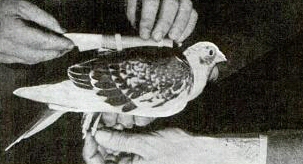
During Prohibition, both booze and drug smuggling were rampant. In 1930, US officials were tipped off that a number of homing pigeons were routinely being shipped north into Quebec. Upon release, they crossed back into northern New York.Authorities at Ogdensburg were put on the case when it was found that each pigeon bore a payload of about one ounce of cocaine. At times, it was literally a fly-by-night operation—some of the birds had been trained to fly under cover of darkness.Homing pigeons also played a role in regional historical events. In 1920, a military balloon launched from Rockaway Point in New York City sailed across the Adirondacks. Last sighted above Wells in Hamilton County, it then vanished. Extended high-profile searches turned up nothing, and three men aboard the balloon were lost.Such missions routinely carried homing pigeons for air-to-ground communication. It was believed that an injured pigeon found on a Parishville (St. Lawrence County) farm had been launched from the balloon, and that its message had been lost during the accident that had broken the bird’s leg. This led to the belief that the balloon had gone down over Lake Ontario.One of the most famous kidnapping cases in American history occurred in 1932 when the Lindbergh baby disappeared. When the body was found, nearly every newspaper in the land covered the story the next day with multiple articles.Among the first stories was one emanating from Lowville, New York, where a homing pigeon had landed at the home of Arthur Jones. The bird’s leg had a non-traditional attachmenta piece of twine holding a paper tag bearing the inscription, “William Allen, New Jersey.” It was William Allen of New Jersey who found the Lindbergh child’s corpse.Lead investigator Colonel H. Norman Schwarzkopf (Stormin’ Norman’s father) followed up on the information and then issued a statement: “Reports from Lowville show that no registry tag was found on the carrier pigeon. This practically precludes the possibility of further tracing the pigeon unless the owner of the same voluntarily reports its absence.”In June, 1936, before more than two dozen reporters and celebrities, former World Heavyweight Champion Jack Dempsey and his wife released a homing pigeon from the tower of the Empire State Building at 11:20 am. Less than five hours later, it arrived at Scaroon Manor on Schroon Lake, bearing the first honeymoon reservation of the season.It wasn’t for Dempsey’s honeymoonit was just a publicity stunt to keep his name active in the media, and certainly raised the manor’s profile as well.Photos: Top?Homing pigeon with message in tube. Bottom?US Naval Station pigeon houses (1925).
Lawrence Gooley has authored eleven books and dozens of articles on the North Country’s past. He and his partner, Jill McKee, founded Bloated Toe Enterprises in 2004. Expanding their services in 2008, they have produced 22 titles to date, and are now offering web design. For information on book publishing, visit Bloated Toe Publishing.

18th-Century Day at the Historic Schuyler House

On Sunday, August 12 from noon to 5pm, the 1777 Schuyler House on Route 4 in Schuylerville, will be the setting for 18th Century Day, a free event with dozens of artisans demonstrating their crafts much as they were plied over 200 years ago when household items were handcrafted.

Visitors to the 34th annual 18th-Century Day will be able to enjoy free tours of the Schuyler House, listen to music of the period, see 18th-century Punch and Judy puppet shows, plus see artisans demonstrating 18th century crafts such as tinsmithing, blacksmithing, broom-making, knitting, rope-making, beer brewing, spinning, dyeing, soap making, butter-making, sheep shearing, and needlework. Also see colonial-era farm life activities such as discussions of farming methods, medicinal treatments and bee keeping.
This traditional event is organized by the Old Saratoga Historical Association, a non-profit educational organization that provides furnishings for the Schuyler House and promotes interest in the history of Old Saratoga, Schuylerville, Victory and the Town of Saratoga, from Native American occupation through present times.

Visitors are advised to dress for hot weather, bring water, and wear insect repellent and sunscreen. Free light refreshments will be available.

USGS Digitized Map Project Nearly Complete

For more than 125 years, the U.S. Geological Survey (USGS), the largest producer of printed topographic maps, has portrayed the complex geography of the nation. Prior to 2009, USGS topographic maps were created using traditional cartographic methods and printed using the lithographic printing process.

Now the USGS National Geospatial Program (NGP) is nearing completion of the conversion of these these historical printed topographic quadrangles to an electronic format (GeoPDF). The scanning and processing effort serves the dual purpose of creating a master catalog and digital archive copies of the irreplaceable collection of topographic maps in the USGS Reston Map Library, as well as making the maps available for viewing and download online.

USGS has digitized nearly 200,000 maps, including its collection for the contiguous United States and Hawaii. Remaining maps for Alaska, Puerto Rico, the Virgin Islands, and Trust Territories are expected to become available in the coming months.Check out the collection online.

John Lennons Travels in Ulster County, New York

The Depuy Canal House has sat in High Falls since the 1790s when it was constructed by Simeon Depuy, “one of the most prominent citizens of High Falls, New York.” It opened, according to the Depuy Canal House’s website, as the Stone House Tavern. The tavern entered its heyday when work commenced on the Delaware &amp- Hudson (D&amp-H) canal to link the coal fields of Pennsylvania to the Hudson River in Kingston. This tavern sat on Lock 16, convenient to the canal men until the canal closed in 1899. Read more

This Weeks Top New York History News

Each Friday morning New York History compiles for our readers the previous week’s top stories about New York’s state and local history. You can find all our weekly news round-ups here.

Subscribe! More than 2,800 people get New York History each day via E-mail, RSS, or Twitter or Facebook updates.

This Weeks New York History Web Highlights

Each Friday afternoon New York History compiles for our readers the previous week’s top weblinks about New York’s state and local history. You can find all our weekly round-ups here.

Subscribe! More than 2,800 people get New York History each day via E-Mail, RSS, or Twitter or Facebook updates.

Votes for Women History Trail Makes Progress

The Omnibus Public Lands Management Act of 2009 signed by President Obama authorized the Women’s Rights National Historical Park (NHP) to administer a Votes for Women History Trail Route that would link properties in the New York State that are historically and thematically associated with the struggle for women’s suffrage in the United States.Upstate New York is home to some of the most significant locations of the women’s suffrage movement and the trail is expected to recognize some of the courageous women who led the way to equal rights and will also allow visitors to see the historic places where these pioneering actions occurred.

Although Women’s Rights NHP was authorized to develop and administer this vehicular route, until now no funds had been appropriated for this purpose. The National Park Service recently provided funds through the Park Service’s Washington office to begin the process of formally establishing the trail by defining the criteria for participation and a selection process by which trail sites would be selected.

The Women’s Rights NHP will be holding a public meeting to seek public comments and
suggestions on Wednesday, August 22, 2012 in Seneca Falls regarding the Votes for Women History Trail Route. All are invited to attend this meeting and share ideas. More information about the time and location of the August public meeting will be made available as soon as it is available.

For more information, please the website www.nps.gov/wori or call (315) 568-0024. 

To be considered for inclusion in the trail, the National Park Service requires that properties be historically significant and easily accessible to the public. The list of potential sites includes:

* Susan B. Anthony Memorial, Rochester

* Antoinette Brown Blackwell Childhood Home, Henrietta

* Ontario County Courthouse, Canandaigua

* M’Clintock House, Waterloo

* Jane Hunt House, Waterloo

* Jacob P. Chamberlain House, Seneca Falls

* Lorina Latham House, Seneca Falls

* Wesleyan Chapel, Seneca Falls

* Elizabeth Cady Stanton House, Seneca Falls

* First Presbyterian Church, Seneca Falls

* Race House, Seneca Falls, Seneca Falls

* Hoskins House, Seneca Falls

* Harriet Tubman Home for the Aged, Auburn

* Harriet May Mills House, Syracuse

* Matilda Joslyn Gage House, Fayetteville.

Annual Fulton Chain of Lakes House Tour by Boat

Whether a historic site or a spectacular new design, individuals with noteworthy homes will host tours during the Annual Fulton Chain of Lakes House Tour by Boat to benefit View, the former Old Forge Arts Center.

Beginning in Old Forge, participants will ride party barges from house to house as they explore local waterways and get the rare chance to view inside the beautiful homes along them. The House Tour will be held on Saturday August 18. Departure will be from the Old Forge Town Docks, at Lake View Ave, in Old Forge, NY promptly at 10am and will return in the middle of the afternoon. To ensure a smooth departure, guests should arrive early, beginning at 9am.
This year’s House Tour By Boat will feature six great camps and homes including Berkeley Lodge, which was once President Benjamin Harrison’s Adirondack Residence. What appears to be just a boathouse from the lake is actually just the beginning of Berkeley Lodge. Former President Benjamin Harrison (of Indianapolis) purchased the 20 acre peninsula between First and Second Lakes in 1895 from Dr. William Sweard Webb.

Berkeley Lodge was designed by a Herkimer architect, Charles E. Cronk, and built in time for Harrison’s return in the summer of 1896 after his 2nd marriage to Mrs. Mary Lord Dimmick. The Lodge living room is flanked by twin octagonal towers at either end. The exterior of Berkeley was sheathed with spruce logs at the bottom and shingles below the eaves. Attached to Berkeley was a cottage containing a kitchen, dining room, and office. The camp also had a house for guides and a boathouse.

In 1910 the property was sold to a New Yorker and then later in 1915, it was purchased by Horace S. deCamp. Horace owned the Harrison property until his death in 1954 and the property was sold at auction and purchased by the Cohen family. The Cohen family sub-divided the property into several parcels before selling Berkeley Lodge. The Lodge, and several other buildings survive to this day. The great camp is owned by Bob and Diane Wallingford, who have renovated a portion of the lodge that was added on in the 1950&#8242-s by the Cohens, made the icehouse/carriage house into a bunkhouse, added a garage and renovated the boathouse keeping all of the same flooring and beams.

Tickets must be purchased in advance. Tickets are $65/$50 for View members. This is a rain or shine event which typically sells out, so call View to reserve your ticket at 315-369-6411. For further questions email [email protected], or visit www.ViewArts.org.


Photos: Above, Berkely Lodge today, and below, at the time Harrison owned it.

Adirondack Museum Acquires William Trost Richards Painting

The Adirondack Museum announces a significant addition to the permanent collection. The painting, Adirondack Landscape [Elizabethtown], 1864, by William Trost Richards (1833-1905), is a gift of the estate of Waldo Hutchins III. The painting is on exhibit in the Lynn H. Boillot Art Galleries for the 2012 season. Read more

Peter Feinman: New York and the Civil War

The Union may have won the war but the South has won Civil War tourism and its legacy. It’s an extraordinary fact of life that wherever the National Park Service has a site, a battle was fought there! And they are all in the South with the major exception of Gettysburg.

Time and time again presentations on life back then in antebellum (before the war) times begin with Gone with the Wind, still the box-office champion adjusted for inflation. What story does the North including New York have to tell that can compare with the pageantry of the South, the chivalry of the idealized plantation, and the glamour of Rhett Butler and Scarlett O’Hara, Clark Gable and Vivien Leigh? Freedom and preserving the Union that made the world safe for democracy in the three world wars in the 20th century should count for something, even for Confederates. Read more