Saratoga National Park Opens Benedict Arnold Exhibit

Saratoga National Historical Park has opened a new exhibit: Broken Trusts, the Chequered Career of Benedict Arnold. On display through April 2013, the exhibit examines the twists and turns of Arnold’s path from active supporter of American Independence to his betrayal of his country and comrades. “People are always puzzled as to why Benedict Arnold changed sides,” notes Park Ranger Joe Craig. “At Saratoga, Arnold’s heroism was stellar, yet later the pendulum swung the other direction and he betrayed his country. Some feel his earlier gallant service should be the main and only focus &#8211 our exhibit seeks to examine some of the enigmas and contradictions of this complex man.”


“A project like this requires a great deal of work by park staff, but could only have been made possible through partner groups” notes park Superintendent Joe Finan. “Funding was provided by Eastern National, our site’s bookstore and audio recordings about Arnold were made possible through our partnership with Siena College. Their Liberal Arts Department provided excellent voice talent and their radio station WVCR, provided high quality recording facilities.”

The exhibit will be on display 7 days a week from May 10 through April 2013. For more information on the exhibit or other Saratoga National Historical Park events, call the Visitor Center at 518-664-9821 ext. 1777 or check their website at www.nps.gov/sara

Illustration: General Benedict Arnold Wounded at the Battle of Saratoga, New York, c.1777.

Jehudi Ashmun, Founder of Liberia (Part 2)

In 1822, three months after Champlain, New York, native Jehudi Ashmun’s colony of freed slaves landed on Africa’s west coast (and two months after losing his wife), the group faced impending hostilities from surrounding tribes. The attack finally came on November 11. Ashmun, a man of religious faith but deeply depressed at his wife’s death, was suddenly thrust into the position of impromptu military leader.

Approximately ten kings of local tribes sent 800 men to destroy the new settlement, which held only 35 residents, six of whom were younger than 16 years old. Many among them were very ill, leaving only about 20 fit enough to help defend the colony. By any measure, it was a slam dunk.
The results are now legendary: against incredible odds, the settlers routed their attackers. It was a great victory, but the fight wasn’t over. Immediately, and for days after, Ashmun worked to improve their defenses, fearing another attack. A confidant informed him his suspicions were warranted, and on November 30, via a foreign ship, Ashmun sent a desperate message to the American Colonization Society, sponsors of the new settlement.

“All the tribes around us are combined in a war against us. Their principal object is plunder. We are surrounded by only a slight barricade and can only raise a force of thirty men. … We endeavor to make God our trust. I have no idea but to wait for His deliverance—or to lay out our bones on Cape Montserado.”

The second assault, which came on December 2, was made by an even larger force, estimated at more than 1,000 warriors. Furious attacks were mounted, including at least four in one location, but all were repulsed. Within 90 minutes, and at great loss to the enemy, the settlement stood intact. Ashmun and his band of colonists had once again achieved the impossible.

It was truly the stuff of legend, marking the beginning of an incredible journey. Jehudi became the settlement’s de facto leader. As per the Society’s instructions, he assisted the new colony in establishing a constitution and code of laws based on those of the United States. Having negotiated deals with several kings before they had decided to turn against him, Jehudi now dealt with the task of mending fences and forging a peace agreement with his enemies.

During the next several years, he successfully navigated through myriad problems, daunting hardships, and frequent illness, leading the colony to success. A working economy was established and new territory was acquired, making for a promising future.
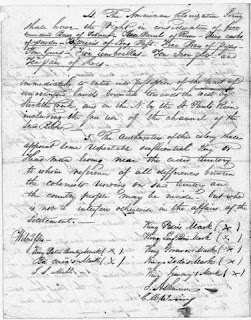
In a treaty signed with five kings, he once traded “500 bars of tobacco, three barrels of rum, five casks of powder, five umbrellas, ten iron posts, ten pairs of shoes,” and other items in exchange for land and certain rights. (See the illustration. At the bottom of the treaty are the kings’ names with their marks (X), and Jehudi’s signature near the bottom right.)

Ashmun was present for the birth and initial growth of the settlement, guiding the way to legitimacy. But in 1828, another serious illness struck, and on July 18, the great dismay, sadness, and appreciation of the entire colony was expressed when he returned to America for treatment.

Writing to his parents in Champlain, he expressed the hope and desire to return to the village in the coming months, but it wasn’t to be. On August 25, at the young age of only 34, Jehudi Ashmun died in New Haven, Connecticut, where he was buried.

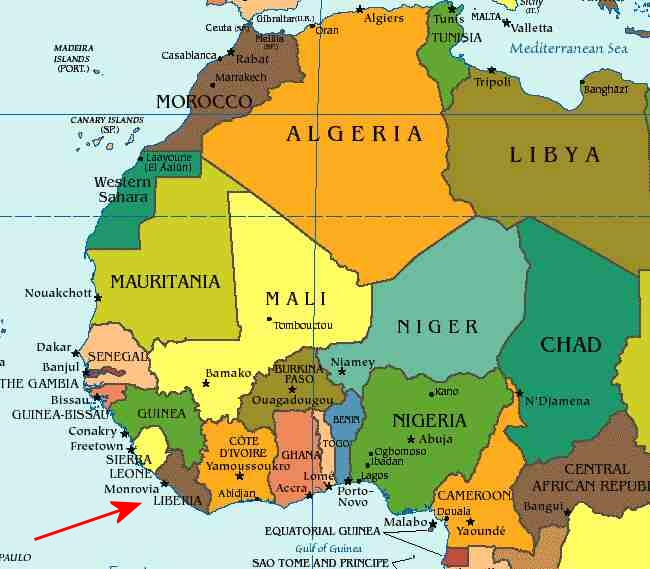
The colony he established had become known as Liberia (“Land of the Free”), and its capital, originally Christopolis, had been renamed Monrovia after President James Monroe. Within a decade of the colony’s birth, those first few dozen settlers had grown to nearly 1,500 citizens- a daily newspaper had been established- a self-governing system of laws was in place- and the economy was supported by trade with other countries, just as Ashmun had envisioned.

In 1847, the Liberian colonists declared their land an independent republic, receiving official recognition from nearly all the world’s countries, with one notable exception: the United States. American recognition was withheld for a familiar reason—southern states refused to accept a black ambassador in Washington.

The US finally came through with recognition of Liberia in 1862, when the southern voices in Congress were silenced by their secession from the Union.

A century after Ashmun’s tiny group of colonists repelled those two initial attacks, Liberia was about the size of Kentucky and had a population of more than two million, which exceeded that of thirty US states. Oddly enough, as noted in 1919 by the National Geographic Society: “Of these two million or more inhabitants, only about 50,000 [12,000 of whom were of American origin] may be considered civilized and take part in government.” That’s only about 3 percent.

It’s rather ironic that a colony of former slaves, established to encourage freedom and provide a voice in their own governance, would one day restrict the freedom and rights of 97 percent of its own population, placing them at the whim of the other 3 percent. Sound familiar?

Further irony is found in Liberia’s constitution, which contains a clause carried forward for generations. It still exists today in Chapter IV, Article 27, Section b): “In order to preserve, foster, and maintain the positive Liberian culture, values, and character, only persons who are Negroes or of Negro descent shall qualify by birth or by naturalization to be citizens of Liberia.”

And so it is that in Liberia, directly translated as “the Land of the Free,” non-blacks are denied citizenship. Perhaps they became more like America than Jehudi Ashmun intended.

Still, there’s no denying the fact that, in light of its most humble of beginnings, and the changes we’ve seen to the globe even in the past 50 years, it’s amazing that Liberia still survives nearly two centuries after Ashmun first landed on Africa’s shores.

He was smart, tough, and wise, but another side of Ashmun that stayed with him throughout life is revealed through his own writings. Consider this self-assessment from 1819: “I am now 25 years of age- almost three years from college- have no profession &#8230- I am involved in debt, possess neither books nor money, and have a delicate and beloved wife to provide for.

“I am wearied with the same daily round of dull employment … of studying in circumstances forbidding the exercise of half the strength of my mental powers- of sleeping immoderately because I have nothing to do or to enjoy sufficiently interesting to keep me awake. … The future is a dreary expanse of storms and clouds, pervaded by a few faint gleams of hope.

“I am broken with disappointments- have been robbed by the perfidy and ignorance of supposed friends and the malevolence of enemies. &#8230- The frown of Heaven is upon me. My hopes for eternity are clouded.”

If at times you feel a deep hopelessness like that once expressed by Jehudi Ashmun, remember what he accomplished in the next few years of his life. Not bad for a North Country boy—or any boy, for that matter.

Photos? Top: Location of Liberia on Africa’s west coast. Bottom: Treaty signed by Ashmun and several African tribal kings.

The Jehud
i Ashmun story is one of 51 original North Country history pieces appearing in Adirondack Gold: 50+ New & True Stories You’re Sure to Love (352 pp.), a recent release by Lawrence Gooley, who has authored ten books and dozens of articles on the North Country’s past. He and his partner, Jill McKee, founded Bloated Toe Enterprises in 2004. Expanding their services in 2008, they have produced 20 titles to date, and are now offering web design. For information on book publishing, visit Bloated Toe Publishing.

[/CATS]

Social Studies Curriculum: A Modest Proposal II

Regular readers of my posts know that the role of civics was an important point of contention raised at the recent annual conference of the New York State Council for the Social Studies. Such readers also know I have consistently advocated on behalf of local history both for the pedagogy of teaching critical skills beginning with one’s own backyard to the civic benefit of developing a sense of place, a sense of belonging, and a sense of community. Those concerns affect not only an individual’s sense of identity with the immediate area where one lives but also with the country as a whole where one is a citizen. Read more

1862 Focus of Peterboro Civil War Weekend

The Peterboro Civil War Weekend Committee invites the public to step back to 1862 on June 9 and 10 to commemorate the Sesquicentennial of the Civil War. The 12th U.S. Infantry hosts the encampment. For two decades the Peterboro encampment has demonstrated aspects of military and civilian life. In recent years exhibits and programs on abolition and the Underground Railroad have been added.

During the event Peterboro relives the period of the mid 1800s when the hamlet held national recognition because of Gerrit Smith’s Underground Railroad station, the visitations of famous abolitionists, and the connection with John Brown that sparked the Civil War. Peterboro sites are on the Heritage NY Underground Railroad Trail and on the National Park Service Network to Freedom Underground Railroad Trail.In 1862 the United States was in the second year of its Civil War. In 1862 Peterboro citizens prepared for service in that war. The 20th Annual Peterboro Civil War Weekend will commemorate the nation’s Sesquicentennial of the Civil War, as well as celebrate the 20th anniversary of the educational and fund-raising event in the historic hamlet of Peterboro, Town of Smithfield in Madison County, NY.

According to the research of Smithfield Town Historian Donna Dorrance Burdick, the Utica Morning Herald & Daily Gazette reported that “Gerrit Smith has donated twenty-five dollars to each volunteer from this town who has enlisted under the last call of the President. The town has raised more than the whole quota of men required by the last two calls of the President.”Days later a farewell reception was held on the Peterboro village green for the 157th NY Volunteer Infantry, a unit raised with men from Madison and Cortland counties. On horseback Smith addressed the troops and arranged for copies of the New Testament to be placed in the knapsack of each soldier. 150 years later on that same Peterboro green, during the opening day of the weekend, Dick Enders as Gerrit Smith and members of the 157th New York Volunteers (reenacting) will recreate segments of this 1862 scene. On Saturday Major Carmichael aka Don Jeffrey will host an exhibit on the 157th at the Smithfield Community Center.

During the weekend event, information on Smithfield citizens who served in the Civil War will be featured at the Peterboro Area Museum. Donna Dorrance Burdick, Smithfield Town Historian, has assembled town records, pension notices, discharge papers, letters, and other documents on the 157th NY Volunteers, as well as other military units and individuals. Burdick and her sister Beth Dorrance Spokowsky, President of the Peterboro Area Museum, will also be conducting their popular and informative tour of the Hamlet of Peterboro on Saturday and Sunday.

On September 22, 1862, President Lincoln shared his early draft of the (Preliminary) Emancipation Proclamation with his Cabinet. Lincoln released the final Emancipation Proclamation in January of the following year and donated the draft copy to the U.S. Sanitary Commission for a raffle to raise funds for the troops. Gerrit Smith bought most, if not all of the raffle tickets, and thus, became owner of the Preliminary Emancipation Proclamation, which he, in turn, donated back to the Sanitary Commission.That priceless document now resides in the New York State Library thanks to NYS legislative action in 1865.

During the 20th Civil War Weekend a facsimile of the proclamation given to the National Abolition Hall of Fame and Museum by the NYS Library will be on display at the Smithfield Community Center, 5255 Pleasant Valley Road, Peterboro. The U.S. Sanitary Commission and Abraham Lincoln (aka Jack Baylis) will once again be at the weekend event.

1862 is the year that legends and research indicate that the short musical piece of Taps began to be played to indicate the end of the day for soldiers. Cheryl Pula, Secretary of the (Brigadier General) Daniel Butterfield Civil War Round Table (which will be participating in the weekend event), explains “Butterfield wrote Taps at Harrison’s Landing, Virginia. The story is that he was tired of the bugle call used for &#8220lights out,&#8221 so he wrote a new call, and gave it to his bugler, Oliver Norton. Norton played it, and the tune caught on, even with the Confederates who overheard it and used it.” The 2012 Peterboro Civil War Weekend will close on Sunday, June 10 with Taps in recognition of its addition to military regimen 150 years ago.

The annual event is an educational and fundraising event sponsored by the Smithfield Community Association, the Town of Smithfield, and private donors. Proceeds from the event support the preservation and promotion of the heritage of the Town of Smithfield. Saturday, June 9 hours are 10 am – 5 pm, and Sunday, June 10 from 10 am &#8211 4 pm. Admission is $8 for adults, $3 for ages 6 – 12, and free for children under 6. Parking is free. For more information contact 315-684-3262 and civilwarweekend.sca-peterboro.org

War of 1812 Bicentennial Event in Prescott, Ontario

The War of 1812 bicentennial is a big deal in Canada, and our neighbors in Prescott, Ontario, will kick off their commemorations May 19-21 at Fort Wellington.

In the spirit of international cooperation members of the Fort La Presentation Association and Forsyth’s Rifles will be there to support the Garrison Weekend Re-enactment.

“In the community of War of 1812 re-enactors, there has been a cross-border exchange for nearly 20 years,” said Forsyth’s Vice President Tim Cryderman. “We look forward to re-enacting battles on the Canadian side to mark 200 years of friendship.”

Re-enactors from Canada and the United States portraying British and American soldiers will set up separate camps on the fort grounds. Civilian heritage interpreters will have their own demonstration area.

“I am really looking forward to exploring the new Fort Wellington Interpretation Center,” said Barbara O’Keefe, President of the Fort Association. “We plan to build a similar structure on Lighthouse Point, so I want to take in as much information and as many ideas as I can during my visit.”

The remains of the 1812-era gunboat Radcliffe are the centerpiece of the new interpretive center. Mr. Gord Brown, Member of Parliament for Leeds-Grenville, will officially open the interpretive center at 1 p.m. Saturday, May 19.

The weekend promises a number of activities: soldiers living in the blockhouse barracks- historic weapons demonstrations- battle re-enactments- and Saturday beginning at dusk, a fiery artillery demonstration followed by spectacular fireworks.

The three-day event will be the biggest celebration in Prescott since the town’s own bicentennial events in 2010.

[/CATS]

This Weeks Top New York History News

Each Friday morning New York History compiles for our readers the previous week’s top stories about New York’s state and local history. You can find all our weekly news round-ups here.

Subscribe! More than 2,800 people get New York History each day via E-mail, RSS, or Twitter or Facebook updates.

This Weeks New York History Web Highlights

Each Friday afternoon New York History compiles for our readers the previous week’s top weblinks about New York’s state and local history. You can find all our weekly round-ups here.

Subscribe! More than 2,800 people get New York History each day via E-Mail, RSS, or Twitter or Facebook updates.

War of 1812 Naval Bases at Sackets Harbor and Kingston

The Annual Meeting of the Sackets Harbor Battlefield Alliance, Sackets Harbor Historical Society, and the Sackets Harbor Area Cultural Preservation Foundation will feature a talk by John R. Grodzinski entitled “A Tale of Two Dockyards: The Naval Bases at Sackets Harbor and Kingston in the War of 1812.”

The War of 1812 witnessed the unprecedented employment of naval power on Lake Ontario. From their humble pre-war beginnings, the dockyards at Sackets Harbor and Kingston grew in scale and by the end of the conflict, were producing ships of a scale intended more for the open ocean than inland seas. This presentation will examine the naval commitment made by Great Britain and the United States on Lake Ontario during the War of 1812 and the legacy of those efforts.

This free event will be held on Tuesday, May 29th, 2012 at the Sackets Harbor Battlefield State Historic Site’s Barn on Hill Street, off Washington Street in Sackets Harbor. The annual meeting begins at 6 pm- the program at 7 pm. Light refreshments will be served.

John R. Grodzinski teaches military history at the Royal Military College of Canada at Kingston, Ontario. He is author of  Sir George Prevost: Defender of Canada in the War of 1812 (forthcoming, University of Oklahoma Press) and several articles examining various topics related to the War of 1812. Grodzinski is also the editor of the on-line War of 1812 Magazine and conducts staff rides and battlefield tours that consider the Seven Years’ War, the American War of Independence, the War of 1812 and the development of fortifications in Canada from 1608 to 1871.

Illustration: The Kingston (now Ontario) naval yard at Point Fredrick in 1815 by E. E. Vidal (watercolor)  now hanging in the Massey Library at the Royal Military College of Canada.

Champlain Bridge Grand Celebration This Weekend

New York Vermont Bridge OrganizationAfter many months of planning the Lake Champlain Bridge Community (LCBC) will host its two-day Grand Celebration which celebrates the re-opening of the Lake Champlain Bridge and the re-connected New York and Vermont communities that surround it. The bridge re-opened to traffic on November 7, 2011, but the celebration was postponed until now.

The Grand Celebration will take place on Saturday and Sunday, May 19 and 20. Saturday’s events begin at 9 a.m. with an opening ceremony and end at approximately 10 p.m. after a street dance. Sunday’s events begin at 6 a.m. with a sunrise ecumenical service and close with a fireworks show at dusk. All events will take place at or near the Chimney Point State Historic Site, Addison, Vermont and the Crown Point State Historic Site, Crown Point, New York. All of the weekend’s events are free and will take place rain or shine.

Lorraine Franklin, co-chair of LCBC, said  &#8220It’s taken more than a year of planning and hard work by hundreds of dedicated people, and we hope to have an event unlike any other seen in this area.&#8221

A schedule of events is available at LCBC’s website. A more detailed schedule, including times of musical and entertainment performances, will be available in the official event program. The program, published by The Addison Independent, will be for sale in advance and during the celebration weekend at a cost of $3/each. Proceeds from program sales will help defray the cost of the event.

Saturday’s Highlights

The weekend kicks off with an opening ceremony at 9 a.m. at Crown Point State Historic Site (NY). Theodore (Ted) Zoli, PE, National Director of Long-Span Bridges for HNTB Corporation is the bridge’s designer and will be the keynote speaker. Several other dignitaries and representatives from federal, state and local governments and agencies will be in attendance and available for a meet & greet with the public immediately after the ceremony.

Two of the weekend’s highlights are parades—one across the Lake Champlain Bridge and one underneath it on the water. The Old Time Hometown Grand Parade (pedestrians and autos) will begin at 11 a.m. on Saturday and move from Vermont to New York. The bridge will be closed to traffic during this time—approximately 60 to 90 minutes. There are currently more than 120 parade participants and some examples of the types of floats attendees will see include the original float that was in the parade that celebrated the 1929 opening as well as floats provided by the Vermont Historic Sites consisting of Chimney Point, Mount Independence w/ Fife & Drum Corp, Hubbardton Battlefield, Old Constitution House, Bennington Battle Monument and the Vermont State House. Total entrants into the parade are approximately 120 floats and vehicles.

Attendees will see many vintage vehicles in the parade—some dating from 1929 when the first Lake Champlain Bridge was opened and dedicated. Riding in the cars will be several guests who were present at the 1929 opening. These people have been dubbed “the 29ers”, and organizers expect more than 25 of them will participate in the 2012 celebration. A private reception for the 29ers is planned during the weekend to honor their attendance at both events.

Featuring many types of vessels, and led by the Lake Champlain Maritime Museum’s schooner Lois McClure, there will be a boat flotilla that travels underneath the bridge. Formation will start at 12:30 p.m. and the flotilla will begin under the bridge at 1 p.m. on Saturday. The direction of boat traffic (north to south/south to north) will depend on prevailing winds. There is detailed information on joining the flotilla on LCBC’s website under the Celebration Events section.

Saturday’s activities will close with a street dance featuring Rick and the Ramblers. The dance will begin at 7 p.m. at the Crown Point State Historic Site (NY) and will be preceded by a dance across the bridge starting from Vermont’s Chimney Point State Historic Site at 6:30 p.m.

Sunday’s Highlights

Sunday’s activities begin with a sunrise ecumenical service, beginning at 6 a.m. Services are on either side of the Lake Champlain Bridge and all will join at the center of the after the ceremony in a symbol of reunification.

At 3 p.m. on Sunday there will be a 5 kilometer fun run that starts and finishes at the Crown Point State Historic Site (NY) and includes a historic run over the new bridge. More details can be found at La Chute Road Runners’ website.

The weekend’s events will wrap up with a closing ceremony at the Chimney Point State Historic Site (VT) featuring Carol Reed of the French Canadian group Va et Vient and the Lake Champlain Waldorf School Dancers.

At dusk (approximately 8:30 p.m.) is the grand finale—the Lights on the Lake Fireworks Spectacular. The fireworks show is provided by Alonzo Fireworks based in Albany, NY and will be simulcast by WVTK 92.1. The firework’s soundtrack is provided by UNIR1 Network. In order to hear the music soundtrack accompanying the fireworks, attendees must have FM radio reception—MP3 players, boom box, or car radio. iPhones will have a few seconds’ delay in reception.

Both Saturday and Sunday

There are more than 50 crafters, food vendors, and non-profit agencies that will be exhibiting, educating and selling their products and services. Crafter and vendor booths will be set up underneath large tents on both sides of Lake Champlain. Food vendors will be located at The Bridge Restaurant on the Vermont side, and a wine tasting tent is located at Cottonwood on Lake Champlain, a Victorian house located at the foot of the bridge on the Vermont side, across the road from Chimney Point State Park. A complete list of crafters and vendors can be found on LCBC’s website, under Celebration Events, or in the official event program. Booths are open from 10 a.m. to 6 p.m. both days.

Throughout the weekend there is a non-stop line up of performers, musicians and dancers. Performances will be held at both state historic sites and a detailed schedule will be available in the official event program.

A vintage car show will be held both days at the Crown Point State Historic Site (NY). The show will be open 1 to 5 p.m. on Saturday and 11 a.m. to 4 p.m. on Sunday. Hosted by the Vermont Automobile Enthusiasts, there will be as many as 50 cars participating—including, but not limited to the vintage vehicles that participated in Saturday’s parade across the bridge.

After a two year closure to accommodate the construction of the water ferries and bridge, the Chimney Point Historic Site (VT) re-opens the weekend of May 19-20th as well. There are many activities planned on both days to bring to life the 9,000 year history of Chimney Point and the bridge project archeological findings. Enjoy a living history encampment, from the Native Americans to the French period and the Revolution, demonstrations of early skills such as stone tool making and spinning, spinning, historic boat replicas on Saturday, and a variety of children’s activities. See the new exhibit with highlights of the archeological discoveries, from the earliest years of Native American presence to the 1731 French fort and 1790s redware pottery.

Parking Information

The parking area will be at the Crown Point (NY) State Historic Site. There will be two shuttle buses that will run continuously during event hours from the New York parking lot, to the New York waterfront, and to the ferry landing in Vermont.

Boat Launch Information

Below is a list of the boat launches available during the weekend.

Public:

· McCuen Slang, Rte. 125, Addison, VT

· Port Henry Boat Launch, Port Henry, NY

· NYSDEC Boat Launch, Ticonderoga, NY

Private:

· Van Slooten Marina, Port Henry, NY

· Champlain Bridge Marina, West Addison, VT

Boat launches at Chimney Point State Historic Site, VT and Crown Point State Reservation Campground, NY will be closed during the weekend

Online Auction

An online auction is being held in conjunction with the event. More than 20 items have been donated by local businesses and artists. Proceeds from the auction will help underwrite the cost of the weekend’s activities. Items can be viewed and bid on at www.biddingforgood.com/accoc. The auction closes at midnight on May 15th.

Commemorative T-shirt

There is an official limited edition LCBC Grand Celebration commemorative T-shirt that’s being sold only during the celebration weekend. The shirt was designed and manufactured by East Coast Printers. The all-over design is dyed into the fabric and features renderings and opening dates of both the old and new bridge. Selling price is $20, with all profits helping to fund the celebration. Adult sizes only.

About the Lake Champlain Bridge Community

Members of the Lake Champlain Bridge Community include area residents, representatives from local business, historical sites, local governments, and chambers of commerce. The Community can be found on the web at www.champlainbridgecommunity.org.

Digital Storytelling: Optimizing Your Web Presence

Many local organizations invest time, energy and money to build a website, but just how visible is your website in the infinite space of the internet? With the small staff and smaller budgets of non-profits, web developers need to be strategic, and generating a lively and engaging webpage is only part of the battle. In this article, we will explore the various opportunities and tools that are available to optimize your web presence.


Secure Your Domain
When building a website, often the first challenge is deciding on a domain name. Selecting a domain name is very important because it will become a part of your organization’s identity. Something that is simple,easy to remember and representative of your organization’s name works best, but may not always be available. When checking for the availability of your desired domain name, you will also want to consider the various extensions (ie. .com,.org, .net, etc.), and alternative spellings.

Once you have decided on one or more appropriate domain(s), lock it down! It costs about $10 to register your domain for a year, and the cost can be reduced if you pay more than one year at a time. It is well worth the estimated $100 to secure your domain names for the next decade.

Metadata
Metadata is like a card catalog for web browsers that matches search queries to keywords built into the web-language. Therefore, if someone enters a search query of “Museums near Anywhere, NY,” your museum may appear first. Work with your graphic designer and identify a set of keywords that could be associated with your organization, and be wary of Search Engine Optimizer SPAM mail.

Social Media
The average U.S. Internet user spends more time on Facebook than on Google, Yahoo, YouTube, Microsoft, Wikipedia and Amazon combined. Websites tend to be static, with regular but not daily updates. Social media websites, such as Facebook and Twitter, create new opportunities for you to create a dialogue with your audience, and learn what they are thinking to drive traffic to your website.

Collaborations and Cross-Links
Local and region chambers, county tourism promotion agencies and multi-regional organizations create great opportunities for collaborations and cross-linking. Learn about regional and multi-regional partnerships in your area, such as Erie Canalway and Hudson River Valley National Heritage Corridors, Mohawk Towpath, Seaway Trail and Lakes to Locks Passage. Lakes to Locks Passage, for example, offers free user-generated web-listings under 40+ categories on their Lakes to Locks Passage and National Geographic Geotourism website, with unlimited capacity for text and media to make the information rich and compelling. (www.lakestolocks.org)

Google Adwords Grants
Is your organization a registered 501(c)3 not-for-profit agency? You may consider applying for a Google Adwords Grant. When Google users search on keywords related to your organization, your ad appears next to relevant Google search results under the Sponsored Links sections. A click on your ad takes users directly to your website. Instead of looking for an audience, you’ have an audience looking for you. (www.google.com/grants/#)

Review and Assess
Setting benchmarks and goals for your website is a great wayto demonstrate impact and keep on task. This means that you have to be aware ofwhere you started, and where you are going. Google Analytics is a free tool formeasuring web traffic, links that refer people to your website and locationdata about the visitor. Utilize this information, and take a strategic approachto developing web-traffic. (www.google.com/analytics/)