Fort Ticonderoga Acquires 1759 Powder Horn

Fort Ticonderoga’s collection is strengthened by a recent donation of an engraved powder horn made in 1759. The horn is inscribed “JOSEPH STAB HIS POWDER HORNE 1759.” Joseph Stab’s identity thus far remains silent. A search of available records for the military campaigns of 1759 has not yet revealed who he was.

Stab’s powder horn is nicely engraved with a variety of scenes and images. Directly above his name is a hunting scene depicting a horseman and three hounds chasing a deer. Another part of the horn is engraved with what appears to be Indians in trees shooting at game. A variety of birds, trees and deer are depicted over much of the remainder of the horn along with depictions of sailing ships one of which is identified as “Sloop Oswego.” The British Navy sloop Oswego was constructed on Lake Ontario in 1755 and captured (burned) by the French on August 14, 1756 at the end of the siege of Fort Oswego. Was the sloop depicted on Stab’s horn as a memory of service in a previous military campaign? Further research may reveal the answer.

Powder horns were regularly issued to American provincial and British regular soldiers in the French & Indian War for carrying bulk gunpowder. Unlike what is commonly seen in the movies, soldiers generally did not load their muskets directly from a horn. The horn was a container in which to carry bulk gunpowder to later be used in making paper cartridges. Many soldiers had their horns engraved perhaps as a way of commemorating their military service. Although there is little direct information that survives regarding the process of engraving a powder horn, it appears from scant evidence that most horns were engraved by a only a handful of men, perhaps individuals with known artistic or engraving skills, serving as fellow soldiers in the army. Some powder horns have poetic phrases reflecting upon specific events and military campaigns- others are inscribed with only the owner’s name and date. Many powder horns have maps or floral or naturalistic scenes engraved on their surfaces. Each horn, however it is decorated is a unique record of a person’s military experience.

Fort Ticonderoga’s collection of 18th-century military objects is celebrated as one of the best of its type in the world. The collection of engraved powder horns numbers about seventy-five pieces spanning the French & Indian War and American Revolution. According to Chris Fox, Fort Ticonderoga’s Curator of Collections, “Each powder horn is unique and has a story to tell.”

Dozens of engraved powder horns are exhibited in the museum each season and many will be featured in the museum’s newest exhibit Bullets & Blades: The Weapons of America’s Colonial Wars and Revolution opening May 2012.

Olana Partnership Elects New Trustee

Richard Sharp, Chairman of The Olana Partnership, has announced the election of Joseph A. Pierson to the board of trustees.

&#8220We are delighted that Joseph has joined our board. He brings to the Partnership a keen visual sense and creative eye, along with a track record of commitment to historic preservation,” said Chairman Sharp. “Joseph continues the tradition of his family’s longstanding support of Olana.”

Pierson is president of Cypress Films, Inc., a successful, independent, New York-based film, theater and television production company. Most recently, he produced and directed EvenHand, an independent feature film shot on location in San Antonio, Texas. Currently in pre-production is a filmed adaptation of Patricia Highsmith’s A Suspension of Mercy and an adaptation of H.G. Wells’ The Invisible Man for the Broadway stage.

Pierson majored in Studio Art at Middlebury College, graduating with departmental honors. He has an avid interest in historic preservation, serving as a member of the Director’s Council of the Historic House Trust of New York City, the Trustees’ Council of the Preservation League of New York State, and as chair of the Fort Tryon Park Trust. In addition, Mr. Pierson serves on the board of the Greenrock Corporation and as president of Abeyton Lodge, Inc.

In 1994, Pierson was elected a trustee of the Rockefeller Brothers Fund. He is a member of the Fund’s Pocantico Center and nominating committees. He and his family have a local residence in Columbia County, New York.

“From the first time Joseph came for a visit to Olana, we could tell that he noticed and appreciated everything, and with his strong background in historic preservation, had insights that we knew would be of great value to us,” said Sara Griffen, President of The Olana Partnership. “The fact that his grandfather Nelson Rockefeller had been responsible for saving Olana from the auction block in the early 1960s made it all the more fitting that Joseph might join the board.”

Celebrating the Holidays in 18th Century Johnstown

The goal of every museum and historic site is to make history come alive in the imagination of the public. The past few days have witnessed a number of celebrations of holiday greenery, music, and feasting, commemorating early festivities in the Mohawk Valley. Most of the greenery and more usual trappings of holiday spirit that are near and dear to our imaginations and hearts did not become common in household celebrations until the nineteenth century. More common in the 18th century secular celebrations were simple gifts of trinkets or money and feasts involving food and drink. There were additional rituals in colonial New York German and Dutch households where ceremonies were brought over from their countries of origin. Read more

Humanities Council Irene Grant Deadline Extended

In the wake of Hurricane Irene and Tropical Storm Lee, cultural organizations throughout New York State experienced damage due to extensive flooding. With support from the National Endowment for the Humanities Chairman’s Emergency Fund, the New York Council for the Humanities has awarded 27 grants totaling over $26,000 to help affected groups. These grants are to be utilized by organizations to defray salary costs for staff members’ work associated with storm clean-up and recovery. A full list of grantees is available online.

While many of the grant recipients took preventive measures, the flooding still damaged the interior and exterior of buildings, as well as papers, books, furniture and technology. The basements and first floors of many buildings filled with water, mud and debris. Staff and volunteers have spent countless hours on clean up and remediation. The Council’s Hurricane Recovery Grants have helped organizations cover some of these additional staff hours, which average 77 hours per site.

For organizations still seeking support, the Council has extended the deadline for these grants until December 31, 2011 to ensure that these resources are made available to as many affected program partners as possible. Information and grant guidelines can be found online.

Photo: Material discarded from the basement at the Tioga County Council on the Arts.

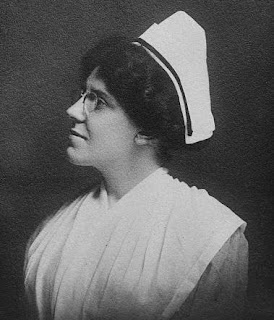
World War One Nurse Florence Bullard

In Adirondack history, like in most other parts of America, war heroes abound. Traditionally, they are men who have lost limbs, men who risked their lives to save others, and men who fought valiantly against incredible odds. Some died, while others survived, but for the most part, they shared one common thread: they were all men. But in my own humble estimation, one of the North Country’s greatest of all war heroes was a woman.

Florence Church Bullard, the female in question, was “from” two places. Known for most of her life as a Glens Falls girl, she was born in January 1880 in New Sweden, a small settlement in the town of Ausable.

By the time she was 20, Florence had become a schoolteacher in Glens Falls, where she boarded with several other teachers. Seeking something more from life, she enrolled in St. Mary’s Hospital, a training facility of the Mayo Brothers in Rochester, Minnesota. After graduating, she worked as a private nurse for several years.

In December 1916, four months before the United States entered World War I, Florence left for the battlefields of Europe. As a Red Cross nurse, she served with the American Ambulance Corps at the hospital in Neuilly, France, caring for injured French soldiers. They often numbered in the thousands after major battles.

On April 6, 1917, the United States officially entered the war, but the first American troops didn’t arrive in Europe until the end of June. Florence had considered the possibility of returning home by fall of that year because of potential attacks on the home front by Germany or Mexico (yes, the threat was real).

But with the US joining the fray in Europe, Florence decided she could best serve the cause by tending to American foot soldiers, just as she had cared for French troops since her arrival.

Until the Americans landed, she continued serving in the French hospital and began writing a series of letters to family and friends in Glens Falls and Ausable. Those missives provide a first-hand look at the war that took place a century ago.

The US had strongly resisted involvement in the conflict, but when Congress voted to declare war, Florence described the immediate reaction in Europe. Her comments offer insight on America’s role as an emerging world power and how we were viewed by others back then.

“I have never known anything so inspiring as Paris has been since the news came that America had joined the Allies. Almost every building in Paris is flying the American flag. Never shall I forget last Saturday evening. I was invited to go to the opera … that great opera house had not an empty seat. It was filled with Russians, Belgians, British, and French, with a few Americans scattered here and there. Three-quarters of the huge audience was in uniform.

“Just before the curtain went up for the second act, the wonderful orchestra burst out into the ‘Star Spangled Banner.’ In a flash, those thousands were on their feet as if they were one person. One could have heard a pin drop except for the music. The music was played perfectly and with such feeling. Afterwards, the applause was so tremendous that our national anthem was repeated.

“The tears sprang to my eyes and my heart seemed to be right in my throat. It seemed as if I must call right out to everyone, ‘I’m an American and that was my national anthem!’ I have never witnessed such a demonstration of patriotism in my life. The officers of every allied nation clad in their brilliant uniforms stood in deference to our country.”

The work she had done thus far received strong support from the folks back home. In a letter to her sister in Ausable, Florence wrote, “Try to know how much gratitude and appreciation I feel to you and all the people of Glens Falls who have given so generously of their time and money. It was such fun to help the committee open the boxes and to realize that the contents had all been arranged and made by people that I know personally.

“The committee remarked upon the splendid boxes with hinged covers and the manner in which they were packed. When the covers were lifted, the things looked as if they might have been packed in the next room and the last article just fitted into the box. I was just a little proud to have them see how things are done in Glens Falls. Again, my gratitude, which is so hard to express.”

Florence’s credentials as a Mayo nurse, her outstanding work ethic, and connections to some important doctors helped ease her transition into the American war machine. The French, understandably, were loathe to see her go, so highly valued was her service.

In a letter to Maude, her older sister, Florence expressed excitement at establishing the first triage unit for American troops at the front. They were expected to treat 5,000 to 10,000 soldiers every 24 hours. Upon evaluation, some would be patched up and moved on- some would be operated on immediately- and others would be cared for until they were well enough to be moved to safer surroundings.

Florence’s sensitive, caring nature was evident when she told of the very first young American to die in her care. “He was such a boy, and he told me much about himself. He said that when the war broke out, he wanted to enlist. But he was young, and his mother begged him not to, so he ran away. And here he was, wounded and suffering, and he knew he must die.

“All the time, that boy was crying for his mother … he was grieving over her. And so I did what I could to take her place. And during the hours of his delirium, he sometimes thought I was his mother, and for the moment, he was content.
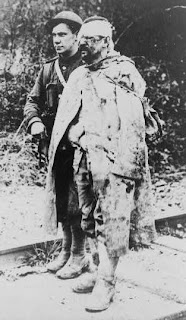
“Every morning, that lad had to be taken to the operating room to have the fluid drawn from off his lungs because of the hemorrhage. When finally that last day the doctor came, he knew the boy’s time was short and he could not live, so he said he would not operate. But the boy begged so hard, he said it relieved him so, that we took him in.

“And then those great, confident eyes looked into mine and he said, ‘You won’t leave me mother, will you?’ And I said, ‘No, my son.’ But before that simple operation could be completed, that young life had passed out. And I am not ashamed to tell you that as I cut a curl of hair to send to his mother, my tears fell on that young boy’s face-—not for him, but for his mother.”

Working tirelessly dressing wounds and assisting the surgeons, Bullard displayed great capability and leadership. She was offered the position of hospital superintendent if she chose to leave the front. It was a tremendous opportunity, but one that Florence Bullard turned down. Rather than supervise and oversee, she preferred to provide care directly to those in need.

Next week: Part 2—Nurse Bullard under hellish bombing attack.

Photos: Above, Florence Church Bullard, nurse, hero- Middle, World War One Red Cross poster- Below WWI wounded soldier in France.

Lawrence Gooley has authored ten books and dozens of articles on the North Country’s past. He and his partner, Jill McKee, founded Bloated Toe Enterpr
ises in 2004. Expanding their services in 2008, they have produced 19 titles to date, and are now offering web design. For information on book publishing, visit Bloated Toe Publishing.

Washingtons Headquarters Holiday Event

Washington’s Headquarters State Historic Site is hosting a open house at Washington’s Headquarters, in Newburgh on Sunday, December 11th, from 12 PM until 4 PM. The event is free and sponsored by the Friends of the State Historic Sites of the Hudson Highlands.

Participants will be able to chat with historic interpreters, enjoy seasonal music performed by the Salmagundi Consort, and snack on hot cider and cookies by an outdoor fire for an afternoon that recreates the mood of warmth and hospitality the Washingtons extended to their war-weary guests.

Washington’s Headquarters State Historic Site is a registered national landmark. It is located at the corner of Liberty and Washington Streets, within the city of Newburgh’s East End Historical District. For more information call (845) 562-1195.

Photo: Washington reenactor in his office (provided).

Networking: Association of Public Historians of NYS

The August 2011 issue of The Public Historian focused on both the richness of the history of New York State and the diverseness of the systems in place to protect and promote that history. This same issue has been seen in recent blogs and articles on the online site New York History and elsewhere.

I appreciate the focus on our state’s history and the concern of many to ensure that our heritage is properly preserved for everyone. Unfortunately, too little attention has been paid to a system that already exists that links and networks with every other agency in the state – the Association of Public Historians of New York State. Read more

Books: Selected Rensselaerwijck Papers

Papers from the New Netherland Institute’s annual Rensselaerswijck Seminar has long served as a platform for local historians to present their latest research on the only successful patroonship in New Netherland.

A Beautiful and Fruitful Place: Selected Rensselaerswijck Papers, vol. 2 (SUNY Press, 2011) includes papers delivered at the seminar from 1988 to 1997 and features New Netherland’s distinctive regional history as well as the colony’s many relationships with Europe, the seventeenth-century Atlantic world, and New England, these cogent and informative papers are an indispensable source toward a better understanding of New Netherland life and legacy.

Leading scholars from both sides of the Atlantic critique and offer research on a dynamic range of topics: the age of exploration, domestic life in New Netherland, the history and significance of the West India Company, the complex era of Jacob Leisler, the southern frontier lands of the colony, relations with New England, Hudson Valley foodways and Dutch beer production, the endurance of the Dutch legacy into nineteenth-century New York, and contemporary genealogical research on colonial Dutch ancestors.

Edited by Elisabeth Paling Funk and Martha Dickinson Shattuck, the newest volume of papers includes chapters from Rensselaerswijck Seminars on domestic life in New Netherland, the Age of Leisler, New Netherland and the Frontier, The Persistence of the Dutch after 1664, The Dutch in the Age of Exploration, Manor Life and Culture in the Hudson Valley, Family History, Relations between New Netherland and New England, The West India Company and the Atlantic World, and more.

Note: Books noticed on this site have been provided by the publishers. Purchases made through this Amazon link help support this site.

Books: Adirondack Hotels and Inns

The Adirondack region evolved over years from vast, impassable wilderness to a land of logging camps, tanneries, sawmills, and small settlements. By the end of the 19th century, the area grew again, becoming a tourist destination famed for its great hotels, quaint inns, cottages, and rustic cabins.

The hotels and inns spread throughout the Adirondacks, beginning after the Civil War and continuing during the Gilded Age between World Wars I and II. The region drew the rich and famous, as well as workers and families escaping the polluted cities. This volume contains 200 vintage images of those famed accommodations that catered to years of Adirondack visitors.

Although Most of the buildings seen in Adirondack Hotels and Inns&#8220>Adirondack Hotels and Inns no longer exist, having been destroyed by fires, the wrecking ball, or simply forgotten over time, the book stills serves a guide to those old places on the landscape.

Author Donald R. Williams has written eight other books on the Adirondacks, among them The Adirondacks: 1830–1930, The Adirondacks: 1931–1990, Along the Adirondack Trail, and Adirondack Ventures, all in Arcadia Publishing’s Images of America series.

Note: Books noticed on this site have been provided by the publishers. Purchases made through this Amazon link help support this site.

Adirondack Land Use and Ethics Symposium

The SUNY College of Environmental Science and Forestry’s Northern Forest Institute At Huntington Wildlife Forest invites submissions for a symposium of interdisciplinary scholarship in land use and ethics, to be held at Huntington Wildlife Forest, Newcomb, Essex County, NY on June 1-3, 2012.

Research is welcomed from across professions and disciplines on topics related to balancing individual and community priorities with respect to land use and the associated expectations for human and ecosystem stewardship and social and environmental ethics. Submissions should generate conversation around a variety of approaches to land use, the moral implications of these approaches, as well as the ways that they influence the ongoing debate over how to achieve social and environmental justice. Submissions from a range of disciplines and professional fields are encouraged.

All submissions must be submitted as a Word document via e-mail to Symposium Coordinator Rebecca Oyer according to the guidelines below. Acceptance notifications will go out by the first week of January 2012 along with detailed travel and accommodation information (preliminary information is below).

Electronic submissions require the following:
o Submission Title
o Submission Type (including required abstract/proposal as noted below):
o Paper
o Panel discussion
o Poster presentation
o Author(s) Information:
o Affiliation (independent scholars are welcome)
o Full name
o Daytime phone
o E-mail
o Mailing address

Anonymity: Abstracts will be sent via email to the Symposium Coordinator who will respond with an e-mail acknowledgement of receipt. Abstracts will be distributed anonymously to the Symposium Chair and selection committee.

A conference fee of $75 will include housing and meals beginning with dinner on Friday, June
1 and ending with lunch on Sunday, June 3 plus a wine and cheese reception at Huntington Lodge on the evening of Friday, June 1. Coffee and refreshments will be available throughout the day on Saturday and Sunday of the symposium. (Note: This is an estimated rate that may increase by $5-$10).

Accommodations: Rustic accommodations will be provided on Huntington Wildlife Forest.

Traditional Papers: The symposium welcomes work in progress. One aim of this meeting is to
provide a collegial environment for new and in-process work and ideas to be offered for comment and critique. Submissions must include a 250 word abstract. Accepted papers/research in progress will be presented by the author followed by a fifteen minute period of open discussion. Panel Discussion: A panel discussion with at least two presenters should examine specific problems or topics from a variety of disciplinary and professional perspectives on land use and ethics. Panel proposals should include a description of the issue that the panel will address, an explanation of the relevance of the topic to more than one discipline/field and an indication of how each paper in the panel addresses each issue. Panel Discussion proposals should include an abstract of 600 words for the panel as a whole.

Poster Presentations: Proposals for Poster Presentations should be in the form of a description of the research project not longer than 1000 words including a brief outline of the problem or topic presented and its relationship to land use and ethics. Posters will be on display throughout the symposium, with presenters available in the display area for a designated time during the symposium.

Session Chairs: If you would like to serve as a Session Chair, please send a CV to the Symposium Coordinator including your areas of research interest/expertise so that we can place Chairs in the most appropriate session.

Confirmation: Anyone making a submission will receive confirmation of receipt within 48 hours. If you have not received confirmation of receipt and/or notification regarding the Program Committee’s decision about your submission by January 1, please contact Symposium Coordinator Rebecca Oyer.

Scheduling: The Program Committee assumes that it may schedule a paper or session at any time
between Saturday, June 2 at 9am and Sunday, June 3 late afternoon.

For all correspondence regarding submission and/or program content, contact Symposium Chair
Marianne Patinelli-Dubay at [email protected]

For submission questions, presentation/IT needs contact Symposium Coordinator Rebecca Oyer at
[email protected]

For information on fees, lodging and accommodations contact Business Manager Zoe Jeffery at
[email protected]

Photo of Arbutus Lodge, compliments of Huntington Wildlife Forest, Newcomb, NY.