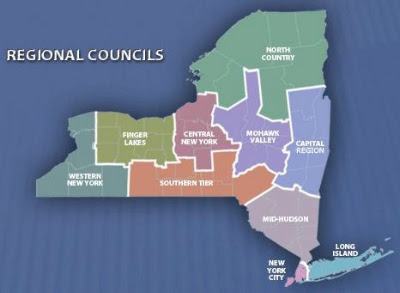
 Governor Andrew Cuomo has announced the recipients of $785 million in economic development funding awarded through his Regional Economic Development Council initiative, an effort designed to drive economic growth and create jobs. A number of projects with significance for New York State history were included and are listed below.
NOTE: A number of rehabilitative projects most geared to housing and streetscape, canalfront, or shoreline improvements, and adaptive reuse of historic buildings are not included in this list. A number of projects will require archeological and cultural resource surveys.
Cayuga County
Isabel Howland House Preservation ($400,000)
The Howland Stone Store Museum will stabilize and rehabilitate for re-use ‘-Opendore,’ a late 19th/early 20th century residence in the historic Hamlet of Sherwood for use as a museum and public meeting space. Also known as the Isabel Howland House, ‘Opendore’ was the gracious Howland family home where, a century ago, Isabel Howland and her family hosted numerous important public rallies promoting women’s rights and other social justice activities.
Chautaqua County
Grape Discovery Center ($200,000)
Final phase in the completion of a Grape Discovery Center in Chautauqua County. The Grape Discovery Center will educate visitors about the historic development of the region and the role that grape growing played in the region’s cultural landscape and communities. The plan proposes 19 exhibit panels in the Display Room and 14 exhibit displays, free standing and wall mounted, for the reception/gift shop space, as well as exterior exhibits and an orientation pavilion.
Broome County
TechWorks! Museum of Invention and Upstate Industry Parking Lot ($116,500)
The Center for Technology and Innovation will install pervious paving in the parking lot and
the Garden of Ideas at the TechWorks! Museum of Invention and Upstate Industry. Porous
pavement will enable o$cials, residents, and developers to see first-hand the benefits and costs of replacing traditional asphalt parking lots with pervious paving.
YWCA Binghamton Preservation ($244,946)
The YMCA of Binghamton and Broome County will restore the exterior masonry and cornice of
their architecturally signi#cant 1907 Beaux Arts/Classical Revival building The building serves as a community anchor providing housing and services for homeless women and children, space for community events and programs and meetings along with healthcare and childcare. This proposed exterior restoration represents one phase of the larger project to renovate the entire building. The work will reinforce and stabilize the exterior of the landmark building and contribute to the rehabilitation and revitalization of Court Street Historic District in the heart of downtown Binghamton.
Clinton County
Plattsburgh Strand Theatre Restoration ($397,000)
The North Country Cultural Center of the Arts will restore the Historic Strand Theatre, circa 1924, located in downtown Plattsburgh, continuing it as a performing arts center and preserving its historical legacy. The funds will be used to repair and point the exposed bricks and terracotta tiles which have signifcant areas of damage and repair or replicate railings and wood caps, balcony and the historic lighting fixtures.
Columbia County
Dr. Oliver Bronson House Restoration ($300,000)
Historic Hudson, Inc. will complete Phase II of the restoration of the Dr. Oliver Bronson House by completing the exterior stabilization of the house, securing the building envelope, and protecting the house from further deterioration and loss of historic fabric so it can be returned to use for public benefit. Sited on a bluff overlooking the South Bay of the Hudson River on 52 acres of open space, the Dr. Oliver Bronson House serves as a magnet for the city, providing a park-like setting and increased public access to this historic site as part of the ongoing revitalization of the City of Hudson.
Hudson Opera House Restoration Final Phase ($400,000)
The Hudson Opera House will complete a key part of the fourth and final phase of the Opera
House restoration – improvements to the first floor, including the badly deteriorated historic Common Council Chambers and anteroom, for community use. New York State’s oldest
surviving theatre (1855), located in the heart of downtown Hudson, the nonprofit multi-arts
center offers more than 1,000 programs, most of them free, to 52,000 visitors each year.
Olana North Meadow Restoration ($274,125)
The Olana Partnership will implement a major aspect of Olana’s Landscape Restoration Plan – the restoration of the historic North Meadow. Designed by Hudson River School artist Frederic Church (1826-1900) as a work of 19th-century landscape gardening, the historic 250-acre landscape is equal in historic and artistic importance to Olana’s house and collections. The completed project will provide a transformational change to the Olana landscape, restoring the historic meadows and pastureland and reopening views that have been lost over the last 100 years to second- and third-growth forest.
Erie County
Buffalo Central Terminal Canopy Restoration ($306,117)
The Central Terminal Restoration Corp., Inc. will rehabilitate and restore two entryway
canopies located at the historic Buffalo Central Terminal. The disrepair and instability of the exterior entryway canopies pose a safety hazard for patrons, tourists and volunteers and
requires immediate rehabilitation.
Shea’s O’Connell Preservation Guild Theater ($400,000)
Shea’s O’Connell Preservation Guild will restore the interior of the theatre auditorium, located at 646 Main Street, Buffalo. The ceiling, walls and facades will be restored to their original condition. Cleaning, minor repair and painting of the molded plaster ceiling and dome together with restoration on the proscenium arch, front wall, balcony underside, walls, and chandeliers will complete the project.
Essex County
Fort Ticonderoga Historic Preservation Planning Report ($20,320)
Fort Ticonderoga Association, Inc. will prepare a structural condition evaluation that will be used to make long-range decisions regarding the facility. This evaluation will establish the structural priorities of the Fort and identify options for repair.
Lewis County
Constable Hall Restoration ($21,668)
The Constable Hall Association will restore this 200-year-old historic home in Constableville, ensuring that it remains open and accessible to the community and its visitors. This project includes restoration work on four Doric pillars, pointing/flashing of chimneys, repair of water damage in two bedrooms, repair of carriage house floor, and painting of the servants’ quarters.
General Walter Martin Mansion Restoration Plan ($18,750)
The Lewis County Historical Society will prepare a Comprehensive Building Condition Assessment report for restoration of the General Walter Martin Mansion in accordance with federal Historic Preservation Standards.
Monroe County
Genesee Country Museum Training ($4,864)
Training for 12 employees in Continuing Education for CFO, Crystal Reports Commercial Electric Wiring, Small Gasoline Engine Troubleshooting and Repair, Commercial Pesticide Certi!cation, and Modern Plumbing- IT technology , Point of S
ale System, QuickBooks 2011.
Montgomery County
Schoharie Crossing Flood Relief ($95,000)
To replace signage and repair parking lot flood related damage to a prominent historic site and regional visitor attraction.
New York County
General Society Mechanics and Tradesmen Hall Report ($63,000)
The General Society Mechanics and Tradesmen of the City of New York will develop a Historic
Structure Report, a planning document for the renovation, restoration and preservation of The
General Society 1890 building. The 70,000 sq. ft. landmark —- at 20 West 44th Street in Midtown Manhattan, housing one of the oldest and the only continuously operated mechanics’ institute in the United States —- must accommodate modern functions. The goal is to preserve the historic characteristics of the building while complying with current building codes, the Americans with Disabilities Act, and reconciling energy codes with preservation requirements.
Niagara County
Niagara Wine Trail Signage ($30,000)
Purchase and installation of signs on designated Niagara Wine Trail route. Project also includes marketing and training.
Ontario County
Finger Lakes Boating Museum ($450,000)
Continuing redevelopment of its lakefront, the City of Geneva will design and construct the Finger Lakes Boating Museum and Visitors Center on Seneca Lake.
Ganondagan Art and Education Center ($400,000)
The Friends of Ganondagan will construct and help operate a 15,654 square-foot, year-round Seneca Arts and Cultural Center at Ganondagan State Historic Site in Victor. Ganondagan was the location of the largest Seneca town in the 17th century. The Cultural Center will be located a short walk from the reconstructed full scale 17th Century Seneca Bark Longhouse—a traditional Iroquois dwelling that housed multiple families. The center will include a gallery for historic and art exhibits- orientation theater for educational films and multimedia- auditorium for lectures, films, performances, and events- classroom for education- and administrative spaces.
Sonnenberg Gardens Roman Bath Stabilization ($43,000)
Sonnenberg Gardens and Mansion State Historic Park will replace clay tiles and install gutters on the interior of the Roman Bath. Located in the heart of Canandaigua’s historic district, Sonnenberg Gardens and Mansion State Historic Park features an 1887 Queen Anne-style mansion and nine formal gardens on a 50 acre estate. Replacing the clay tiles on the Roman Bath’s roof and installing a gutter and drainage system will slow the deterioration process and prevent further loss.
Rockland County
Bear Mountain Inn Restoration ($400,000)
The Palisades Parks Conservancy, Inc. will continue ongoing renovations at the historic Bear Mountain Inn. Renovations will include constructing a new accessible vehicle entrance for the Inn, modifying the north end of the Bear Mountain parking area to improve parking for the Inn and improve accessibility, designing and installing new interpretive and directional signs, beautification of the grounds, and designing and constructing a new green storm-water
remediation system for the parking area.
Saratoga County
Day Peckinpaugh Barge Museum Improvements ($191,000)
Improvements to the Day Peckinpaugh Barge Museum, a multi-regional educational and heritage tourism project, will improve its operations.
Schenectady County
Schenectady Proctor’s Theatre Preservation Work ($100,000)
The Arts Center and Theatre of Schenectady will complete historic preservation work at Proctors Theatre that will include repairs, restoration and improvements to the theatre’s ceilings, walls, side boxes, scagliola, balcony, mezzanine and orchestra areas, women’s and men’s lounges, and the Golub Arcade.
Suffolk County
Ships Hole Farm Restoration ($400,000)
Peconic Land Trust will acquire the Ships Hole Farm property, expand the farm operation, begin restoring the historic farmhouse and agricultural barn/outbuildings, connect the farm with the existing nature trail, and begin educational and historic programming.
Polo Stable Restoration at Caumsett State Historic Site ($400,000)
The Caumsett Foundation, in partnership with the state, the local community, other government entities, for-pro!t groups and private foundations, will restore from severe deterioration the masonry, carpentry and other exterior elements of the Polo Stable at Caumsett State Historic Site. This is the third and final phase of the exterior renovation project. The Polo Stable, the most architecturally important building at Caumsett, was designed by John Russell Pope, and is on the State and National Registers of Historic Places. The Foundation has already replaced the slate roof and cupola.
Warren County
Lake George Underwater Trail Website and Marketing ($50,000)
The Village of Lake George will develop and maintain a website for the New York State
Underwater Blueway Trail that will publicize and market the individual dive sites that together make up the Underwater Blueway Trail.
First Wilderness Heritage Corridor Implementation ($463,116)
Warren County will advance recommendations of the First Wilderness Heritage Corridor
Action Plan, an intermunicipal revitalization strategy for nine communities along the Upper
Hudson River and Delaware & Hudson rail line in Saratoga and Warren counties. E”orts
will include: modernization of the Dynamite Hill Ski Area to allow it to serve as a day-use
destination area in winter months- streetscape improvements between the municipal center
and the North Creek Train Station Complex- enclosing existing platforms and providing
restrooms at the historic railroad stops in the towns of Thurman and Hadley- small business
development to !ll vacant storefronts in the hamlets of the First Wilderness Heritage
Corridor- construction of a boarding platform at the site of the old Corinth station- design and construction of a new 1,100-sq.ft. classroom, an ADA-compliant restroom and o#ce space
for administrative services at the Adirondack Folk School in Lake Luzerne- and the creation,
marketing and promotion of activities to enhance tourism.
Westchester County
Tarrytown Music Hall Restoration ($400,000)
The Friends of Mozartina Musical Arts Conservatory rehabilitate and restore the Tarrytown Music Hall, a highly distinctive 1885 Queen Anne-style local, state, and federal landmark. The project will include the replacement of deteriorated foundations, restoration and repair of walls and windows, rehabilitation of the roof, and restoration of exterior soft stucco and paint finishes and interior lobby plaster and paint finishes.
Bird Homestead Meeting House Rehabilitation ($250,600)
The Committee to Save the Bird Homestead will replace the roofs of the Bird Homestead’s
three buildings, make drainage systems and foundation repairs, replace the main roof and restore of the clerestory for the Meeting House. The Bird Homestead contains an 1835 Greek Revival house, a 19th-century barn and a woodworker’s shop with attached henhouse and woodshed, and the project will help preserve historic structures that retain a high degree of authenticity, but suffer from longdeferred maintenance.
Wyoming County
Letchworth State Park Signage ($3,000)
The Friends of Letchworth State Park will develop and install signage along the Clan Trail at the Council Grounds in Letchworth State Park. This signage will enhance the interpretation and understanding of the role of the Seneca Indian Nation in Western New York for the park visitor an
d especially the school children who study this local history in the 4th grade Social Studies curriculum in New York State.
Yates County
Finger Lakes Museum Building Renovation ($2,281,000)
The Finger Lakes Museum is proposed as the premier natural and cultural resource dedicated to the enjoyment, education and stewardship of the Finger Lakes Region – and to fresh water conservation around the world. The first step in renovating a former elementary school building will be the installation of a green roof, covering the roof with vegetation and a drainage system to absorb rainfall and limit stormwater runoff, as well as restoring and protecting adjacent stream banks.
A full list of funded projects is available online [pdf].
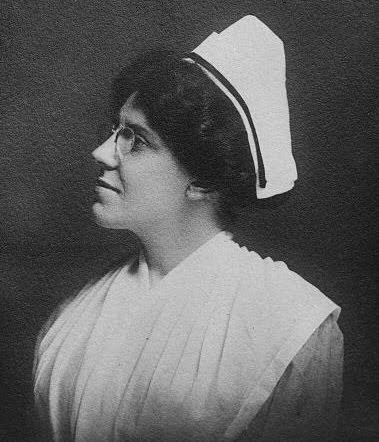 In one evacuated village, Florence Bullard’s (see Part 1 of the story) crew was forced to work from a hospital cellar, which she described as a cave. Under very harsh conditions, they treated the severely wounded soldiers who couldn’t be moved elsewhere. In a letter home, she noted, “I have not seen daylight for eight days now and the stench in this cave is pretty bad- no air, artificial light, and the cots so close together you can just get between them.
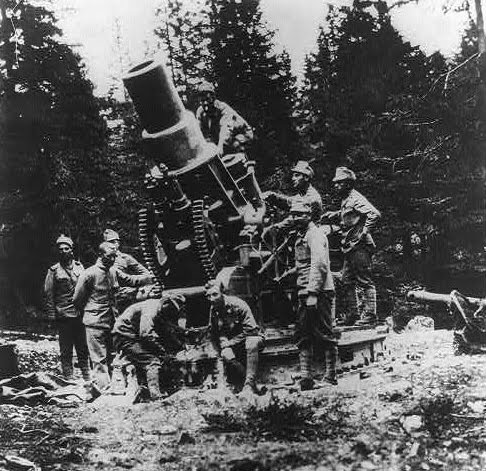 Bullard’s commanding officer stated it succinctly: “… the next four months will be very tragic ones for us all. We cannot spare you, for we cannot refill your place, and when you explain just that to your family, they will be the first to see it as we see it.”
 Just two months later, the war ended, and Florence returned home. In February 1919, she was treated to a grand reception at Glens Falls, where she received a donation of $600. A good long rest was in her plans, but by May she was on the battlefront again, this time in the United States. The Red Cross of America sent Florence on tour to Redpath Chautauqua facilities and other venues to promote good health and sanitation practices.


 Independent scholar Anthony Vaver’s blog


