Underground Railroad Conference This Weekend

The 11th Anniversary Conference on the Underground Railroad Movement, sponsored by the Underground Railroad History Project of the Capital Region Conference, will be held at Russell Sage College in Troy, April 13-15th. This year’s conference, &#8220The Underground Railroad Turned On Its Head – Old Themes, New Directions,&#8221 focuses on new research on the Underground Railroad, slavery, abolition and the 19th century. Old assumptions such as “There is little documentation of the Underground Railroad”, “The UGRR was a string of safe houses to Canada” and numerous other ideas are challenged by new research and interpretations.

The conference will feature:

Friday, April 13, 2012

An Educators’ Workshop

Opening Address – Manisha Sinha, PhD
“Fleeing for Freedom: Fugitive Slaves and the Making of American Abolitionism”

Saturday, April 14, 2012

Keynote Address – Barbara McCaskill, PhD
“A Thousand Miles for Freedom: A New Take on the Old Story of William and Ellen Craft, the Georgia Fugitives”

Artists in Residence – Miles Ahead Jazz Quartet

Spectres of Liberty
Experience history – step into the recreated Liberty Street Presbyterian Church of Henry Highland Garnet

Over 20 Workshops, plus Vendors & Displays

Sunday, April 15, 2012

A bus tour of UGR Sites in Rensselaer County by Kathryn Sheehan, Rensselaer County Historian.

The Underground Railroad History Project of the Capital Region researches, preserves, and retells New York’s regional history of the Underground Railroad, highlighting the role of African-American freedom seekers and local abolitionists.

More information can be found online.

2012 Ellis Island Family Heritage Awardees Announced

The Statue of Liberty-Ellis Island Foundation has announced the recipients of its annual Ellis Island Family Heritage Awards, which honor distinguished Americans who trace their ancestry through Ellis Island, and the B.C. Forbes Peopling of America Award recognizing individuals who themselves immigrated to America. The Awards will be presented on April 19th at a ceremony to be held in the historic Great Hall on Ellis Island. The 2012 honorees are:

Angela Lansbury – The B.C. Forbes Peopling of America Award – Entertainment

This London-born actress, who returns to Broadway this year in Gore Vidal’s The Best Man, began her ascendancy up the ranks of American entertainment ladder shortly after her family evacuated to New York City in 1940, just days before the London blitz. Her first of over 50 films, Gaslight, won her an Oscar nomination. Since then, she has been a star of film, stage and television for seven decades, garnering her five Tonys, six Golden Globes, three Oscar nominations, and over 15 Emmy nominations. In 1994, Queen Elizabeth II appointed her Commander of the Order of the British Empire for services to the dramatic arts. She is also a recipient of the National Medal of Arts and the Kennedy Center Honors in 2000. Lansbury became a naturalized U.S. citizen in 1951.

Richard Meier &#8211 Ellis Island Family Heritage Award – The Arts/Architecture

Born in Newark, New Jersey, Richard Meier is a Pritzker Prize-winning architect who designed the Getty Center in Los Angeles. His distinct minimalist style of has garnered him 10 honorary degrees, numerous design awards as well as the American Institute of Architects Gold Medal in 1997. He has taught at many universities including Princeton, Harvard and UCLA. With current projects underway in Asia, Europe, Latin America, North America and his hometown, he serves on the Board of Directors of the Cooper-Hewitt National Design Museum and the American Academy in Rome. His maternal grandfather &#8211 a leather tannery owner &#8211 Joseph Kaltenbacher, emigrated from Germany through Ellis Island in 1896.

Anthony &#8220Tony&#8221 La Russa, Jr. – Ellis Island Family Heritage Award – Sports

Tony La Russa was born in Tampa, Florida, where his paternal grandparents had settled after arriving from Sicily thru Ellis Island in 1906. As an infielder, La Russa began his career with the Kansas City Athletics in 1963. Turning to managing in 1979, he became one of the longest tenured managers in the history of Major League Baseball. He spent 32 years at the helm of the Chicago White Sox, Oakland Athletics, and St. Louis Cardinals, where he topped the Cards’ managerial win list with 1,408 victories. He ranks third in all-time major league wins by a manager, holding six league championships and three World Series titles, most recently with the Cardinals in 2011. A staunch advocate for animal rescue, La Russa, his wife Elaine and their daughters founded ARF (Animal Rescue Foundation) in 1991, which aids homeless and abandoned animals and uses them to help people in need.

The ceremony will be hosted by journalist Meredith Vieira and will mark the 120th anniversary of the opening of Ellis Island on New Year’s Day 1892. Until it closed in 1954, Ellis would process 17 million immigrants. Forty percent of Americans today can trace their roots to an ancestor who was among them.

Throughout its 10 year history, the Ellis Island Family Heritage Awards have recognized more than 40 individuals, among them Dr. Madeleine Albright, Irving Berlin, Yogi Berra, Lee Iacocca, Jerry Seinfeld, Mike “Coach K” Krzyzewski, Mary Higgins Clark, General Colin Powell, Martin Scorsese, and Bruce Springsteen.

More information can be found online.

Oz and Bedford Falls: Upstate NYs American Icons

Upstate New York has bequeathed to the American culture two iconic towns, neither of which exist in the real world. Bedford Falls from the movie It’s a Wonderful Life is based on the village of Seneca Falls&#8230-or so claim the people of Seneca Falls! Oz of the Wizard of Oz book series and one memorable movie also derives its origin from the exact same area &#8211 author Frank Baum was spurred on by his living in Fayetteville in what is now the Gage Home. Read more

Lawrence Gooley Presenting Robert Garrow Lecture

The next lecture in the Adirondack Museum’s 2012 Cabin Fever Sunday, &#8220Tracking Robert Garrow&#8221 with author and New York History contributor Lawrence Gooley, will be held on Sunday, April 15, 2012.

In the summer of 1973, serial killer Robert F. Garrow went on a murderous rampage that changed the Adirondack region forever. However, there was much more to Garrow’s story than the murders. From his unfortunate childhood to escapes from the law, the longest manhunt in Adirondack history, and his manipulation of legal, medical and corrections professionals, hear the full story of Garrow’s life from author Lawrence Gooley. Due to graphic content, this program is suitable for adult audiences.

Lawrence P. Gooley is a proponent of the North Country, a lover of books, and a history enthusiast. He operates Bloated Toe Enterprises, an internet-based business that currently includes Bloated Toe Publishing and The North Country Store. Gooley has also organized a North Country Authors group to help raise the profile of area authors and their works. Gooley’s writings have appeared in various magazines and newspapers. He has contributed to other works, including a recent piece in an annual book series, the Franklin County Review, and has provided editing services for several other titles. He has also authored nine books including Terror in the Adirondacks: The True Story of Serial Killer Robert F. Garrow.

This program will be held at the Adirondack Lakes Center for the Arts at Blue Mountain Lake, and will begin at 1:30 p.m. Cabin Fever Sundays are offered at no charge to museum members or children of elementary school age and younger. The fee for non-members is $5.00. For additional information, please call (518) 352-7311, ext. 128 or visit www.adirondackmuseum.org.

Forest to Fields: Champlain Valley Agriculture History

A short booklet, From Forest to Fields: A History of Agriculture in new York’s Champlain Valley published by Cornell Cooperative Extension (CCE) of Essex County and the Lake to Locks Passage Scenic Byway highlights the rich history of the Champlain Valley with a focus on the region’s farms and fields.

From Forests to Fields is authored by Anita Deming, who has more than 30 years experience as an agricultural extension agent with CCE, and Andrew Alberti, Program Manager for Lakes to Locks Passage since 2008 (where he focuses on 21st century technology applications and local and regional interpretation and planning) and a contributor here at New York History. Alberti is also editor for the Lakes to Locks Passage and National Geographic Geotourism website.

Chapters cover Native American agriculture, early explorers and settlements, the agricultural revolution, farming in the modern era and a short review of the architecture and use of farm buildings and a list of resources. The authors explain the impact of the 1807 Embargo Act, the influence of the opening of the Champlain Canal in 1823 on local farm trade, the grange movement, and changes in the local sheep and dairy industries, and more.

The booklet is 48 pages and profusely illustrated. You can request a copy by contacting Lakes to Locks Passage. There is a suggested $10 + S&H donation.

Honors Awarded at Great Lakes Trail Quilt Event

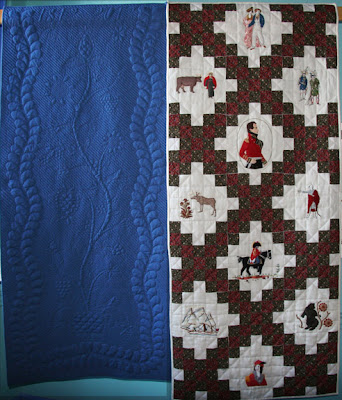
A regiment of Canadian quilters and a Pennsylvania woman have won Viewer’s Choice honors from the Great Lakes Seaway Trail War of 1812 Bicentennial Quilt Show. The show featured 1812 period-correct and pictorial quilts from 18 U.S. states and from across Canada.

The favorite quilt of the more than 1,000 visitors to the show hosted by three early 19th century historic sites in Sackets Harbor, a New York State 1812 Heritage Community, was made by nine of the living history interpreters at Upper Canada Village, Morrisburg, Ontario.


Janice Toonders, who demonstrates spinning and weaving at the Village, designed the quilt using an Irish chain pattern. Toonders, Martina Bols, Linda Brown, Mary Casselman, Christine Christie, Ivah Malkin, Marjorie Munroe, Judy Neville, and Sharon Shaver used wool cloth, silk thread and cotton fabrics to fashion symbols from the 1812 time period for the colorful pictorial. Sharon Shaver, the quilting demonstrator at Upper Canada Village, added the binding and quilting.

“British Major Sir Isaac Brock is front and center. Lieutenant General Sir George Prevost is aside as he navigates his horse home in shame for not advancing his troops at Plattsburgh. We have the First Nation’s Confederacy leader Tecumseh and Joseph Brant, the Mohawk Chief who was working with the British to create a nation in the west,” Toonders explains.

The Upper Canada Village quilters also included the sloop “Wolf” that fought in one of the Battles of Sackett’s Harbour. A bear, a moose, a First Nation’s symbol, a British sailor and Laura Secord who notified the British of a U.S. attack are also among the quilt’s storytelling images.

Quilts from four Canadian provinces made up approximately 30 percent of the show’s quilts.

The show’s second Viewer’s Choice winner is the “Underhill Tree of Life Whole-Cloth Quilt” made by Jill C. Meszaros of Cambridge Springs, PA, 25 miles south of Erie and the Great Lakes Seaway Trail Pennsylvania. The all-blue quilt is intricately quilted by hand with a dark blue thread.

Meszaros says, “I chose to create a whole-cloth quilt to honor my family heritage and the history of quilting and our nation. My fourth great-grandfather, Major David Underhill traveled to Huron County, Ohio, in 1810. In 1812 he reacted to the news that the British and Indians were landing only to learn they were really soldiers in Hull’s army. As I quilted, my husband was away and I imagined what it would have been like in 1812 to wait for him to come home.”

Meszaros, a stay-at-home mother of six, fashioned her design after the Clarke Family Quilt in the book “Massachusetts Quilts” and used fruit, floral and foliate motifs inspired by “Quilts-Masterworks from the American Folk Art Museum.” The quilt’s batting is wool, typical of the 1812 time. She says, “The last stitch went in the I day I shipped the quilt to the show.”

Show manager Lynette Lundy-Beck notes, “This show inspired people to learn more about the War of 1812, its battles, the soldiers and their loved ones, and about the quilters’ own families. This show is indeed a storytelling event that interprets the travel themes for the Great Lakes Seaway Trail in many interesting and personal ways, and that is what makes this quilt show unique among quilt shows and tourism showcases.”

Much of the war was fought along the Great Lakes Seaway Trail, a National Scenic Byway in the U.S. The 518-mile leisure driving route parallels the St. Lawrence River, Lake Ontario, Niagara River, and Lake Erie. Quilting is just one of many travel themes for the byway.

Watch www.seawaytrail.com/quilting for details on the impact of the 2012 show and for guidelines on the Beauty of the Byways theme for the 2013 show.

This Weeks Top New York History News

  • Budget, New Funding Boosts NY History
  • TX Chain to Reincarnate a Landmark Theater
  • NY Historian Revises Civil War Dead Estimate
  • 1940 Now Being Indexed
  • Turkey Seeks Return of Met Artifacts
  • New Images of Titanic Revealed
  • Lee Benson, US Historian, Adctivist Dies
  • 1940 NYC Phone Books Online
  • Bolton Museum Eyes Expansion
  • NYSCA Gets Increase in State Budget
  • Each Friday morning New York History compiles for our readers the previous week’s top stories about New York’s state and local history. You can find all our weekly news round-ups here.

    Subscribe! More than 2,800 people get New York History each day via E-mail, RSS, or Twitter or Facebook updates.

    New Director for Newburgh Bay, Highlands Historical

    The Historical Society of Newburgh Bay and the Highlands has announced that lifelong Newburgh resident Johanna Porr will serve as the organization’s new director. Porr assumed the position last week.

    “To be able to study the largest historic district in New York State is certainly fun, but to be entrusted with a role to use that understanding to help rebuild this city is an honor,” she said in a statement release to the press.

    As director, Porr’s duties include fundraising, directing future research and programs, overseeing the remaining renovations to the Captain David Crawford House, creating useful networks in the fields of public history and academic history and increasing membership within the group the statement said.

    “The Historical Society has been and will continue to be a resource for people who want to learn more about Newburgh’s history or those who are interested in restoring homes here,” she said.

    Porr &#8220wants to establish an inspiring new direction for the Historical Society of Newburgh Bay and the Highlands while maintaining everything Newburgh has come to love about the organization. Her goals are to keep up with the current trends in the academic world, exchange information and ideas with other historical societies in New York and beyond and to use the society’s resources to make Newburgh’s history
    more relevant to today’s citizens,&#8221 the press statement said.

    “It’s important to find the academics who are already doing the research and connect them with the people on the ground who have a better idea of the questions the public is interested in,” said Porr. “I’d like to see more serious focus on scholarly research being done in the Hudson Valley.”

    Porr has been an historical interpreter at Washington’s Headquarters, where she has both volunteered and been employed for nearly a decade. She attended Franklin College in Switzerland where she studied European history, earned an M.P.A. from Marist College and recently spent time in Virginia doing archaeology at Historic Jamestown and historic-trades research at Colonial Williamsburg.

    “Newburgh is a fascinating place,” said Johanna, who grew up in city. “We call it ‘History City’ because you can take any major movement and tie it back here somehow- you can always find a way to understand the scope of American history through the narratives that are available in Newburgh.”

    The new director is the daughter of former Newburgh city manager Harold Porr and Joan Mauriello, who volunteered as a preservationist and historical activist while Johanna was growing up.

    “This society is one of the earliest and we’ve been building a collection and archive since 1884,” Johanna said. “I’m proud to be part of such a strong institution, especially since the viability of Newburgh’s future is inseparable from its legacy.”

    This Weeks New York History Web Highlights

    Each Friday afternoon New York History compiles for our readers the previous week’s top weblinks about New York’s state and local history. You can find all our weekly round-ups here.

    Subscribe! More than 2,800 people get New York History each day via E-Mail, RSS, or Twitter or Facebook updates.

    Quadricentennial Photo Exhibit Unveiled

    The Essex County Historical Society in Elizabethtown, recently announced an online commemoration of the 2009 Quadricentennial in Essex County. The Lake Champlain Quadricentennial 1609-1909 site has been designed to highlight photographs by Jack LaDuke acquired by the Essex County Historical Society in 2010. The site celebrates pride of place expressed through LaDuke’s photographs of the 2009 commemorative year, and features photographs and items from the Essex County Historical Society’s own collection from the 1909 Tercentenary and 1959 commemorations. The public is encouraged to contribute their own photographs to compliment items featured on the site.

    Jack LaDuke was hired in 2009 to take photographs of the many significant events in the Champlain Valley region of New York State during the Quad year. LaDuke has forty years experience as a photographer, journalist and story-teller reporting on the Adirondacks and the North Country. He works for Mountain Lake PBS in Plattsburgh, New York as a contributing reporter after spending most of his career with WCAX in Burlington, Vermont.