Stoddard’s Natural Views Exhibit Opeing May 4th

Long considered beautiful photographs of the Adirondack landscape, Seneca Ray Stoddard’s views also serve as documents of the plants that inhabited the region in the 19th century. Since he was rediscovered in the late 1970s, Stoddard’s work has been featured in numerous exhibits that explored the history of 19th century life in the Adirondacks. A survey of the 3,000 images in the Chapman Historical Museum archives, however, revealed hundreds of images that are purely natural landscapes. The subject matter is the Adirondack environment – not great hotels, steamers, camp scenes or other obvious evidence of human activity.

The Chapman’s summer exhibit, S.R. Stoddard’s Natural Views, features forty enlarged photographs of varied Adirondack settings – lake shores, marshes, meadows, riverbanks and mountainsides. Included are such locations as Surprise Falls on Gill Brook, Indian Pass, Lake Sanford, Ausable Chasm, Wolf Pond and Paradise Bay on Lake George. The exhibit examines these photographs as documents of the history of ecological habitats, providing an opportunity to consider the issue of environmental change – an issue as relevant in Stoddard’s time as it is today.

To address this issue the museum consulted with Paul Smith’s College biologist, Daun Reuter, and Don Leopold of SUNY-ESF, who identified botanical species in Stoddard’s photographs. Plants that they discovered in Stoddard’s photographs &#8212- from small flowers to shrubs and trees – are highlighted in modern color images supplied by Ms. Reuter and others and in digital reproductions of period specimens from the herbarium at the New York State Museum. These show details of the plants in their various stages – details rarely visible in Stoddard’s photographs many of which were taken late in the year after the plants had lost their flowers and started to wither.

By bringing attention to this group of Stoddard photographs, the exhibit will give visitors the opportunity to discover and reflect on the changing environment – a topic of urgent concern in the region. Through their experience visitors will gain greater appreciation for not only Stoddard’s photographic vision but also the natural world of the Adirondacks. The exhibit is funded by grants from the Leo Cox Beach Philanthropic Foundation and the Waldo T. Ross & Ruth S. Ross Charitable Trust Foundation and sponsored by Glen Street Associates and Cooper’s Cave Ale Co.

For those who wish to learn more, the Chapman Historical Museum has scheduled a series of programs (detailed below) to be held at both the museum at and other sites. The museum is located at 348 Glen Street, Glens Falls, NY. For more information call (518) 793-2826 or go to www.chapmanmuseum.org.

RELATED PROGRAMS

Wednesday, May 30, 7 pm
Talk: “UNWANTED: Invasive species of the Adirondacks”
Speaker: Hilary Smith, Director, Adirondack Park Invasive Plant Program
At the Chapman. Free.

Saturday, June 9, 8:30 -11:30 am
Bird Walk in Pack Forest, Warrensburg
Guide: Brian McAllister, Adirondack Birding Center

Bird watch along the nature trail to the old growth forest. Bring binoculars, field guide, water, snack, bug repellant, hiking shoes, and appropriate dress. For birders of all levels. Call (518) 793-2826 for directions.

Wednesday, June 20, 2012, 7 pm
Talk: “Go Native! An Introduction to Gardening with Native Plants”
Speaker: Emily DeBolt, Fiddlehead Creek Farm & Native Plant Nursery
At the Chapman. Free.

Thursday July 12, 9:30-11:30 am.
A plant paddle at Dunham’s Bay.
Guide: Emily DeBolt, Lake George Association.

Part of the 7th annual Adk Park Invasive Species Awareness Week Bring your own canoe or kayak. Meet at Dunham’s Bay Marina For reservations call the LGA at (518) 668-3558

Saturday, August 4, 1 &#8211 3 pm
Guided Bog Walk of Native Adirondack Plants
Guide: Daun Reuter, Dept Biology, Paul Smith’s College

At Paul Smith’s Visitor Interpretive Center. Reservations: $20. Call the VIC at (518)327-6241

Saturday, August 18, 8 am
Guided alpine plant hike up Wright Peak
Guide: Sean Robinson, Dept Biology, SUNY Oneonta

Meet at ADK LOJ parking lot. Parking $. Info & Reservations: Call the museum at (518) 793-2826

Photos: Above, Silver Cascade, Elizabethtown by S.R. Stoddard, ca. 1890.
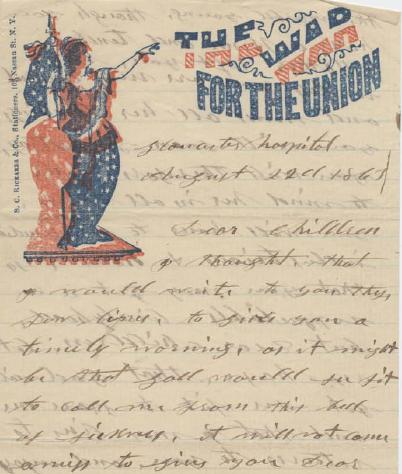
Wanda Burch on Civil War Letters The Home Voices Speak Louder than the Drums

On August 7, 1862, Henry Graves, physically exhausted from walking, fighting, and from four days detail digging trenches under a Petersburg, Virginia, sun and not “a breath of air stirring,” sat down and wrote to his wife, describing the importance of the imagination to survival.

He saw himself standing – not with spade in hand &#8211 but eating from a bowl of peaches in the midst of “homefolk” with his coat off, moving across the piazza, enjoying the cool breeze “that almost always is blowing fresh through there.” He told her that he often went into this place in his imagination to pass time swiftly and shared that “soldier mortals” would not survive if they were not “blessed with the gift of imagination and the pictures of hope.” The second “angel of mercy,” he said, was the night dream, which presented him even more vivid pictures of hope than any daydream. Read more

Cultural Landscape Workshop Set for Lorenzo SHS

Lorenzo State Historic Site, in Cazenovia, Madison County, NY, will host a one-day workshop for preservation planners, cultural resource managers and stewards of historic properties.

The day’s agenda will include defining the types and characteristics of cultural landscapes- documenting historic and current conditions including preparation of period and contemporary plans- developing treatment plans within an historic preservation context- examples of cultural landscape reports and their various components- interpreting the cultural landscape- what resources to consult and what steps to take in establishing a cultural landscape preservation program- and touring the historic landscape at Lorenzo.

Presenting cultural landscape experts:

John Auwaerter, Co-director of the Center for Cultural Landscape Preservation, SUNY ESF, and a National Park Service Partner with the Olmsted Center in Boston

Christine Capella-Peters, member of the technical staff for the NYS Historic Preservation Office, a division of OPRHP

George Curry, Professor Emeritus, Dept. of Landscape Architecture, SUNY ESF and cultural landscape Project Director at SUNY ESF

The registration deadline is May 15, 2012. The cost is $40 for MAAM members- $50 non-MAAM members (payment accepted by check or credit card). More information can be found online.

The program is presented by the Mid-Atlantic Association of Museums in cooperation with the NYS Office of Parks, Recreation and Historic Preservation (OPRHP), the State University of New York, College of Environmental Science & Forestry (SUNY ESF), and the National Park Service Olmsted Center for Landscape Preservation.

Website Highlights Free New York Documentaries

The popular website DocumentaryStorm.com is celebrating its 1st anniversary, and is recommending several documentaries available on the site about New York City for New York History readers. These documentaries that focus on a couple of seldom visited spaces in New York life, the sewer system and the fire department, along with one of New York City’s most visited places. DocumetaryStorm.com is dedicated to finding providing free, full-length documentaries from around the web.

The New York City Fire Museum

NYC’s Fire Department plays an indispensable role in keeping New York’s citizen’s safe. While September 11th, 2001 shone a very bright and hot media light on the department &#8211 rightfully highlighting their training and sacrifice &#8211 the department has a sordid and quite remarkable history dating back many centuries. For many decades the firefighters were all community volunteers. This documentary explores the department’s origins and traces the various incarnations, training, and equipment through the 1800&#8242-s to today. When was the first fire truck used? How were fires put out in the early 1800&#8242-s? What did the firemen used to wear to protect them against fire?

New York from the Underneath

This is a rare and unique glimpse into the sewer system that runs below New York City. Beautifully shot, captivating, and gritty, the documentary traces the underbelly of New York from the Bronx to Queens. Urban Historian Steve Duncan leads the journey through a maze of winding tunnels, man-made waterfalls, and local wildlife. The scars of history’s past is evident in the brickwork and drawings on the wall. We explore more than two centuries of urban planning: a generational patchwork. Half vision, half compromise. The city’s first enclosed sewer system is located on Canal Street and survives intact to this day. Duncan sleeps in the sewers by day and leads us on an entertaining 25 minute tour by day. New York City: like you’ve never seen her before.

The Empire State Building Shall Rise

Proving that the Great Depression was no match for New Yorkers- the Empire State Building continued to rise: past the height of the Eiffel Tower &#8211 which had been the tallest building in the world for decades. Past the height of the Chrysler Building &#8211 which had been the tallest building for barely a year. The Empire State would stand as the tallest building in the world for over 40 years. It is still the tallest building in New York, following September 11th, 2001. Remarkable historical footage of an American treasure.

Adirondack Museum Program in Rochester

The Adirondack Museum will offer a special presentation in Rochester, NY, &#8220The Adirondack 46er &#8211 the Ultimate Challenge!&#8221 The program will be held Thursday, May 3 from 6:30 to 8:00 p.m., in the Adirondack Lodge at the Midtown Athletic Club.

Learn about becoming a &#822046er&#8221 with Tony Goodwin, guest speaker and author of Ski and Snowshoe Trail in the Adirondacks, and current editor of the Adirondack Mountain Club’s Adirondack Trails High Peak Region. Most recently, Tony wrote the introduction to the 2011 publication, Heaven Up-h’isted-nes: The History of the Adirondack Forty-Sixers and the High Peaks of the Adirondacks.

With Tony, and back by popular demand, is Nancie Battaglia, renowned Lake Placid based photographer and licensed guide. Both have climbed all 46 High Peaks more than just once &#8211 Tony five times.

Tickets are $10 per person and proceeds benefit the Adirondack Museum. For tickets, please call the Midtown Athletic Club directly at (585) 461-2300.

A NY Classic: Drums Along the Mohawk

After its first publication in 1936, Walter D. Edmonds’ classic historical novel Drums Along the Mohawk battled Gone With the Wind as the most popular historical novel of the ensuing years, and became a feature film in 1939 directed by John Ford, and starring Claudette Colbert and Henry Fonda.

A New York Times review by Frank Nugent celebrated the film. &#8220It is romantic enough for any adventure-story lover,&#8221 Nugent wrote. &#8220It has its humor, its sentiment, its full complement of blood and thunder. About the only [John] Ford staple we miss is a fog scene. Rain, gun smoke and stockade burnings have had to compensate. The fusion of them all has made a first-rate historical film, as rich atmospherically as it is in action.&#8221 Those laudatory comments still suit the original novel just as well, but for those with an interest in the history of the Mohawk Valley, there’s more than just a good story.

Edmonds was born in 1903 in Boonville (Oneida County) and died in 1998. Edmonds was troubled by the presentation of the history of the American Revolution and used local primary sources to create life on the Revolution’s frontier. &#8220Edmonds turned to &#8216-Working with the sources’,&#8221 Frank Bergman wrote when Syracuse University Press took over publication of the novel in 1997. &#8220His knowledge of the facts enabled Edmonds to dye his narrative in the wool- his history is color-fast and guaranteed not to fade&#8230- His goal was not to establish &#8216-how it actually was,’ but to allow his readers to experience the past as if it were the present.&#8221

&#8220To those readers who may have felt some curiosity about the actual occurrences in the Mohawk Valley during the Revolution,&#8221 Edmonds wrote in the book’s &#8220Author’s Note&#8221, I should like to say here that I have been as faithful to the scene and time and place as study and affection could help me to be.&#8221 Edmond’s sources were varied, but he himself points to the importance of the Minute Book of the Committee of Safety of Tryon County &#8220to understand what valley life was really like&#8221.

This summer readers will have a taste of that life at an outdoor drama based on Drums Along the Mohawk that coincides with the British Brigade and Continental Line’s national Revolutionary War encampment at Gelston Castle Estate in Mohawk, NY. About 1,000 reenactors are expected to take part in honor of the 235th anniversary of the Battle of Oriskany.

Note: Books noticed on this site have been provided by the publishers. Purchases made through this Amazon link help support this site.

Exec Dir David Setford to Leave Hyde Collection

The Hyde Collection has announced that David F. Setford has informed the Board of Trustees that he intends to leave his post as Executive Director in August. A nationwide search will be conducted to identify a successor.

Setford, who has led the Hyde for four and a half years, spearheaded high-profile exhibitions including Degas and Music in 2009 and Andrew Wyeth: An American Legend in 2010 and oversaw a successful $3 million capital campaign. He has accepted a position with International Fine Art Expositions in Florida, as Managing Executive directing international art fairs in Palm Beach and Miami.

“Leading The Hyde Collection has been one of the greatest professional experiences of my career, and I leave with both deep affection for this spectacular collection and great expectations for its future,” Setford said. “The Hyde is one of the most distinguished regional art museums in the United States, respected both for its profound cultural impact and its economic importance to the Greater Glens Falls and Capital Regions.”

Candace Wait, chair of The Hyde Collection Board of Trustees, said: “We are indebted to David for his steady leadership and vision, especially in helping the Board of Trustees and our staff carefully chart the future of one of the most important cultural institutions in Upstate New York. He has led us through the process of updating The Hyde Collection’s long-term strategic plan and to the near completion of our Facilities Master Plan. David’s leadership, good humor and enthusiasm will be missed.”

“During the next four months, as we prepare for David’s departure, our Board will engage in a careful national search for a successor who shares our commitment to thttp://www.blogger.com/img/blank.gifhe mission of The Hyde and our passion for bringing The Hyde experience to an even broader audience throughout New York and New England,” Wait added.

The Hyde Collection attracts thousands of visitors annually. Its collection of more than 3,000 objects of European and American art includes works by Rembrandt, Rubens, Picasso, Renoir, and Hassam. Its holdings are regularly in high demand by art museums around the world. Its “Christ with Folded Arms” by Rembrandt was loaned to the Louvre last year.

The museum is located at 161 Warren Street in Glens Falls, where it was founded in 1963 in the historic American Renaissance mansion of Charlotte Pruyn Hyde and Louis Fiske Hyde. Mrs. Hyde was the daughter of the co-founder of the Finch Paper mill in Glens Falls. Hyde House, as the residence is known, is on the National Register of Historic Places. More information is available at www.hydecollection.org.

This Weeks Top New York History News

  • Genealogy Sites to Merge
  • Restored Poe Cottage Wins Preservation Award
  • New Boscobel House Exe Dir Leaving
  • Public History Awards Announced
  • Space Shuttle to Land in New York
  • Fire-Museum, Never Open, Loses Lease
  • Mine Sought at Ft Anne Battlefield
  • Global History, Geography Exam Optional?
  • Crowd Shows for Historic Church Meeting
  • Top Historian: Preserve Fort Ann Battlefield
  • Each Friday morning New York History compiles for our readers the previous week’s top stories about New York’s state and local history. You can find all our weekly news round-ups here.

    Subscribe! More than 2,800 people get New York History each day via E-mail, RSS, or Twitter or Facebook updates.
    Each Friday morning New York History compiles for our readers the previous week’s top stories about New York’s state and local history. You can find all our weekly news round-ups here.

    Nellis Tavern: War of 1812 Songs and Stories

    The historic Nellis Tavern museum east of St. Johnsville (Montgomery County) will present performer and researcher Dave Ruch on Saturday, May 5, in a special concert entitled “The War of 1812 – Songs and Stories from New York and Beyond.” The program will begin at 2 p.m.

    With guitar, mandolin, banjo, jew’s harp, bones, and voice, Dave Ruch interprets the traditional and historical music of the New York State region. For this program, Ruch presents a ringing portrait of the War of 1812 through the songs and stories of the people themselves.


    Ruch has dug deeply into archival recordings, diaries, old newspapers and other historical manuscripts to unearth a wealth of rarely-heard music which, alongside some of the classics from the war period, offers a rounded and fascinating picture of this “second war of independence.” Special emphasis is given to New York State’s important role in the conflict.

    By the War of 1812, the Nellis Tavern, originally built about 1747 facing the Mohawk River, had been enlarged and faced the recently completed Mohawk Turnpike (NYS highway 5). The turnpike was an important thoroughfare during the war, and the tavern served a host of travelers, military and civilian alike. Ruch will perform music which might have been heard in the tavern two hundred years ago.

    Ruch travels widely from his home base in Buffalo, giving hundreds of performances each year for schools, museums, historical societies, libraries, festivals, community events and more. He will appear at the Nellis Tavern as a Speaker in the Humanities sponsored by the New York Council for the Humanities.

    Admission is free and open to the public.

    For more information, contact the Palatine Settlement Society at 518-922-7051.

    John Brown Day Planned for May 5th

    Frederick Douglass’ great-great-great grandson Kenneth B. Morris, Jr., will give the keynote address at the annual John Brown Day celebration to be held on Saturday, May 5, at the John Brown Farm State Historic Site in Lake Placid, NY. Morris will talk about the friendship and enduring legacy of Douglass and fellow abolitionist John Brown.

    The two men first met in Massachusetts in 1848, a decade after Douglass successfully escaped from slavery on a Maryland plantation and eleven years before Brown’s history-changing raid on the federal arsenal at Harpers Ferry, Virginia. By the time they met, Douglass had become one of the most eloquent and sought-after champions of freedom and equal suffrage for women and men, regardless of race.

    Founder and President of the Frederick Douglass Family Foundation, Morris will also discuss the Foundation’s work today to create a modern Abolitionist Movement in schools all over the country through the vehicle of Service-Learning.

    There are an estimated 27 million men, women and children held in some form of slavery in the world today, generating billions of dollars along the supply chain of labor and products that make much of our daily lives possible.

    Joining Morris will be Renan Salgado, a Human Trafficking Specialist based in Rochester, who will shed light in his remarks about slavery and trafficking in New York State today. According to the U.S. State Department, there are approximately 17,500 people trafficked into the U.S. each year. Along with California, Texas, and Florida, New York ranks among the states with the greatest incidence of documented slavery in the country.

    Young, award-winning orators from the Frederick Douglass Student Club in Rochester will recite from Douglass’ speeches and excerpts from Brown’s letters. The folk quartet The Wannabees and the hip-hop recording artist S.A.I. will also perform.

    John Brown Day revives the tradition dating back to the 1930s of making a pilgrimage to remember and honor Brown by laying a wreath at his grave. Over the last 13 years, the grassroots freedom education project John Brown Lives! has worked to keep that tradition alive and relevant.

    John Brown Day 2012 is free and open to the public and it is held outdoors. A brief reception will follow in the lower barn at the site. Donations will be appreciated.

    For more information, contact Martha Swan, Executive Director of John Brown Lives! at 518-962-4758 or [email protected].

    Visit the John Brown Lives! Friends of Freedom on Facebook.