Rare Maps of the American Revolution in the North

The 1776-1777 Northern Campaigns of the American War for Independence and Their Sequel: Contemporary Maps of Mainly German Origin by Thomas M. Barker and Paul R. Huey is the first, full-scale, presentation in atlas form of the two, abortive British-German invasions of New York – events crucial to understanding the rebel American victory in the War for Independence. The book includes 240 pages with 32 full-color illustrations.

The bulk of the maps are from the German archives. The material has previously been little used by researchers in the United States due to linguistic and handwriting barriers. The volume includes transcriptions, translations, and detailed textual analysis of the naval and land operations of 1776 and 1777. It is written from a novel military-historical perspective, namely, British, German, loyalist, French Canadian, and First American.

The attack of Benedict Arnold and Richard Montgomery on Quebec City, the colonial assailants’ repulse and withdrawal to the Province of New York and the Hudson River corridor, prior actions in the adjacent St. Lawrence-Richelieu river region of Canada, the Battle of Valcour Island on Lake Champlain, the forts at Crown Point and Ticonderoga, and the Battles of Bennington and Saratoga all receive detailed attention. The last section of the atlas deals with the less known, final phase of combat, in which the Britons, Germans, refugee tories, Quebec militia, and Amerindians kept the insurgents off balance by mounting numerous small-scale expeditions into New York.

The significance of the publication is highlighted by Russell Bellico, author of Sails and Steam in the Mountains: A Maritime History of Lake George and Lake Champlain. He writes that Barker’s and Huey’s tome is “a superb work of scholarship based on exhaustive research on both sides of the Atlantic.” J. Winthrop Aldrich, New York State Deputy Commissioner for Historic Preservation, states that the maps “are of significant help now as we continue to build our understanding of what happened in our war for independence, and why. This rediscovered treasure and the illuminating commentary and notes superbly advance that understanding.”

Dr. Thomas M. Barker is emeritus professor of history, University of Albany, State University of New York at Albany. He is the author of numerous books about European military history, especially the Habsburg monarchy, Spain, World War II as well as ethnic minority issues. Dr. Paul R. Huey is a well-known New York State historical archeologist and also has many publications to his credit. He is particularly knowledgeable about the locations of old forts, battlefields, colonial and nineteenth-century buildings, and/or their buried vestiges. He works at the New York State Office of Parks, Recreation and Historical Preservation Bureau of Historic Sites office on Peebles Island in Waterford, New York. The book is co-published with the Lake Champlain Maritime Museum.

Note: Books noticed on this site have been provided by the publishers. Purchases made through this Amazon link help support this site.

This Weeks Top New York History News

Each Friday morning New York History compiles for our readers the previous week’s top stories about New York’s state and local history. You can find all our weekly news round-ups here.

Subscribe! More than 550 people get New York History each day via E-Mail, RSS, or Twitter or Facebook updates.

Finger Lakes Boating Museum Elects Officers

Trustees of the Finger Lakes Boating Museum that will be built on the Geneva waterfront in 2011 elected officers at their December Board of Trustees meeting.

Bill Oben of Bluff Point, a founding trustee, was re-elected as board president. Following a career in manufacturing management with Dupont and Kodak, he retired to Yates County where he has served on the boards of several other non-profit community organizations, including the Keuka Lake Association and the Yates County Genealogical & Historical Society.

Also re-elected to one-year terms were: Ed Wightman of Hammondsport, vice president- Bill Smith of Pittsford and Branchport, secretary- and Dennis Karalow of Penn Yan, treasurer.

Wightman, a native of the Keuka Lake area, is a retired college professor. In his retirement he restores Finger Lakes wooden boats. He is a past president of the boating museum and is a board member of Wine Country Classic Boats.

Smith, a registered professional engineer, Diplomate of the American Academy of Environmental Engineers, retired from Malcolm Pirnie Env. Engrs. where he was responsible for design, construction and operation of water and wastewater utilities. A consultant in the environmental field, he teaches at RIT.

Karalow relocated to Penn Yan from Virginia where he was the owner and general manager of Connell’s Valet, a drycleaning business in Vienna, VA., for 30 years.

The boating museum reached agreement with the City of Geneva last fall to establish a permanent home on the Geneva waterfront in association with the Visitor Center. The building, which will be located on the current Chamber of Commerce site, is being enabled by a $3.5 million grant provided to the city by state Sen. Michael Nozzolio. Construction is expected to start this spring.

The other members of the 14-member Board of Trustees are Phil Beckley of Geneva, Dave Bunnell of Geneva, Mayor Stu Einstein of Geneva, City Manager Matt Horn of Geneva, Scott Johnson of Hornell, Sam Pennise of Hammondsport, Vince Scalise of Geneva, Keith Toaspern of Penn Yan, Al Wahlig of Hammondsport and Chris Bennett-West of Pultneyville.

The following committee chairs will serve in 2011: Collections, Oben- Communications, Beckley- Finance, Karalow- Membership, Wightman- Nominating, Wahlig- Resource Development, Scalise- and Site Development, Oben.

The boating museum has assembled a collection of more than 100 wooden boats built in the Finger Lakes over the past 100 years, as well as numerous related artifacts and extensive reference material. The collection is stored in the Geneva Enterprise Development Center on North Genesee Street arranged by the Geneva IDA and in Yates County.

Portions of the collection will be displayed on a rotating basis within the new facility, but President Oben emphasized that there will be a lot more to the museum than viewing boats because education, restoration and preservation are the key elements of the museum’s mission.

Also featured will be boat rides on Seneca Lake, active on-water programs including sailing and small boat handling, interactive workshops and displays to engage visitors in the design and construction of boats and boating history materials and programs.

The boating museum is a 501c3 not-for-profit corporation and was chartered by the New York State Department of Education in 1997 to “research, document, preserve and share the boating history of the Finger Lakes region.”

Additional information about the boating museum may be found on its website.

This Weeks New York History Web Highlights

Each Friday afternoon New York History compiles for our readers a collection of the week’s top weblinks about New York’s state and local history. You can find all our weekly round-ups here.

Subscribe! More than 550 people get New York History each day via E-Mail, RSS, or Twitter or Facebook updates.

Black History Month at Brooklyn Museum

The Brooklyn Museum’s First Saturday attracts thousands of visitors to free programs of art and entertainment each month. The February 5 event celebrates Black History Month and the contributions of African Americans during the thirties, forties, and fifties with programs inspired by the exhibition Lorna Simpson: Gathered.

Throughout the evening, a cash bar will offer beer and wine, and the Museum Cafe will serve a wide variety of sandwiches, salads, and beverages. The Museum Shop will remain open until 11 p.m.

Some Target First Saturday programs have limited space available and are ticketed on a first-come, first-served basis. Programs are subject to change without notice. Museum admission is free after 5 p.m. Museum galleries are open until 11 p.m. Parking is a flat rate of $4 from 5 to 11 p.m.

Highlights include:

5-7 p.m. Music
The Fat Cat Big Band plays bebop and swing.

5:30 p.m. Film
The Great Debaters (Denzel Washington, 2007, 126 min., PG-13). True story of Melvin B. Tolson, a professor at Wiley College in Texas who inspired students to form the school’s first debate team in the segregated South of 1935. Writer Trey Ellis introduces the film and leads a discussion following the screening. Free tickets are available at the Visitor Center at 5 p.m.

6-7 p.m. Discussion
Writer Kalia Brooks on Lorna Simpson: Gathered.

6:30-8:30 p.m. Hands-On Art
Create a triptych portrait inspired by the work of Lorna Simpson. Free timed tickets are available at the Visitor Center at 5:30 p.m.

7 p.m. Curator Talk
Sharon Matt Atkins, Curator of Exhibitions, on Norman Rockwell: Behind the Camera. Free tickets are available at the Visitor Center at 6 p.m.

7-8 p.m. Interactive Project
Bring your photos to contribute to a collaborative artwork on African American history.

8 p.m. Young Voices Talk
Student Guides on American Identities: A New Look.

8-10 p.m. Dance Party
DJ Stormin’ Norman, resident DJ of Harlem’s Sundae Sermon, hosts a hip-hop and soul dance party highlighting African American contributions to music.

9-10 p.m. Artist Talk
Hank Willis Thomas discusses his installation Unbranded and issues of race and class in magazine advertisements.

9-10 p.m. Performance
The Small’s Jazz Club All-Stars play big-band music of the thirties, forties, and fifties.

Photo: Fat Cat Big Band. Photo Courtesy of the Artist.

Adk Museum Acquires Architecure Collection

The library of the Adirondack Museum at Blue Mountain Lake, New York has acquired the archives of a major Adirondack architectural firm that include what museum officials are calling &#8220the most important collection of historic architectural records in the Adirondack Park.&#8221

The Saranac Lake firm began as William L. Coulter, Architect and ended more than a century of notable work as Wareham, DeLair Architects (WDA). Principals in the firm over time included Coulter- his partner, Max H. Westhoff who practiced solo after Coulter’s death- William G. Distin, Coulter’s protege and Westhoff’s partner- Arthur Wareham, Distin’s partner- and Ronald H. Delair, partner since 1970.

The Adirondack Museum received the materials as a donation from Ronald DeLair, the firm’s final principal. According to museum librarian Jerry Pepper, the process to receive the collection began in the late 1970s. Official transfer of custody was completed in the late summer, 2010.

Pepper notes that DeLair took extraordinary care of the collection over time, and that the extensive material is very well organized. The collection is diverse as well as wide-ranging. The index alone is comprised of forty single-spaced pages.

Including thousands of architectural drawings and renderings for camps, residences, businesses, sanitarium, Olympic facilities, municipal buildings and churches, a certificate signed by President Theodore Roosevelt, as well as forty boxes of records and three-dimensional models, the collection documents some of the region’s most important architects.

Coulter was the first resident architect to establish a practice in the Adirondacks. Distin was a pioneer of the Adirondack style of architecture. A sample of his classic designs include “Camp Mossrock” on Upper Saranac Lake, “Camp Wonundra” built for William Rockefeller in 1934, and Eagle Nest, designed for Walter Hochschild in 1938.

Westhoff was a member of the original class at Pratt Institute and introduced a Swiss motif into the firm’s repertoire. Wareham completed design work for the Trudeau Institute and worked on numbers of libraries and municipal buildings. DeLair designed fewer camps than his predecessors, concentrating on public projects.

Wareham DeLair Architects, which celebrated it centennial in 1997, is the fifth oldest firm in continuous practice in New York State.

In addition to capturing the wide spectrum of regional architecture, the collection also illustrates changing tastes and building technology over time, and provides a unique and invaluable insight into the history of the Adirondacks.

Jerry Pepper says that the DeLair material builds on the Adirondack Museum’s already significant collections of architectural records that include drawings by William West Durant, Grosvenor Atterbury, Augustus Shepard, and John Burnham.

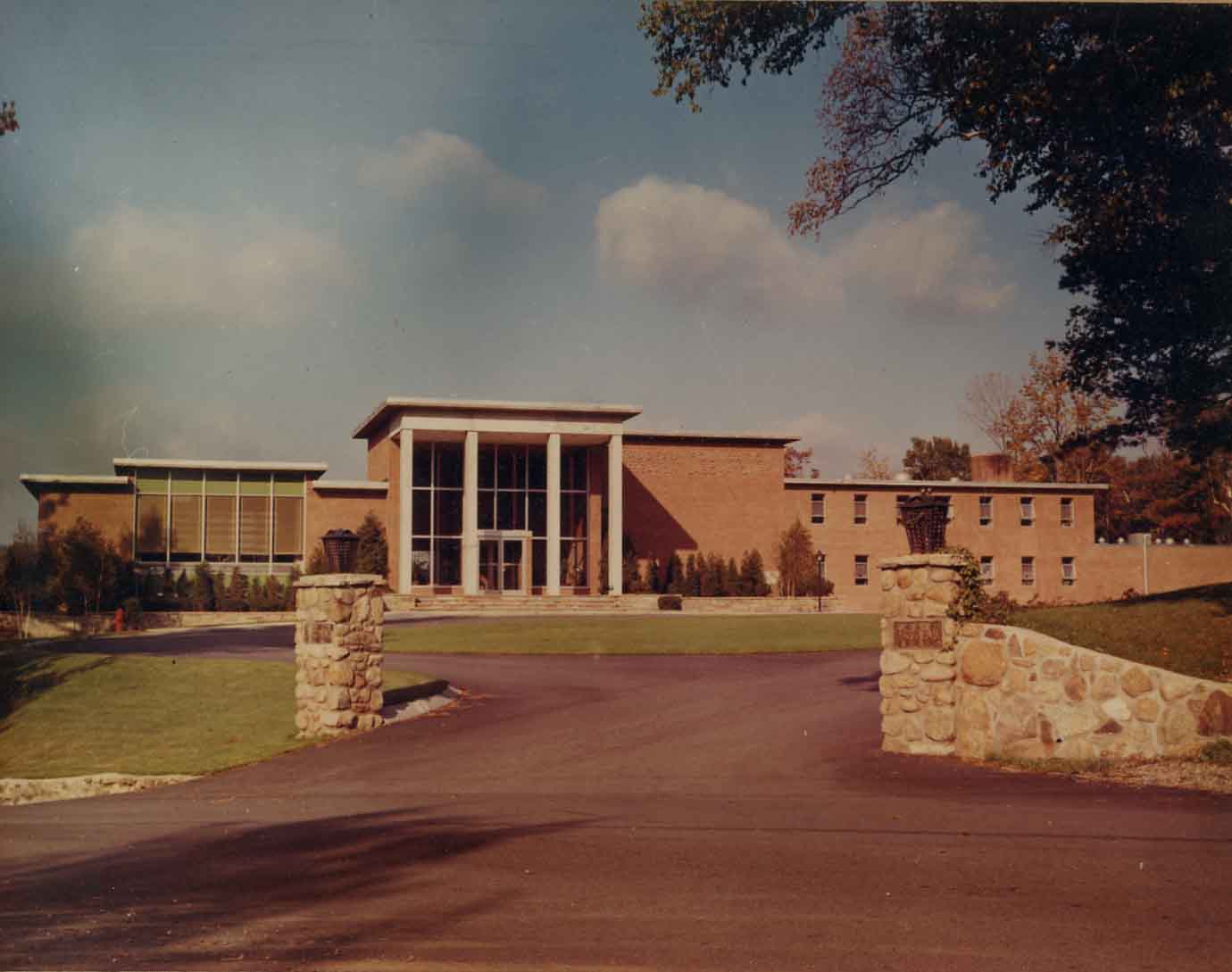
Photo: Trudeau Foundation Research Laboratory, Saranac Lake, NY. Distin and Wareham Architects, 1964. Collection of the Adirondack Museum.

Huntington Painting Returns to Historic Jay Estate

The Jay Heritage Center (JHC) celebrated the recent anniversary of John Jay’s birthday on December 12 with news of an extraordinary gift from one of his descendants. In celebration of the continued restoration of the 1838 Jay House in Rye, Ada Hastings of Great Barrington, Massachusetts and her family magnanimously donated a portrait of John Jay’s great granddaughter that once hung in the mansion’s Drawing Room. The luminescent painting of a young Alice Jay by pre-eminent artist Daniel Huntington is documented in sepia toned family photos from 1886- it is visible hanging in a prominent location next to two other famous artworks originally owned by the Jays of Rye: Gilbert Stuart’s portrait of John Jay (which today is on view at the National Gallery in Washington, D.C.) and Asher Durand’s depiction of Peter Augustus Jay (which belongs to New York Hospital where Peter Augustus Jay served as President of the Board.

The young subject of the painting, Alice Jay, along with her parents and siblings, lived both in New York and at the Rye estate during the mid and late 19th century. Windows into Alice’s life and times, particularly during the Civil War, are well documented in family letters and diaries. Alice’s father, Dr. John Clarkson Jay, was John Jay’s grandson and a vocal opponent of slavery like his grandfather and father before him. Through the local Episcopal church where he served on the vestry, he was instrumental in spearheading efforts in Rye to recruit volunteers for the Union efforts during the Civil War, a campaign which drew enlistments from Alice’s two older brothers, Peter, who became Captain of a local militia, and John, who served as an assistant surgeon. Alice’s sister kept a diary in which she wrote proudly in 1862, “Rye is called the banner town of the county for she has raised more men by volunteering than any of the other towns.”

The artist of the painting, New Yorker Daniel Huntington (1816 – 1906), trained with Jay family friends and esteemed colleagues like John Trumbull (who accompanied Jay as his secretary to Europe during treaty negotiations but also achieved renown as a painter, most notably for his grand scale Declaration of Independence now at the Capitol Rotunda) and Samuel F. B. Morse (whose successful career as an artist preceded his renown as an inventor and earned him the nickname of “America’s Da Vinci.”) Under the tutelage of men like these, Huntington rose to prominence both during and after the Civil War. He was a member of the National Academy of Design for most of his life and acted as its President for 22 years- he was also Vice-President of the Metropolitan Museum of Art for 33 years and helped that institution expand and grow in stature.

Perhaps Huntington’s most recognizable work, The Republican Court, was completed in 1861 at the start of one of our nation’s bloodiest engagements. His tableau harkened back to what was sentimentally remembered as a more harmonious time between the states &#8212- the initial founding of our union &#8211and it represented an idealized assembly of the leaders of that period (Northern and Southern) in a European, court like setting. The image prominently features John Jay and Sarah Livingston Jay and 62 other identifiable personages of the Revolutionary War. Huntington’s painting was reproduced in 1865 as a very popular engraving. The larger original oil painting is owned by the Brooklyn Museum of Art.

Winter hours for the Jay Heritage Center are Tuesday through Friday, 10am &#8211 5pm and by appointment. Please call (914) 698-9275 or contact JHC Program Director, Heather Craane at [email protected] to schedule group or school tours. The Jay Heritage Center’s Exhibit commemorating the 150th Anniversary of the Civil War, “The Jays and the Abolition of Slavery: From Manumission to Emancipation” will open in May 2011.

John Jay’s home in Rye is a National Historic Landmark and a designated site of the Hudson River Valley National Heritage Area selected for its themes of Environment, Landscape and Gardens, Architecture and Freedom and Dignity. It is one of 13 sites on Westchester County’s African American Heritage Trail.

Illustrations: Above, &#8220The Republican Court&#8221 by Daniel Huntington (1861, Brooklyn Museum of Art). John Jay is depicted in the crimson robe on the far left and Sarah Livingston Jay is opposite him in white in the right foreground. An engraving based on this painting was recently donated to the Jay Heritage Center. Middle, &#8220Alice Jay&#8221 by Daniel Huntington- Below, an 1886 photograph of the Jay Drawing Room. Gilbert Stuart’s portrait of Jay is on the left of the mirror and Asher Durand’s portrait of Jay’s eldest son Peter is on the right.

Saratoga Battlefields 16th Annual Frost Faire

The 16th annual Frost Faire will be held from 10:30am to 3pm on Saturday, January 22 at Saratoga National Historical Park, located on Routes 4 and 32 in Stillwater. Bring your snow tube for rides on the “Big Hill” (only snow tubes allowed- no sleds or toboggans) and enjoy horse-drawn carriage rides, winter nature treks, Contra Dancing, special exhibits, games (including Giant Soldier Puzzle, Ice Bowling and Bottle Fishing), plus cocoa and cookies by the bonfire. The event is free.

Popular in the 1700s, a “Frost Faire” eased the effects of “cabin fever” with opportunities to visit friends and enjoy winter activities, refreshments and entertainment.

Ongoing activities in the Visitor Center include contradancing, colonial
handwriting demonstration, children’s craft room including decorative tin piercing
and copper embossing, Stillwater town historian’s exhibit.

Cannon firing demonstrations are scheduled for 10 AM, 11 AM, 12
noon, 1 PM, 2 PM, and 3 PM- musket firing demonstrations at 10:30 AM, 11:30
AM, 12:30 AM, 1:30 PM, and 2:30 PM.

This event is sponsored by the Town of Stillwater and Saratoga National Historical Park. For more information on this or other events at Saratoga National Historical Park, please call the Visitor Center at 518-664-9821 ext. 224 or check their website at www.nps.gov/sara.

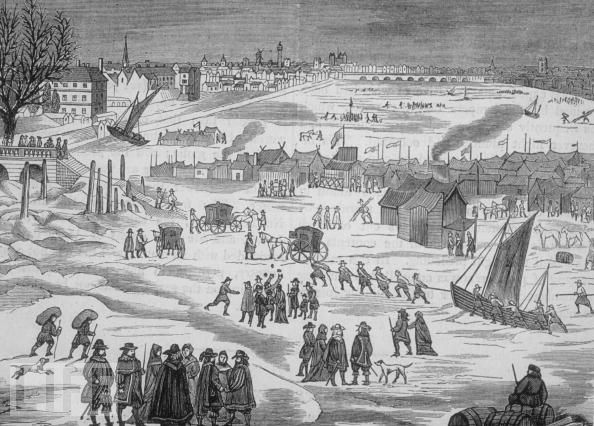
Illustration: Frost Fair on the frozen Thames River, engraving from Old and New London: The City Ancient and Modern by Walter Thornbury, 1897.

University Courts Online History Audience

Historians at The University of Texas at Austin have introduced what they are decribing as a &#8220first-of-its-kind Web site to help the public learn more about Texas, American and world history.&#8221

Developed by the History Department, &#8220Not Even Past&#8221 is expected to showcase new articles each month from history professors writing about the time periods and areas of history they study. The inaugural article by Professor Jacqueline Jones focuses on life in Savannah, Ga. during the Civil War.

The site is also expected to include book recommendations, movie clips and podcasts, links to historical documents and artifacts, virtual courses, a daily &#8216-fact checker’ designed to &#8220debunk historical myths.&#8221

&#8220&#8216-Not Even Past’ is our effort to offer history to a wider audience. All of our former students and literally anyone interested in history will find something interesting on our site,&#8221 says Professor Joan Neuberger, who studies Russian history.

Visitors to &#8220Not Even Past&#8221 will be able to take the virtual courses beginning this semester with Pulitzer Prize finalist H.W. Brands, who will offer a course on American leaders- Charters Wynn, who will offer a course on World War II on the Eastern Front- and Frank Guridy, who will offer a course on Cuban-U.S. relations. Each professor will assign three great books to their virtual students and lead a live chat devoted to each book during the semester.

&#8220The students will have the chance to do some great reading with award-winning teachers who are experts in their fields — with no tests,&#8221 says Neuberger. &#8220At the end of each semester, they’ll be honored at commencement with virtual certificates.&#8221

The Web site draws its name from American novelist William Faulkner, who once said, &#8220The past is never dead. It’s not even past.&#8221 Professors and graduate students in the university’s History Department developed the site and will produce most of its content.

&#8220During these difficult budget times, we have developed and plan to maintain this Web site with our existing resources thanks to the hard work of our professors and students,&#8221 says History Department Chair Alan Tully, a scholar in early American political culture. &#8220No other university is doing anything like this. We view it as a way to connect the acumen of our History Department faculty with the inquisitiveness of historically minded members of the general public.&#8221

Public Input Sought for Bridge Reopening Celebration

The Lake Champlain Bridge Coalition has announced the formation of the Lake Champlain Bridge Community (LCB Community). The New York State Department of Transportation (NYSDOT) has entrusted the Coalition and LCB Community to create, plan and lead the public festivities that will celebrate the replacement and re-opening of the Lake Champlain Bridge. The celebration will also showcase the reunited regional communities of Addison, Vt. and Crown Point, N.Y.

The LCB Community will hold a public meeting on Monday, January 24, 2011 at 6:00 p.m. at the Crown Point Historic Site Museum. The purpose of the public meeting is to encourage area residents, business owners, and other stakeholders to join the LCB Community and become involved in the celebration planning by serving on a committee, volunteering time or offering ideas. If anyone is unable to attend this meeting, they are still welcome to join the LCB Community or offer their ideas for the event. The committees will plan and organize a proposed two-day event and coordinate fundraising and marketing of the celebration.

“When NYSDOT entrusted the planning of this historic event to us, they emphasized that this should be a ‘grassroots’ celebration,” said Karen Hennessey, co-chair of the LCB Community and owner of Sugar Hill Manor B&B, Crown Point, NY. “That’s why it’s so important for us to reach out to community members and gather input as to what shape and form these celebration activities should take. We welcome everyone’s input—whether or not you can be at the meeting on January 24th.”

The date of the bridge re-opening is yet to be announced by New York’s and Vermont’s transportation departments and Flatiron Construction, the firm constructing the new bridge. Early indications suggest the re-opening will be in early- to mid-October 2011.

“The 1929 celebration of the first Lake Champlain Bridge has been the inspiration and guiding force for this upcoming event,” said Lorraine Franklin, co-chair of the LCB Community and owner of West Addison General Store. “Forty thousand people attended the opening in 1929, and we hope our event will far surpass that landmark celebration. This will be our celebration, and we all look forward to the day the second Lake Champlain Bridge is open.”

Members of the Lake Champlain Bridge Community include area residents, representatives from local business, historical sites, local governments, and chambers of commerce.