This Weeks Top New York History News

Each Friday morning New York History compiles for our readers the previous week’s top stories about New York’s state and local history. You can find all our weekly news round-ups here.

Subscribe! More than 3,200 people get New York History each day via E-mail, RSS, or Twitter or Facebook updates.

This Weeks New York History Web Highlights

Each Friday morning New York History compiles for our readers the previous week’s top stories about New York’s state and local history. You can find all our weekly news round-ups here.

Subscribe! More than 3,200 people get New York History each day via E-mail, RSS, or Twitter or Facebook updates.

Path Through History: An Historical Perspective

The Path though History project does not operate on a tabula rasa. When Henry Hudson arrived, there were no signs to guide him. Today there are more signs then one can count. For Path through History the challenge is not to create ex nihilo but to create order out of chaos. Read more

1812: The War That Should Not Have Been

Bob Wells speaks on &#8220The War That Should Not Have Been&#8221 as part of the War of 1812 Lecture Series on Monday, September 17, 7 p.m. at the St. Lawrence County Historical Association at the Silas Wright House, 3 East Main St., Canton.

The United States of America, a young nation with a scattered peacetime army of only 12,000 regulars and a comparatively small navy did not let these facts stand in the way of going to war with England in June of 1812. But did the War of 1812 have to happen?

In his program &#8220The War That Should Not Have Been,&#8221 Bob Wells will discuss reasons why the war was not inevitable or even particularly popular in New England and Northern New York, including St. Lawrence County. U.S. Justifications for the war, such as the annexation of Canada, the need to quell the hostile Native American tribes supposedly armed by the British, and the need to end the English naval practice of impressments of U.S. sailors could have all been handled differently. Another reason cited for war with England was the U.S. desire to be free to trade with France without the English blockading harbors or seizing merchant ships coming from French ports. This issue was actually settled in favor of the United States just prior to the beginning of the war.

The program will be presented by Bob Wells, who serves on the SLCHA’s War of 1812 Bicentennial Committee and Civil War Sesquicentennial Commission. He is an active member of the association’s Civil War Roundtable. Wells is a former Mayor of the Village of Canton and was a professor for over 34 years at St. Lawrence University. He retired from full-time teaching in 1999 as the emeritus Munsil Professor of Government.

This War of 1812 program is part of the St. Lawrence County Historical Association’s Commemoration of the 200th anniversary of the War of 1812, which was fought from 1812-1815. St. Lawrence County was one of the battlefields of the War of 1812. 

The SLCHA Gift Shop is a great way to learn about the War of 1812. Books include Major Battles of the War of 1812 and Famous People of the War of 1812. SLCHA members receive a 10% discount on these books and most other items in the gift shop.

The St. Lawrence County Historical Association at the Silas Wright House is open Tuesday through Saturday noon to 4 p.m., Friday noon to 8 p.m. Admission to the museum is free- admission to the archives is free for members and children, $2.50 for college students, and $5 for the general public. The St. Lawrence County Historical Association is located at 3 E. Main St., Canton. Parking is available in back of the SLCHA, next to the museum’s main entrance.

The St. Lawrence County Historical Association is a membership organization open to anyone interested in St. Lawrence County history. For more information, or to become a member, call the SLCHA at 315-386-8133 or e-mail [email protected]. Exhibits and programs are made possible in part with public funds from the New York State Council on the Arts, a state agency. Visit the SLCHA’s website, www.slcha.org, for more information on St. Lawrence County history

Illustration: Columbia Teaching John Bull his New Lesson from the Library of Congress by William Charles, 1813, a caricature presenting a U.S. view of the War of 1812. On the left, Columbia (the personification of the United States, holding a pole with a liberty cap on it, and with a stars-and-stripes shield behind her) says: ‘I tell you Johnny, you must learn to read Respect &#8212- Free Trade &#8212- Seaman’s Rights &c. &#8212- As for you, Mounseer Beau Napperty, when John gets his lesson by heart, I’ll teach you Respect, Retribution, &c &c.’ In the middle, a short-statured Napoleon says: ‘Ha Ha &#8212- Begar, me be glad to see Madam Columbia angry with dat dere John Bull &#8212- But me no learn respect &#8212- me no learn retribution &#8212- Me be de grand Emperor.’ On the right, John Bull says: ‘I don’t like that lesson, I’ll read this pretty lesson’ (holding a book with ‘Power constitutes Right’, i.e. ‘might makes right’).”
 

More Hudson River Ramble September Weekends

The 2012 Hudson River Valley Ramble continues for the weekends of September 15-16, 22-23, and 29-30, 2012. More than 170 events will be held from the Capital District to New York City.

The Ramble brings people outside to enjoy our distinct cultural heritage and the natural beauty of the Hudson River Valley. It also serves as an economic boost for our region’s tourism. Nearly 150 environmental, land conservancy, trail and historic preservation organizations, State historic sites and parks, as well as the National Park Service participate by offering events. Many events are free of charge and family friendly. Guided hikes, cycling and kayaking tours, historic site walks, festivals and river explorations are examples of some of the types of events that will be available for every ability level. With all that the Ramble has to offer, it’s easy to find a Ramble adventure nearby.

Read more

Fenimore Lunch Lecture Series Spotlights New Exhibits

Food for Thought, the popular lunch-and-lecture series at the Fenimore Art Museum, offers an in-depth understanding of the museum’s new exhibitions, including Tasha Tudor, G.C. Myers, and New York in the Civil War.

All Food for Thought programs are held on Wednesday from 12:30-2:30 pm at the Fenimore Art Museum. The museum offers two discounts: NYSHA members receive $5 off. Register for three or more Food for Thought programs at once, receive $2 off.
September 12: In Plain Sight: Hidden Gems of Native American Open Storage

Join Eva Fognell, Thaw Collection Curator, as she offers a behind-the-scenes look at the museum’s Study Center, which houses open storage of the Thaw Collection of American Indian Art. Appreciate the extraordinary range of art produced by North America’s first artists, including ritual objects, ceremonial clothing, pottery, and basketry.

September 19: Artist and Visionary: William Matthew Prior Revealed

Learn about America’s most prominent folk artist as Paul D’Ambrosio, President and CEO, explores the William Matthew Prior exhibition (on display through December 31).

October 10: On the Home Front: New York in the Civil War

Join John Hart, Assistant Curator of Collections, as he shares Civil War artifacts from the On the Home Front exhibition. Objects tell us so much about the past and the history of those who made and used them. Learn about New York State and its place in the American Civil War through lively discussion.

October 17: Tasha Tudor Around the Year

Come for a heart-warming discussion and tour of Tasha Tudor Around the Year, an exhibition from the Norman Rockwell Museum. This exhibition illuminates beloved author and illustrator Tasha Tudor and stirs the imagination through the artist’s iconic art and greeting cards. Co-curator Jeanette Chandler Knazek reflects on the changing seasons and special celebrations as depicted by Tudor.

October 24: Oral Histories of New York’s Farm Women

Professor William Walker of the Cooperstown Graduate Program plays excerpts from oralhistory interviews with women who have lived and worked on farms in central New York State. Using recordings available on the website CGP Community Stories, Dr. Walker leads a discussion of the varied experiences of women in the agricultural heartland of the state.

November 7: Internal Landscapes: The Paintings of G.C. Myers

Guest curator Gary C. Myers joins us in a discussion and tour of his contemporary exhibition, InternalLandscapes. Learn first-hand from the artist in this amazing exhibition of paintings that provide moments of stillness and encourage reflection and a renewed sense of purpose.

November 14: Flags, Uniforms, and Insignia: New York State Material Culture of the Civil War
Ted Shuart, printing supervisor at The Farmers’ Museum and re-enactor with the 125th New York State Volunteer Infantry, discusses flags, uniforms and insignia of New York troops during the Civil War. Learn about New York State’s wartime history while looking at objects from the period and understand what they tell us about one of the most tumultuous times in American history.

Pricing Information: Lunch and lecture fee &#8211 $20 members/$25 non-members. Register for three or more Food for Thought programs at once and receive a discounted price of $18 members/$23 non-members per program. Call (607) 547-1461 with questions regarding pricing or the cancellation policy.

Auburn Prison, Gillette Case Documentary, Lecture

A North Woods Elegy: Incident at Big Moose Lake is a documentary feature film that explores one of the most famous American murder cases. Grace Brown, a pregnant young woman from upstate New York, was killed in the Adirondacks on July 11, 1906 [watch the trailer].

Her lover, Chester Gillette, was eventually tried and convicted of her murder. Gillette died in the Auburn Prison electric chair on March 30, 1908. The case became the basis for Theodore Dreiser’s 1925 novel, An American Tragedy.

A North Woods Elegy explores the fascination America had, and still has, with the case, encompassing issues of class, jurisprudence in America at the turn of the 20th century and ethics and sensationalism in news reporting.

The documentary film will be shown in Theater Mack at the Cayuga Museum, twice on Saturday, September 15, at 1:00 pm. and again at 4:00,. Derek Taylor, the film’s producer, director and editor, will answer questions after each screening.

At 3:00 p.m., there will be a lecture on “Gillette in Auburn” by Tompkins County Judge Jack Sherman, editor of The Prison Diaries and Letters of Chester Gillette. Gillette spent more than a year in Auburn Prison before his execution- his diary from that time is today in the collection of Hamilton College. Both the film screenings and the lecture are free and open to the public.

Touring Old Mine Road: The Esopus-Minisink Trail

The other day, driving home from Kingston, I could not help but notice the sea of New York State Education Department signs (NYSED) that lined the roadside. The blue and yellow plaques are designed to alert those passing by of significant historic events that had occurred somewhere in the vicinity of the signs. These signs made me think about when I lived in Boston and followed that city’s Freedom Trail. Read more

Encampment Marks Battles of Saratoga Anniversary

This Saturday and Sunday, September 15-16, Saratoga National Historical Park, located on Routes 32 and 4 in Stillwater, will present an 18th century living history encampment marking the 235th anniversary of the what’s been called the world’s “most important battle of the last 1,000 years.”  Camps will be open Saturday from 11:00 AM to 4:00 PM, and on Sunday from 11:00 AM to 3:00 PM.

This two-day encampment will surround visitors with the sights, smells, and sounds of military camp life from the American Revolution.

Dozens of re-enactors portray American and British officers, soldiers, cavalry troops, and camp followers from the Battles of Saratoga.  See cavalry charge, join in a court-martial and decide the soldier’s fate, take part in a musket drill, follow along with a scouting party, or listen to stories of the revolutionary war experience.  Feel the thunderous roar of cannons, smell the acrid smoke of musket fire as well as the welcoming wisps of camp cooking fires.

On Sunday, there will be a 2:00 PM Wreath Laying Ceremony by Sons of the American Revolution and Daughters of the American Revolution at Tour Road Stop 2.  The public is welcome to attend this commemorative wreath laying. The event is free, but the normal entrance fee to the park of $5 per car and $3 per hiker or cyclist (good for one week entry) is charged.  For more information about this or other events, please call the Visitor Center at 518-664-9821 ext.1777, check the park website at www.nps.gov/sara or follow them on Facebook at www.facebook.com/saratoganhp

North Countrys Union General H. Judson Kilpatrick

H. Judson Kilpatrick, a Union general during the Civil War, has been described as flamboyant, rash, and tempestuous. There’s no doubt that he was often a rogue officer, sometimes to disastrous effect. The South developed a deep hatred of him for the extreme methods he employed, but he was certainly part of the team effort that led to the North’s victory.

As every leader knew during the war, many levels of support were necessary in order to win. Despite being brash and confident in his abilities, Kilpatrick famously cited a North Country man, Captain John Viall, as critical to the general’s own success, and the Union’s as well.

John Greeley Viall, son of William and Mary Viall, was born in November 1829 in Westport, New York, on the western shore of Lake Champlain. In January 1852, when he was 22 years old, John left New York and settled in Texas. Nine months later, he purchased the San Antonio Tin, Copper, and Sheet Iron Ware Manufactory, which sold and/or fabricated stoves, cookware, water pipes, and just about anything made of metal.

Texas was still wild territory, having attained statehood just seven years earlier. Viall maintained contacts in Westport, and in a letter home in 1854, he described San Antonio as in “a state of intense excitement.” Several families had been killed by Indians, while others were scalped and left for dead in disputes along the state’s border. Viall had chosen a tough place to make a living.

In 1858, six years after he purchased the metal manufactory, the business failed. Viall returned to the North Country, where he became involved in politics. That same year, he was among the delegates to the convention in Springfield, Illinois, where Abraham Lincoln was nominated to succeed Stephen Douglass in the US Senate.

On September 17, 1861, several months after the outbreak of hostilities between North and South, Viall enlisted at Crown Point. For three years following induction, he served as a private, second lieutenant, first lieutenant, and captain of Company H, Fifth New York Cavalry.

From that point (July 1864) forward, John served as captain and assistant quartermaster of volunteers until his honorable discharge in November 1865. Those final 16 months of service prompted General Kilpatrick to offer high praise for Quartermaster Viall, a man burdened with tremendous responsibility.

The duties of the quartermaster were remarkably varied, deeply complex, and absolutely critical to victory. The Quartermaster Review of 1928 noted that the success of all military operations relied on the promptness and efficiency of the quartermaster.

That may sound like an exaggerated assessment of any position, but consider the Review’s description of what the job entailed during the Civil War.

“The quartermaster’s department is charged with the duty of providing the means of transportation by land and water for all the troops and all the material of war. It furnishes the horses for artillery and cavalry- supplies tents, garrison equippage, forage, lumber, and all materials for camps- builds barracks, hospitals, wagons, and ambulances- provides harness, except for artillery horses- builds or charters ships and steamers, docks and wharves- constructs or repairs roads, bridges, and railroads- clothes the army- and is charged generally with the payment of all expenses attending military operations which are not expressly assigned by law or regulation to some other department.

“… wagonmasters, agents, teamsters, scouts, and spies, all … come under the supervision and pay of the quartermaster. He must … anticipate every want of the army.

“The quartermaster … builds the warehouses at every post- repairs, refits, and furnishes all houses and offices for army use- provides all hardware and building material (nails, glass, rope, etc.) and all the machinery used- fits up hospitals for the sick- and furnishes coffins for the dead.

“He pays the mileage of officers- expenses of courts-martial, per-diem of extra-duty men- postage on public service- expenses incurred in pursuing and apprehending deserters- burials of officers and soldiers, interpreters, veterinary surgeons, clerks, mechanics, laborers, and cooks.”
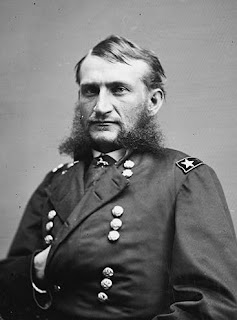
For General H. Judson Kilpatrick, one of the roughest, gruffest, most controversial men in the Union army, Viall provided those services better than any of the hundreds of men who undertook them for the Union cause. The general bestowed lasting glory on him with the oft-quoted pronouncement: “John Viall is the best quartermaster in the Army of the Potomac.”

Quartermaster General Montgomery Meigs, the top man in the department, urged Viall to remain in the army at war’s end (ill health forced him to leave the service). Meigs himself was cited as indispensable to the Union cause by Secretary of State Seward. Clearly, Meigs’ assessment of Viall’s value was the highest of commendations.

Though working as quartermaster was the hallmark of his career, Viall did much more on the Union’s behalf, complementing a family history of stellar military service. His grandfather had fought in the Revolutionary War, “from Bunker Hill to Yorktown,” and his father had served in the War of 1812.

Impressive, for sure, but Viall’s own field experience took a back seat to none. He fought in the battles of Fredericksburg, Second Bull Run, Gettysburg, Appomattox Court House, Richmond, and dozens of others.

Throughout the remainder of his life, Viall consistently supported the military, though he struggled for reciprocation from the government. His health had suffered badly from the war, and when the military pension program was instituted in 1890, Viall began receiving $12 per month (equal to $300 in 2012).

A request for increased benefits due to stomach, kidney, and liver problems was rejected in 1892 (he was 63 at the time). Another rejection followed in 1900, even though a board of surgeons found him “totally disabled by reason of indigestion, enlarged prostate, and age.”

Finally, in 1907, the House of Representatives looked at Viall’s entire record from the Civil War. His great service was noted, leading up to a physical breakdown “from exposure and hardships in the West Virginia campaign.” Upon recovery, he had been “promoted to division quartermaster, and at the close of the war was acting quartermaster for the cavalry corps.” In retrospect, it was recognized that his efforts for the Union cause had been truly heroic.

A physician’s affidavit informed lawmakers of Viall’s current condition: “… the beneficiary is totally unable to perform any kind of manual or clerical labor due to general physical and mental debility, imperfect heart action, and senile decay.

“Other proof filed shows that the officer, owing to unfortunate financial ruin, has now nothing to live upon except the small pension of $12 per month, which is totally inadequate to maintain him. In consideration of the officer’s meritorious services for the period of four years, his great age, total inability to labor, and destitution, an increase of his pension to $24 per month is believed to be warranted.”

By an official Act of Congress on February 25, 1907, his pension was increased to $24 (equal to $575 per month in 2011).

Six years later, on September 1, 1913, John Greeley Viall—Westport nat
ive, loyal soldier, and among the best supply men to support the Union troops—died in Washington at the age of 85. He was buried in Arlington National Cemetery with full military honors.

Photos:  Captain’s medal of John Greeley Viall- Major General H. Judson Kilpatrick.Lawrence Gooley has authored 11 books and dozens of articles on the North Country’s past. He and his partner, Jill McKee, founded Bloated Toe Enterprises in 2004. Expanding their services in 2008, they have produced 24 titles to date, and are now offering web design. For information on book publishing, visit Bloated Toe Publishing.
