Richard Ketchum, 89, American Revolution Author

Richard M. Ketchum, an author and editor who writings include Saratoga: Turning Point of America’s Revolutionary War and Divided Loyalties : How the American Revolution Came to New York, died on January 12 at a retirement home in Shelburne, Vermont. He was 89 and until four years ago had lived on his nearly 1,000-acre farm, Saddleback, in Dorset, VT.

Author David McCullough describes “like Shelby Foote unfolding the drama of the Civil War, Richard M. Ketchum writes of the Revolution as if he had been there . . . No novelist could create characters more memorable than the protagonists on both the American and British sides”

I had the pleasure of meeting Mr Ketchum, ten years ago in Olympia Hall in Schuylerville. He volunteered to speak one night as one of the activities commemorating the 225th Anniversary of the Battles of Saratoga. He and his wife were very generous with their time. He mentioned that night that there were others in the room that knew more about the Battles. I remember thinking then that they may be knowledgeable, however there is not a better writer and storyteller of this history than Richard Ketchum. I know that my community and all those with an interest in the American Revolution will be forever grateful for the writing of Richard Ketchum.

To learn more about Richard Ketchum visit this The NewsHour with Jim Lehrer Transcript

A full obituary can be read in the New York Times.

Sean Kelleher is the Historian for the Town of Saratoga and Village of Victory in the Upper Hudson Valley. He has a particular interest in colonial history, being active as a reenactor for 34 years and has served as a Commissioner on the New York State French and Indian War 250th Anniversary Commemoration Commission.

Fort Ti Material Culture Seminar This Weekend

Fort Ticonderoga will host its Second Annual “Material Matters: It’s in the Details” Seminar the weekend of January 28 & 29, 2012. This weekend event focuses on the material culture of the 18th century and is intended for collectors, re-enactors, and people with a general interest in learning more about objects of the 18th century and what they can tell us about history. “Material Matters” takes place in the Deborah Clarke Mars Education Center at Fort Ticonderoga and is open by pre-registration only.

A panel of material culture experts from the United States and Canada come to Fort Ticonderoga for the weekend to share their knowledge of 18th-century material culture in a series of presentations. Designed for those who want a deeper understanding of the everyday objects that help tell the story of life and the contests for control of North America during the 18th century, the weekend’s informal approach enables attendees to interact with presenters and provides an opportunity to examine 18th-century objects up close.

Fort Ticonderoga’s Curator of Collections Chris Fox will discuss the archeological remains of clothing and sewing-related artifacts in the Fort’s collection found during the Fort’s restoration in the early 20th century.

Joel Anderson, Artificer Program Supervisor at Fort Ticonderoga, will discuss the challenges of supplying the Northern Department of the Continental Army during the year 1776.

Matthew Keagle, a scholar of 18th-century Atlantic material culture, will talk about grenadier caps used by various 18th-century armies and their cultural significance.

David Ledoyen, a heritage presentation coordinator from Montreal, will explore 18th-century surgeons’ instruments and the evolution of surgeons as a profession in New France.

Stuart Lilie, Director of Interpretation at Fort Ticonderoga, will discuss equestrian saddlery and horse furniture. Lilie is a saddler specializing in 18th- and early 19th-century saddlery.

Sarah Woodyard, an apprentice in millinery at Colonial Williamsburg, will talk about 18th-century undergarments.

Registration for “Material Matters” is now open. A brochure with the complete schedule and a registration form is available on Fort Ticonderoga’s website by selecting “Explore and Learn” and choosing “Life Long Learning” on the drop-down menu. A printed copy is also available upon request by contacting Rich Strum, Director of Education, at 518-585-6370. The cost for the weekend is $120 ($100 for members of the Friends of Fort Ticonderoga).

Photo: Speaker Henry Cooke (left) and Curator of Collections Chris Fox (right) examine an original 18th-century coat during a “Material Matters” session last winter.

Stoddard Views Coming to Chapman Museum

Long considered beautiful photographs of the Adirondack landscape, Seneca Ray Stoddard’s views also serve well as documents of the plants that inhabited the region in the 19th century. The Chapman Historical Museum’s summer exhibit, S.R. Stoddard’s Natural Views, which will run from May 4 through September 2, will feature fifty enlarged photographs of different Adirondack settings – lake shores, marshes, meadows, riverbanks and mountainsides. Highlighted in modern color images will be examples of the plants discovered in Stoddard’s photographs &#8212- from small flowers to shrubs and trees.

Since he was rediscovered in the late 1970s, Stoddard’s work has been featured in numerous exhibits that explored the history of 19th century life in the Adirondacks. A survey of the 3000 images in the Chapman archives, however, revealed hundreds of images that are purely natural landscapes. The subject matter is the Adirondack environment – not great hotels, steamers, camp scenes or other obvious evidence of human activity.

The summer 2012 exhibit will examine these photographs as documents of the history of ecological habitats, providing an opportunity to compare the present environment with the past. To address this issue the museum is consulting with Paul Smith’s College biologist, Daun Reuter, who will identify botanical species in Stoddard’s photographs, and exploring 19th century biological fieldwork records housed at the New York State Museum.

By bringing attention to a group of Stoddard photographs that have been overlooked but are significant examples of his work, the exhibit will give visitors the opportunity to discover and reflect on the changing environment – a topic of urgent concern in the region. Through their experience visitors will gain greater understanding not only to Stoddard’s photographic vision but also of the natural world of the Adirondacks.

Photos: Above, Silver Cascade, Elizabethtown by S.R. Stoddard, ca. 1890. Below: modern color photo of Wild Raisin by Dawn Reuter, Biology Dept., Paul Smith’s College.

Frick Collection Director Charles Ryskamp’s Bequest

Over the course of fifty years-from the 1950s until his death in 2010 at the age of eighty-one-former Frick Collection Director Charles A. Ryskamp (1928-2010) assembled an extraordinary personal trove of European drawings. Reflecting on his pursuits in 2009, Dr. Ryskamp remarked, &#8220I have always believed that giving, as much as acquiring, is the principle of my collecting.&#8221

This spirit of sharing is embodied in a group of ten superb drawings that he bequeathed to the Frick, selected from among his large and varied collection by Anne L. Poulet, Director Emerita, and curators Colin B. Bailey and Susan Grace Galassi.

Other sheets were donated to The Morgan Library & Museum, where Dr. Ryskamp served as Director from 1969 to 1987, or auctioned at Sotheby’s for the benefit of Princeton University, where he began his career as a professor of literature. The works bequeathed to the Frick enlarged the museum’s holdings in drawings them by nearly a third, while complementing the permanent collection’s focus on landscape and figural subjects.

This winter and spring the Frick celebrates Charles Ryskamp’s generosity-and discerning taste-with an exhibition of the works from his bequest. The drawings, which have never before been shown at the Frick, will be presented in the Cabinet, a space created by Dr. Ryskamp during his tenure as Director from 1987 to 1997 and intended especially for the display of works on paper. The installation is accompanied by two oil-on-paper studies of clouds by John Constable, which Dr. Ryskamp was instrumental in bringing to the Collection. A Passion for Drawings: Charles Ryskamp’s Bequest to The Frick Collection wasorganized by Katie L. Steiner and Nicholas Wise, Curatorial Assistants, The Frick Collection.

Illustration: Pierre-Joseph Redoute (1759-1840), Plum Branches Intertwined, 1802-4, watercolor on vellum, 31.9 x 26.3 cm, The Frick Collection, bequest of Charles A. Ryskamp, 2010- Photo: Michael Bodycomb.

American Loyalists in the Revolutionary World

On November 25, 1783, the last British troops pulled out of New York City, bringing the American Revolution to an end. Patriots celebrated their departure and the confirmation of U.S. independence. But for tens of thousands of American loyalists, the British evacuation spelled worry, not jubilation. What would happen to them in the new United States? Would they and their families be safe?

Facing grave doubts about their futures, some sixty thousand loyalists—one in forty members of the American population—decided to leave their homes and become refugees elsewhere in the British Empire. They sailed for Britain, for Canada, for Jamaica, and for the Bahamas- some ventured as far as Sierra Leone and India. Award-winning historian Maya Jasanoff’s new book Liberty’s Exiles: American Loyalists in the Revolutionary World (Knopf, 2011), chronicles their stories.

Jasanoff re-creates the journeys of ordinary individuals whose lives were overturned by extraordinary events. She tells of refugees like Elizabeth Johnston, a young mother from Georgia, who spent nearly thirty years as a migrant, searching for a home in Britain, Jamaica, and Canada. And of David George, a black preacher born into slavery, who found freedom and faith in the British Empire, and eventually led his followers to seek a new Jerusalem in Sierra Leone.

Mohawk leader Joseph Brant resettled his people under British protection in Ontario, while the adventurer William Augustus Bowles tried to shape a loyalist Creek state in Florida. For all these people and more, it was the British Empire—not the United States—that held the promise of “life, liberty, and the pursuit of happiness.” Yet as they dispersed across the empire, the loyalists also carried things from their former homes, revealing an enduring American influence on the wider British world.

Note: Books noticed on this site have been provided by the publishers. Purchases made through this Amazon link help support this site.

This Weeks Top New York History News

  • Etta James, Dies at 73
  • NYPL Announces Freedom of Information Day
  • Andrew Cuomo to be Subject of Biography
  • NYC Historic Designation Won’t Stop Project
  • Fort Ticonderoga Receives Award
  • Book Features SUNY’s Oldest Campus
  • 2012 Another Tight Year for SUNY
  • Each Friday morning New York History compiles for our readers the previous week’s top stories about New York’s state and local history. You can find all our weekly news round-ups here.

    Subscribe! More than 2,300 people get New York History each day via E-mail, RSS, or Twitter or Facebook updates.

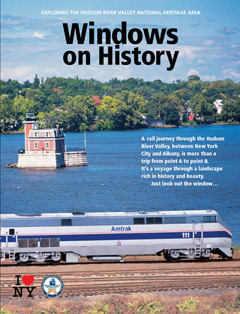
    National Park Service Recruiting Amtrak Guides

    The National Park Service will hold a volunteer recruiting session on Saturday February 4 at 1pm in the Erie Canalway/Peebles Island Visitor Center at 1 Delaware, Avenue, Cohoes or on Sunday February 26 at 1pm at Roosevelt-Vanderbilt National Historic Sites at 4097 Albany Post Road in Hyde Park.

    Volunteers are provided uniforms and training on the history of the area, then are scheduled aboard the Adirondack or Maple Leaf trains to present various educational programs about the significant examples of the natural, cultural, and historical resources of each route.

    Three national parks represented along the train routes are Roosevelt-Vanderbilt National Historic Sites, Saratoga National Historical Park (the Battlefield) and Erie Canalway National Heritage Corridor.

    Email or call Volunteer Manager, Joe LaLumia at [email protected] (518) 573-8628 to reserve your seat and learn more about this exciting volunteer opportunity. Visit the National Park Service Trails and Rails website.

    Students Write About Place, Win Class Trips

    Teaching the Hudson Valley (THV) has announced the winners of its first student writing contest. Three winning writers and their classmates will visit the places they wrote about with costs covered by a THV Explore Award.

    Aayushi Jha, a fifth grader at Main Street School in Irvington, is the elementary school winner. Her essay, Tug of War, describes an experience aboard the Hudson River Sloop Clearwater. Aayushi’s teacher, Susan Wallace, responded to the announcement with this note, “WOW! We are so THRILLED! Thank you so much for offering this opportunity to the future
    environmentalists and writers of the world!” You can read Aayushi’s essay online.

    “Climbing up Bonticou Crag, I split open the wilderness,” is the provocative opening line of Looking Topside Down, a poem about the Mohonk Preserve by high school winner Nicole Yang. The middle school winner is seventh grader Emilie Hostetter who wrote a poem about Minnewaska State Park called I Did Not Know. Nicole and Emilie are students of Janine Guadagno at Tabernacle Christian Academy in Poughkeepsie. You can read both poems here.

    “We received many wonderful and inspiring pieces of writing,” said THV coordinator Debi Duke. “Although we could have only three winners, we’re looking forward to publishing more student writers throughout the winter and spring. Essays about Eleanor Roosevelt’s Val kill in Hyde Park, the replica of Henry Hudson’s Half Moon, and Muscoot Farm in Westchester County
    are among those readers can watch for.”

    This Weeks New York History Web Highlights

    Each Friday afternoon New York History compiles for our readers the previous week’s top weblinks about New York’s state and local history. You can find all our weekly round-ups here.

    Subscribe! More than 2,300 people get New York History each day via E-Mail, RSS, or Twitter or Facebook updates.

    Mabee Farm to Host 1700s Colonial Festival Dinner

    The Mabee Farm’s in Rotterdam Junction will play host to prominent 18th century citizens of the Schenectady area during a Colonial Festival Dinner, the featured event of the Schenectady Heritage Area’s Annual Schenectady Colonial Festival.

    Participants are likely to meet General Schuyler, soldiers on campaign, a Sachem of the Mohawk Wolf Clan, merchants or land speculators working for the Western Inland Lock Navigation Company, and several members of the Mabee Family and their household. Part of the Mabee’s farm in Rotterdam Junction, the inn was frequented by military leaders, Native American traders, bateau men and many others traveling the Mohawk River. Read more