- Big Jump in Attendance at NYS Parks
- DEC Celebrates 40 years
- W Train Makes It’s Last Stop
- House Panel Holds Archives Hearing
- NEH Announces $20 Million in Grants, Awards
- Netherlands: 51 Horse Skeletons Unearthed
- Costs Rise As US Capitol Crumbles
- Weeds Choke Old Erie Canal
- 4,600-Year-Old Burial Found in Ontario
- Rutland: 7,000 Year-Old Artifacts Found
Year: 2010
NY Parks, Historic Site Attendance Soars
 The State Office of Parks, Recreation and Historic Preservation Commissioner Carol Ash has announced an increase in park attendance. According to Ash, state parks attendance has increased by 1.3 million visitors, up 11 percent from last year, while July 4th holiday weekend camping reservations reflect 90 percent occupancy. Additionally, sales of the park system’s $65 annual pass, the Empire Passport, increased statewide 1.5 percent over 2009 numbers, with more than 40,000 passes sold this year.
Ash also introduced a new summer campaign to encourage New Yorkers to visit and support state parks and historic sites. The statewide Find Your Fun social network and web-based initiative will run through September and utilize the agency’s website (www.nysparks.com) as well as Facebook and Twitter.
Regular updates and highlights will be provided about summer-related Find Your Fun suggestions and activities going on at state parks and sites to engage visitors. Park staff will offer an insider’s look at popular spots, hidden gems and interesting facts, and visitors will be encouraged to share photos, recipes, and favorites, while programs, activities and trip suggestions will also be promoted.
Ash is also encouraging New Yorkers support parks and historic sites by joining Friends Groups, volunteering at parks or making financial donations to the park through the agency website.
Last year, the state park system recorded nearly 56 million visits. The New York State Office of Parks, Recreation and Historic Preservation oversees 178 state parks and 35 historic sites. For more information on any of these recreation areas, call 518-474-0456 or visit www.nysparks.com.
This Weeks New York History Web Highlights
- ADE: Garry Trudeau Talks About Saranac Lake
- Irish Times: Nazi’s Planned to Invade Ireland
- NY Times: John Updike’s Archive
- David Livingstone’s ‘-Lost Letter’ Deciphered
- American Folk Art: Girl With A Squirrel
- Flickr: Adirondack Museum’s Photostream
- NYCO’s Blog: History as Voodoo
- Peeling Back the Bark: Tree Farm Records
- Lost City: Times Square’s Rum House to Close
- Franklin County Historian: 1934 Earthquake
Intern Wins McHenry Preservation Award
 The Open Space Institute has announced that this year’s Barnabas McHenry Award for Historic Preservation has been given to Matthew Colon of Newburgh for a project that will digitize and catalogue the entire slide collection of the nation’s first publicly-owned and operated historic site, Washington’s Headquarters.
The Friends of the State Historic Site of the Hudson Highlands, an ancillary group to Washington’s Headquarters State Historic Site, nominated volunteer intern Matthew Colon in recognition of his outstanding performance this past year ensuring that the Washington’s Headquarters library and archives will be useful to the staff and the public. Matt honed his archivist skills while a student at SUNY Oswego, as well as from related professional development classes. The McHenry Award will support Matt’s next project: to properly accession important images previously available only through outdated equipment and make them accessible for a myriad of uses now and in the future.
In 2007, the Open Space Institute created the The Barnabas McHenry Hudson River Valley Awards to honor Barney McHenry’s extensive leadership, contributions, and accomplishments in the Hudson River Valley. For the past forty years, McHenry has worked to protect the Hudson River Valley’s landscapes, heritage, and culture. He demonstrates his commitment to the region as a Member and Secretary of the Palisades Interstate Park Commission, Chair of the Hudson River Valley Greenway Communities Council, Co-Chair of the Hudson River Valley Natural Heritage Area, President of Boscobel, and Trustee of both Friends of the Hudson Valley and the Open Space Institute.
The McHenry Awards provide financial support to the “pairing” of young leaders and exemplary projects that make significant contributions in environmental conservation, historic preservation and the arts in the Hudson River Valley.
Abenaki Focus of Vermont July 4th Event
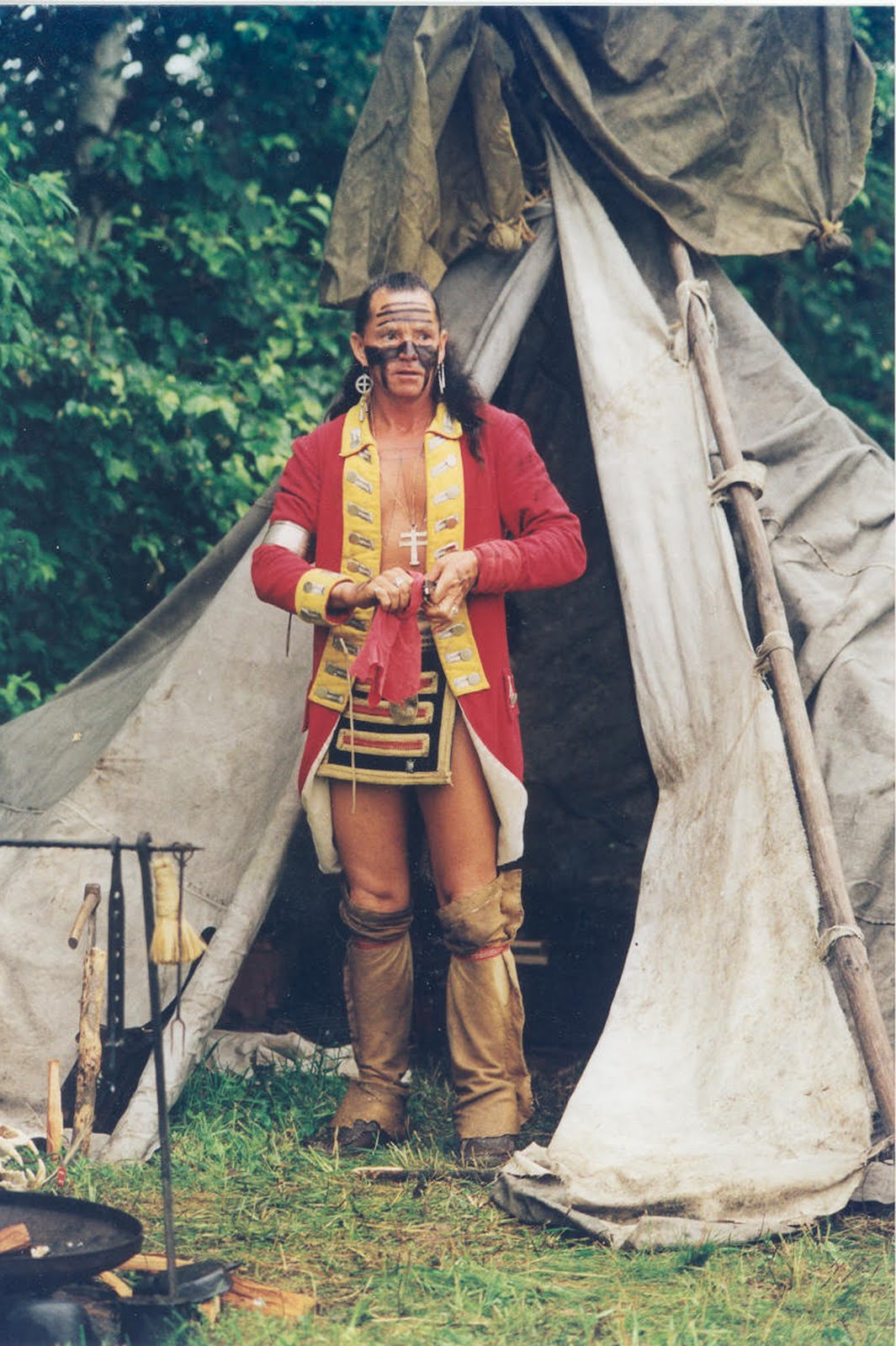 On the anniversary of American independence, a historical re-enactor will visit one of the historic sites from that period and detail its connections to the Native Americans who also inhabited the area.
Wes “Red Hawk” Dikeman of Ticonderoga, New York, will be coming to the Mount Independence State Historic Site on Saturday, July 3, from 1:00 to 3:00 p.m. to share his extensive knowledge about the Abenaki connections to the area in the American Revolution and as first inhabitants.
“Dikeman is a riveting storyteller who has been studying and interpreting this history for many years,” said Elsa Gilbertson, Regional Historic Site Administrator with the Vermont Division for Historic Preservation. “He often takes part as a re-enactor in the annual Revolutionary War living history weekends at the Hubbardton Battlefield and Mount Independence.”
She said the program will be an informal afternoon with Red Hawk, and a special discussion at 2:00 p.m.
“He will show some of his artifacts, as well as Revolutionary War attire and gear,” Gilbertson said. “Native Americans have had a very long history at Mount Independence, first digging chert quarries for making stone tools, and then participating in the American Revolution.”
Mount Independence, a National Historic Landmark, was built in 1776-77 by American troops as a defense against British attack from Canada, and named after the Declaration of Independence.
On the night of July 5 and 6, 1777, the American Army under General Arthur St. Clair withdrew from Mount Independence and nearby Fort Ticonderoga after British General John Burgoyne sailed down Lake Champlain in an effort to cut New England off from the rest of the United States.
Since a British force more than twice his size had occupied higher ground from which they could bombard his positions with impunity, St. Clair abandoned the fortifications without a fight.
Two days later at the Battle of Hubbardton, soldiers from Vermont, Massachusetts, and New Hampshire fought in a decisive rear guard action to halt Burgoyne’s army.
The fact that his decisions preserved the army and ultimately led to the American victory in October at the Battle of Saratoga didn’t stop an outraged Congress from officially censuring St. Clair for the loss of the forts. He argued that his conduct had been honorable, demanded review by a court martial, and was ultimately exonerated
Admission is $5.00 for adults and free for children under 15, and includes a visit to the museum and access to all the trails.
The site is located nearly the end of Mount Independence Road, six miles west of the intersections of Vermont Routes 22A and 73 near Orwell village. Regular hours are 9:30 a.m. to 5:00 p.m. daily through October 12. Call 802-948-2000 for more information.
Photo: Wes Dikeman.
New Windsor, Knoxs Headquarters Independence Days
 The New Windsor Cantonment and Knox’s Headquarters will present a weekend filled with Revolutionary War activities July 3rd and 4th, 2010. Throughout the celebration, authentically dressed soldiers and civilians will share stories of life from that exciting time. In addition, at the New Windsor Cantonment, there will be cannon and musket firings each day at 2:00 P.M. as well as blacksmithing and children’s activities. At Knox’s Headquarters, visitors may tour the beautiful 1754 Ellison House and watch as a small cannon is fired at 1:30 P.M. and 3:30 P.M. each day.
On the 4th, at 3:00 P.M., New Windsor Cantonment invites the audience to help read the Declaration of Independence, the revolutionary document that inspired the holiday. Following the reading, the 7th Massachusetts Regiment will fire a “feu-de-joie,” a ceremonial firing of muskets in honor of independence.
Knox’s Headquarters, the Ellison House, honors the site’s namesake General Henry Knox, Washington’s Chief of Artillery, with the firing of a 4 1/2 ” bronze coehorn mortar at 1:30 P.M. and 3:30 P.M on Saturday July 3 and Sunday July 4. This mortar, designed to be carried by two men, fired a grenade size exploding ball. John and Catherine Ellison were gracious hosts to three Continental Army generals at different times during the Revolutionary War.
Admission is free.
Both New Windsor Cantonment and Knox’s Headquarters will be open Saturday July 3rd, 10:00 A.M. – 5:00 P.M. and Sunday July 4th, 1:00 P.M. – 5:00 P.M.
For more information, please call New Windsor Cantonment at (845) 561-1765 or Knox’s Headquarters at (845) 561-5498.
New Windsor Cantonment is located with the National Purple Heart Hall of Honor on Route 300 (374 Temple Hill Road) in the Town of New Windsor, four miles east of Stewart Airport. It is three miles from the intersection of I-87 and I-84 in Newburgh, New York. Knox’s Headquarters is located, a mile away from the New Windsor Cantonment, at the intersection of Route 94 and Forge Hill Road in Vails Gate.
Photo: 2nd Continental Artillery Soldiers Load a Replica British Cannon
Madison Rediscovered Through Lost Law Notes
 The unearthing of law notes made by a young James Madison sheds new light on the shaping of the mind of the man. Rediscovered by Mary Sarah Bilder, Professor of Law at Boston College, the 39 sewn-together pages of notes on common law cases were found among the papers of Thomas Jefferson at the Library of Congress.
Long thought to be Jefferson’s notes, Bilder’s painstaking study of the handwriting, style of language, summarising technique, paper watermarks and numbering system has led her to conclude that the notes were in fact Madison’s. Madison served as the 4th United States President- his Vice President was New YOrk State’s first Governor, George Clinton.
Bilder’s account of the discovery, and what it reveals about Madison, is published in the latest edition of the legal history journal Law and History Review, published on behalf of the American Society for Legal History by Cambridge University Press. Bilder contends that the law notes demand a reassessment of Madison who, unlike other important early national leaders such as John Adams, Thomas Jefferson and John Marshall, had been thought to have had little interest in law beyond some desultory early studies.
The notes cover a wide range of topics including criminal law, the make-up of courts, elections, how to accurately measure time and even sex and relationships.
The error of assuming the notes were made by Jefferson is not surprising, writes Bilder, as the two men’s handwriting was very similar: “Late in life, Madison successfully ‘faked’ Jefferson’s handwriting in altering a letter…-.and the two men exchanged numerous letters.”
Provenance is also supportive of Madison’s authorship of the notes, which came to the Library of Congress in 1931 from Mary M. McGuire of New York City, grandchild of James C. McGuire, the administrator of the Dolley Payne Madison estate and the largest collector of Madison manuscripts.
In revealing something of the ‘mind of Madison’ Bilder admits that there is disappointment for any reader, “looking for a protoconstitutional mind”. But she does find a foreshadowing of the Fifth Amendment in Madison’s notes on a case of an indictment for treason: “you shall not ask a witness or a juror any question yt wd make a man discover what tends to his shame, crime, infamy or misdemeanor.” He also made notes on cases relating to Habeas Corpus, legislatures and elections.
Many of the notes relate to Madison’s contemporary concerns during his work in the Virginia legislature, including the possible make-up of court systems. He avoided anything that was not relevant to post-revolutionary America such as uniquely English forms of property law.
The private Madison also emerges from the notes as he appears to seek enlightenment on matters in his personal situation. As an eldest son, he would become his father’s executor and the two lengthiest notes involve the settling of estates. Given his dependence on the Virginia legislature for a living, he was, not surprisingly, interested in cases about salaries for various offices.
That the Notes have survived at all Bilder describes as ‘serendipitous’, for, at the end of his life, Madison destroyed many of his papers. She argues that the restoration of the notes to the authorship of Madison reveals the inaccuracy of the long-held view that he had little interest in law: “These notes have been missing for over a century, and their loss contributed to the sense that Madison must not have been that interested in law. Now located, these notes reveal Madison’s significant grasp of law.
Madison also made a surprising number of notes on cases relating to sex and relationships. Perhaps recalling erstwhile love, Kitty Floyd, who broke off their engagement, he made notes on breaches of promise to marry. He also made notes on cases involving cohabitation and seemed particularly interested in bastards. Bilder concludes wryly: “What motivated his fascination with the subject has to remain purely speculative.”
David B. Mattern, Research Professor and Senior Associate Editor of the Papers of James Madison at the University of Virginia, refers to the research as “a remarkable feat of detective work”.
The entire article is available free of charge at http://journals.cambridge.org/bilder.
Portrait of James Madison from the White House Collection.
Free Kids Programs at Schuyler House in July
 The Friends of Saratoga Battlefield present a series of Children’s Programs at 1pm on Thursdays in July at the historic Schuyler House located on Route 4 in Schuylerville. These free programs are open to children ages 5 and up and offer fun ways to experience what children’s lives were like during the time of the American Revolution.
July 1: “We’re Cooking Now!” — What did children eat at the time of the American Revolution? Was it really cooked on an open-fire? Find out, as participants discuss open fire cooking, fire safety, and food practices.
July 8: “Fun and Games and Toys!” — Learn about games children enjoyed and toys they played with – after their chores were done, of course.
July 15: “Come Dancing!” — Dancing was an important social skill for adults and children alike. Participants will experience fwhat dance looked like over 200 years ago.
July 22: “Let’s Dress Up!” — Dress like girls and boys did during America’s Revolution. Try on a ball gown, long coat, a soldier’s regimental uniform, or a camp follower’s clothes, and see how you look. You can also try laundry with out a washing machine!
These programs are presented by educator Shari Crawford, a certified K-12 teacher who is also an experienced re-enactor. She has been involved in living history and children’s historical programs a numerous schools and historical sites.
Programs will be held rain or shine. Parents: have your children dress in clothes you don’t mind if they get dirty. The Schuyler House is located on Route 4 at the south end of the Village of Schuylerville.
For more information on these and other events at Saratoga National Historical Park, the National Park in your backyard, call the Visitor Center at 518-664-9821 ext. 224 or check the park website at www.nps.gov/sara.
Albany Institutes Free, Discount Admission Days
 The Albany Institute of History & Art has announced that it will offer a special discount admission program on Fridays and Saturdays in July and August 2010, as part of an ongoing effort to reach out to members of the Capital District community.
On each Friday in July and August, the Albany Institute will offer free admission to all visitors during regular museum hours, from 10:00 a.m. to 5:00 p.m. There will be no charge for any visitors to enter the museum and see the galleries on these dates: July 2, 9, 16, 23, 30, and August 6, 13, 20, and 27. Additionally, the Institute will offer buy-one-get-one-free admission on Saturdays during July and August during regular museum hours from 10:00 a.m. to 5:00 p.m. Any adult or child visitor purchasing one admission will be entitled to one free admission of equal or lesser value. Buy-one-get-one-free Saturday dates are: July 3, 10, 17, 24, 31 and August 7, 14, 21, and 28.
“We understand, especially in difficult economic times like these, that not everyone is able to include a visit to the Albany Institute in their entertainment and education budgets,” said Chris Miles, Executive Director of the Albany Institute. “However, economic ability should never be a barrier to learning. That’s why we’re thrilled to offer this opportunity for people who might not otherwise be able to see all that the Institute has to offer.”
This program is not available in combination with any other discount or coupon offers and does not apply to group tours, facilities rentals, or special events. For more information about the summer discount admission program, call (518) 463-4478. To learn more about current exhibitions and events, visit www.albanyinstitute.org.
Venison and Potato Chips:Native Foodways in the Adirondacks
 During the nineteenth century, a number of Adirondack Indians marketed their skill as hunters, guides, basket makers, doctors, and cooks.
On Monday, July 5, 2010 Dr. Marge Bruchac will offer a program entitled “Venison and Potato Chips: Native Foodways in the Adirondacks” at the Adirondack Museum in Blue Mountain Lake. Bruchac will focus attention on what might be a lesser-known Native skill – cooking.
The first offering of the season for the museum’s Monday Evening Lecture series, the presentation will be held in the Auditorium at 7:30 p.m. There is no charge for museum members. Admission is $5.00 for non-members.
Nineteenth century white tourists paid good money to purchase wild game from Native people, to hunt in their territories, to buy medicines and remedies, and to eat in restaurants or lodgings where Indians held sway in the kitchen.
Dr. Bruchac will highlight stories of individuals such as Pete Francis, notorious for hunting wild game and creating French cuisine- George Speck and Katie Wicks, both cooks at Moon’s Lake House and co-inventors of the potato chip- and Emma Camp Mead, proprietress of the Adirondack House, Indian Lake, N.Y., known for setting an exceptionally fine table.
Bruchac contends that these people, and others like them, actively purveyed and shaped the appetite for uniquely American foods steeped in Indigenous foodways.
The Adirondack Museum celebrates food, drink, and the pleasures of eating in the Adirondack Park this year with a new exhibition, “Let’s Eat! Adirondack Food Traditions.” The exhibit includes a 1915 photograph of Emma Mead as well as her hand-written recipes for “Green Tomato Pickles” and “Cranberry Puffs.”
Marge Bruchac, PhD, is a preeminent Abenaki historian. A scholar, performer, and historical consultant on the Abenaki and other Northeastern native peoples, Bruchac lectures and performs widely for schools, museums, and historical societies. Her 2006 book for children about the French and Indian War, Malian’s Song, was selected as an Editor’s Choice by The New York Times and was the winner of the American Folklore Society’s Aesop Award.
Photo: Dr. Marge Bruchac