Albany Institute Lecture on Clarks Picasso Exhibit

This Thursday, July 15, at 6:00 pm, the Albany Institute of History & Art will host a free lecture by Sarah Lees, Associate Curator of European Art at the Sterling and Francine Clark Art Institute in Williamstown, Massachusetts. Lees will discuss The Clark’s current exhibition, Picasso Looks at Degas, which opened on June 13 and will close on September 12.

Picasso Looks at Degas is a fascinating exhibition including work from both artists. The first of its kind to explore the relationship between the two masters, the exhibition mainly focuses on Pablo Picasso’s work made in response to or inspired by the work of Edgar Degas, who was his Parisian neighbor in the early 20th century. Picasso admired Degas, though it is not clear whether the two ever met. The exhibition illustrates how Picasso’s work often echoes imagery and devices typical of Degas without blatantly imitating him. Picasso Looks at Degas traces the development of both artists and includes a broad array of mediums, including paintings, sculptures, and etchings.

The lecture will take place at the Albany Institute, 125 Washington Ave., Albany, and is free and open to the public. Call (518) 463-4478 for more information.

Illustration: Nude Wringing her Hair, 1952, Pablo Picasso, oil on plywood, 154 x 120 cm, private collection, Acquavella Gallery, New York. © 2010 Estate of Pablo Picasso/Artist Rights Society (ARS), New York.

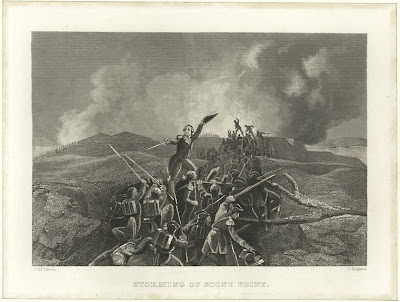
231st Anniversary of the Storming of Stony Point

On the seemingly calm night of July 15, 1779, an unusual chill drifted through the summer air at Stony Point. The British garrison stationed there was confident in their position on the Hudson River and unaware of American plans to invade. Just before midnight, the stillness of the fort was broken as Brigadier General Anthony Wayne and his Light Infantry took the British by storm with a surprise attack. By 1 A.M., the garrison had surrendered, marking an important triumph for America and the last major battle in the north.

Visit Stony Point Battlefield State Historic Site on Friday, Saturday and Sunday, July 16th-18th, to celebrate the 231st anniversary of this bold victory as reenactors from British, American, and Loyal American regiments recreate soldier and family life during the Revolutionary War.

The Battlefield will come alive with demonstrations of 18th century warfare and performances of tactical demonstrations and mock skirmishes. Musket and artillery drills are planned throughout the weekend, showing visitors how weaponry was used in combat. Learn about the kinds of currency circulating through the colonies from our camp paymaster and witness a demonstration of the mail system by our colonial postmaster. Reserve a place on the Battlefield Lantern Tour Saturday evening and witness a recreation of the midnight assault while you take a guided walking tour through the battleground.

A range of activities are planned which will provide fun for the whole family. Children will love enlisting in Washington’s army at the camp recruitment table (where they will receive a certificate signed with a quill pen) and anyone can collect a reward for discovering the renegade hiding in the camp. Enjoy a Tea Party with staff dressed in colonial costume and learn about 18th century fashions and etiquette. Talk to our working blacksmiths to discover how tools were repaired or created to meet the needs of the army.

On Saturday and Sunday afternoons, Tom Hanford will present a family show of 18th century entertainment with music, stories and dramas from life &#8220In the Good Old Colony Days.&#8221

There will be a $5 parking fee. For more information and directions, please call the site office, 845-786-2521.

Illustration: Storming of Stony Point by J. Rogers (ca. 1770-ca. 1880).

Archives Partnership Trust to Honor Richard Dreyfuss

The New York State Archives Partnership Trust and the History channel will host a conversation with Academy Award-winning actor and passionate advocate for strengthening history education in our schools Richard Dreyfuss and nationally prominent Lincoln Scholar Harold Holzer to be held on Tuesday, September 28, 2010 at 7:30-8:30pm at The Egg, Center for the Performing Arts, Empire State Plaza, Albany, New York. Mr. Dreyfuss will then be presented with the Empire State Archives and History Award.

The cost for the program is $10 per person (plus handling fees). Tickets are available August 1st. Reservations are required. Tickets can be purchased by calling The Egg Box Office at (518) 473-1845 or online at www.theegg.org.

In advance of the program, a reception to meet Mr. Dreyfuss will be held at The Egg, Center for the Performing Arts, from 5:30-7:00 pm. Reservations will be accepted starting August 2, 2010 by calling the Trust office at (518) 473-7091. Please see the Trust website for reception ticket prices.

History of American Musical Theater Program

The Franklin County Historical & Museum Society presents &#8220America’s Song: A History of American Musical Theater in Word and Music,&#8221 a collaboration between Drew Benware and members of the Ithaca College School of Music, on Tuesday, July 13, 2010 at 7 pm. Admission is $10.00 per person, to benefit the Franklin County Historical Society. The program of toe-tapping favorites will be held in the Bobcat Cafe in the Joan Weill Student Center at Paul Smith’s College.

Drew Benware is a native of the North Country, having grown up in Malone, New York. Upon graduation from Franklin Academy, he enrolled at the Ithaca College School of Music where he received a degree in Music Education with a concentration on Trumpet in 2003. For the next three years, Drew served as the Director of Instrumental Music at Saranac Lake High School where he worked with the Concert Band, Jazz Ensemble, Pep Band, Parade Band, and annual Musical Theater Productions. Drew returned to Ithaca College to pursue a Master of Music degree in Choral Conducting, working with the renowned Larry Doebler and Janet Galvan. Among the high points of this period was a performance of Verdi’s &#8220Requiem&#8221 at Alice Tully Hall in Lincoln Center in New York City. Drew’s choral degree was put to use during the 2008-9 academic year during which he served as Director of Choral Activities at the Peru Middle/High School. Since that
time, he has been on the faculty at the Ithaca College School of Music as an Assistant Professor of Music Education, instructing courses in woodwind and brass techniques, instrumental conducting, wind instrument pedagogy, and acting as supervisor to both Junior and Senior level teachers. Drew also works closely with the nationally acclaimed Ithaca College Department of Theatre Arts, serving as faculty accompanist for the Musical Theater Workshop and performing in Pit Ensembles. Drew continues to serve as an active pianist, performing as music minister at All Saints’ Church in Lansing and as a frequent artist-collaborator including the 2009 Saranac Lake First Night Celebration. He
is active as a singer also, performing with the Saranac Lake Madrigal Singers and the Cayuga Vocal Ensemble, Ithaca’s only professional choir. He has provided musical direction or pit performances for several works of Musical Theater, among them &#8220Children of Eden,&#8221 &#8220Parade,&#8221 &#8220A Little Night Music,&#8221 &#8220Once On This Island,&#8221 &#8220The Music Man,&#8221 and &#8220Les Miserables.&#8221

The program will also feature performers from the Ithaca College School of Music and Department of Theatre Arts.

&#8220America’s Song&#8221 is co-sponsored by The Franklin County Historical & Museum Society and Paul Smith’s College. The Franklin County Historical & Museum Society, founded in 1903, preserves the history of Franklin County, NY through its House of History Museum and Schryer Center for Historical & Genealogical Reseach, located in Malone. It is supported by membership dues and donations, grants, and municipal support. Paul Smith’s College, the College of the Adirondacks is the only four-year private college in the Adirondack Park and is commited to experiential, hands-on learning.

For more information, please contact Anne Werley Smallman at 518-483-2750. Visit the Paul Smith’s College website for directions.

18th-Century Day at the Historic Schuyler House

On Sunday, August 8 from noon to 5pm, the 1777 Schuyler House on Route 4 in Schuylerville, will be the setting for dozens of artisans demonstrating their crafts much as they were plied over 200 years ago when many things for the home were handcrafted. Visitors to the 32nd annual Eighteenth Century Day will be able to enjoy free tours of the Schuyler House, listen to music of the period, see Punch and Judy puppet shows, plus stroll around artisans demonstrating 18th century crafts and showing their wares. Tinsmithing, blacksmithing, broom-making, basket-making, rope-making, beer brewing, spinning, dyeing, weaving, rug-hooking, butter-making and carpentry are among some of the arts to be demonstrated. There will also be colonial-era farm life activities such as discussions of farming methods, medicinal treatments and leather-working. Free light refreshments will be available.

This traditional event is organized by the Old Saratoga Historical Association, a non-profit educational organization that provides furnishings for the Schuyler House and promotes interest in the history of Old Saratoga, Schuylerville, Victory and the Town of Saratoga areas, from Native American occupation, through modern times.

Saratoga National Historical Park presents special interpretive events and programs throughout the year. For further information about this and other programs, please call (518) 664-9821 ext. 224 or check their Web site at www.nps.gov/sara.

Last Call: The Rise and Fall of Prohibition

During Prohibition my grandfather’s brother Denis Warren, a veteran of some of the bloodiest American battles of World War One, was left for dead on the side of Route 9N south of Port Henry on Lake Champlain. He was in the second of two cars of friends returning from Montreal with a small supply of beer. Going through Port Henry local customs agents gave chase and the car he was in hit a rock cut and he was badly injured in the accident. Figuring his was dead, or nearly so, and worried he would go to prison, one of Denis’s best friends rolled him under the guardrail, climbed into the other car, and sped off.

Joe Kennedy, never really enthusiastic about World War One, spent the war as an assistant general-manager of Bethlehem Steel and used the opportunity to buddy up to Franklin D. Roosevelt who was then Assistant Secretary of the Navy. During Prohibition Kennedy went to England and with the help of FDR’s eldest son James Roosevelt secured the exclusive American rights for Gordon’s Dry Gin and Dewar’s Scotch. Contrary to rumors, Kennedy wasn’t a bootlegger, he imported his British booze legally under a permit to distribute medical alcohol. Kennedy was of course, the father of John F. Kennedy.

The story of these two Irish-Americans serves as a kind of microcosm of the story of Prohibition, when all of America seemed upside down. &#8220In almost every respect imaginable, Prohibition was a failure,&#8221 Daniel Okrent writes in Last Call: The Rise and Fall of Prohibition. &#8220It deprived the government of revenue, stripped the gears of the political system, and imposed profound limitations on individual rights. It fostered a culture of bribery, blackmail, and official corruption. It also maimed and murdered, its excesses apparent in deaths by poison, by the brutality of ill-trained, improperly supervised enforcement officers, and by unfortunate proximity to mob gun battles.&#8221

The medical exemption to Prohibition, along with the sacramental wine exemption, and the fruit exemption for homemade wine and cider, meant that Prohibition was fairly doomed from the start according to Okrent. In fact it’s a wonder that Prohibition even got started. In the late nineteenth century drinking was at an all time high, a central part of American life. But immigration was also at an all time high, along with the Protestant Christian reformers, xenophobia, and racism. An unlikely alliance emerged to battle &#8220Demon Rum&#8221 that included racists (including the Klan), progressives, suffragists, and populists.

Okrent lays out the story of this coalition in a readable way, avoiding much of the political minutiae, while still illuminating the personalities &#8211 people like Mother Thompson, Frances Willard, axe-wielding Carry Nation, bible-thumping Billy Sunday, William Jennings Bryan (who helped bring the Democratic party on board), Wayne Wheeler (the long-forgotten man considered the father of Prohibition), and Mabel Willebrandt (the Assistant US Attorney General despised by the nation’s drinkers).

The usual suspects are all here: the rise of organized crime from scattered minor street gangs, the rum runners contributions to boat design, the rise of Sam Bronfman’s Seagrams empire. The most interesting parts of the book however, detail how leading suffragists sought the vote after being denied leadership positions in the temperance movement and then used that vote to secure first the income tax (considered crucial to weaning the government off the alcohol excise tax teet) and finally Prohibition. Okrent also clearly presents the brewers’ failure to band together with the distillers, and their lack of action against the Prohibitionist until it was too late. Mostly German-Americans, World War One sealed their fates.

Also illuminating is Okrent’s telling of how the Eighteenth Amendment, which along with the Thirteenth Amendment outlawing slavery is the only constitutional amendment to deal with personal property and the only one to have been repealed, came to be reversed. Last Call chalks it up to a few primary factors. The ease of access to booze which was no longer regulated, and so could be found everywhere, not just at bars (the old joke went &#8220Remember before Prohibition? When you couldn’t get a drink on Sunday?&#8221). The presidential campaign of solidly wet New York Governor Al Smith (defeated by mostly dry anti-Catholics) that changed the political mood of the country’s immigrants [video]. The Great Depression, and the need for the billions in excise tax (which helped fund the New Deal) that gave Repeal a push. But the biggest factor was perhaps the right-wing wealthy anti-tax (and future anti-Roosevelt) Pierre S. DuPont who believed so profoundly that Repeal would mean an elimination of the income tax that he bankrolled the fight himself. Fundamentally though, it was the Democratic title-wave that swept FDR into office [music] that changed the make-up of the Congress that allowed the crucial Repeal vote.

Okrent avoids the obvious comparisons to today’s Drug War, but even the causal reader, can’t miss them. The seemingly limitless supply, the institutionalized hypocrisy of legal tobacco and alcohol while pot smokers go to overcrowded prisons. The overzealous and expensive enforcement on the one hand (particularly in the inner cities), alongside marijuana buyers clubs and lax enforcement that amounts to a defacto local option.

It took about 10 years to understand that Prohibition only increased lawlessness, corruption, greed, and violence. Last Call leaves the astute reader wondering how long it will take us to come to the same conclusion about the War on Drugs.

Note: Books noticed on this site have been provided by the publishers. Purchases made through this Amazon link help support this site.

Yankee Stadium Negro League Anniversary Event

The Museum of the City of New York will present a program celebrating the 80th Anniversary of the first Negro League baseball game played at Yankee Stadium on Monday, July 26th, at 6:30 pm.

Join Negro League players Bob Scott and Jim Robinson, Dr. Lawrence Hogan, professor and author of Shades of Glory: The Negro Leagues and the Story of African-American Baseball (National Geographic, 2006), and baseball historian John Thorn for a conversation about the game, the times, and what the anniversary tells us about how America has, and hasn’t, changed in the last 80 years.

On July 5, 1930, the first Negro League baseball game was played at Yankee Stadium, ushering in a new era in American professional sports. In addition to its historical importance, the game was also a benefit for the Brotherhood of Sleeping Car Porters, the first African-American labor organization to receive a charter from the American Federation of Labor.

Reservations required. $6, Museum members- $12, non-members- $8, seniors and students.

Photo courtesy the National Baseball Hall of Fame, Cooperstown, New York.

Olympic Bobsled Track Added to National Register

Lake Placid’s 1932 and 1980 Olympic bobsled track will officially become a part of the National Register of Historic Places during a plaque unveiling ceremony on Monday, July 12. The ceremony is scheduled to begin at 3 p.m. on the deck of the Lamy Lodge.

The original one-and-a-half mile long track (photo taken during construction at left) at Mt. Van Hoevenberg was completed in Dec. 1930, in time for the 1932 Olympic Winter Games, and since that time has played a significant role in the sport of bobsled’s history. It was during those games that Olympic two-man racing was introduced as well as the push start.

In 1934, the International Bobsled Federation (FIBT) established a one-mile standard for all tracks. To accommodate the change, the top one-half mile was shut down above the Whiteface curve and the number of curves was reduced from 26 to 16, making the upper portion of the run unusable.

The 1,537-meter long course has also hosted five world championship races (1949, 1969, 1973, 1978, 1983) and one more Olympic event, in 1980. The 1949 Worlds also marked the first time a track outside of Europe had hosted that event.

Today, the track no longer hosts international competitions, but it remains in use. Summer bobsled rides are held on the course, where visitors can enjoy half-mile rides, reaching speeds in excess of 50-miles-per-hour, with professional drivers steering their sleds.

Guest speakers during the National Registry ceremony include New York State Olympic Regional Development Authority (ORDA) president/CEO Ted Blazer- representatives from Town of North Elba, the Village of Lake Placid, New York State Parks, Recreation and Historic Preservation and 1932 and 1980 Lake Placid Olympic Museum member Phil Wolff, who was also instrumental in the track’s efforts to be listed in the National Register of Historic Places.

Admission to the ceremony is free after 2 p.m. A guided tour with Guy Stephenson, licensed NYS guide, Wilmington Historical Society member, and retired Olympic Sports Complex staff member responsible for the restoration work on the 1932 portion of the track, will also begin at 2 p.m. Tour participants will be bussed to the 1980 start to begin the one-hour walk up the 1932 piece of the track. Light hiking attire is suggested.

Also from 2-4 p.m., in celebration of the national historic registry, half-mile long wheeled bobsled rides on the 1932 and 1980 Olympic track will be available for $55 per person. Bobsled rides have been a continuous part of the track’s operations since it first opened, Christmas 1930.

The National Register of Historic Places is the official list of the Nation’s historic places worthy of preservation. Authorized by the National Historic Preservation Act of 1966, the National Park Service’s National Register of Historic Places is part of a national program to coordinate and support public and private efforts to identify, evaluate, and protect America’s historic and archeological resources. For other listings and more information about the National Register of Historic Places, log on to www.nps.gov/nr.

Established in 1982, the New York State Olympic Regional Development Authority (ORDA) was created by the State of New York to manage the facilities used during the 1980 Olympic Winter Games at Lake Placid. ORDA operates Whiteface and Gore Mountain ski areas- the Olympic Sports Complex at Mt. Van Hoevenberg- the Olympic speedskating oval, Olympic jumping complex and Olympic arena. As host to international and national championships.