Adirondack History: Have You Seen That Vigilante Man?

The Wilmington Historical Society will be hosting a program with historian and author Amy Godine entitled &#8220Have You Seen That Vigilante Man?&#8221 to be held on Friday, July 30th at 7 pm at the Wilmington Community Center on Springfield Road in Wilmington.

Night riders, white cappers and vigilante strikes- the darker side of American mob justice was not confined to the Deep South or the Far West. Adirondack history is ablaze with flashes of &#8220frontier justice,&#8221 from farmers giving chase to horse thieves to &#8220townie&#8221 raids on striking immigrant miners to the anti-Catholic rallies of the KKK. Amy Godine’s anecdotal history of Adirondack vigilantism plumbs a regional legacy with deep, enduring roots, and considers what about the North Country made it fertile and forgiving ground for outlaw activity.

Readers of Adirondack Life magazine are acquainted with Amy Godine’s work on social and ethnic history in the Adirondack region. Whether delving into the stories of Spanish road workers, Polish miners, black homesteaders, Jewish peddlers or Chinese immigrants, Godine celebrates the &#8220under-stories&#8221 of so-called &#8220non-elites,&#8221 groups whose contributions to Adirondack history are conventionally ignored. Exhibitions she has curated on vanished Adirondack ethnic enclaves have appeared at the Chapman Historical Museum, the Saratoga History Museum, the Adirondack Museum and the New York State Museum. The recently published 3rd edition of The Adirondack Reader, the anthology Rooted in Rock, and The Adirondack Book, feature her essays- with Elizabeth Folwell, she co-authored Adirondack Odysseys. A former Yaddo, MacDowell, and Hackman Research Fellow, she is also an inaugural Fellow of the New York Academy of History.

The “Have You Seen That Vigilante Man?” program on July 30th is free and open to the public. Refreshments will be served. For further information, contact Karen Peters at (518) 524-1023 or Merri Peck at (518) 946- 7627.

Photo: Members of Ku Klux Klan march in Washington DC in 1925.

Troy: Chances to Tour Limited Access Sites

Hidden history will be revealed as the Rensselaer County Historical Society offers unique opportunities to tour limited-access sites around Troy. From a riverfront warehouse painstakingly renovated into an elegant loft apartment to the attic of the 1786 Melville House, the Rensselaer County Historical Society’s Hidden History programs offer the public opportunities to tour historic buildings and sites not normally open to the general public.

Participants may register for individual programs ($12 members/$15 not-yet-members) or for the whole 4-program series ($45 members/$50 not-yet-members). All tours last an hour and meet at the location specified. Call 518-272-7232, x12 to register or register online at http://www.rchsonline.org/registration.html.

HIDDEN HISTORY: 169 River Street Renovation
Date: Tuesday, July 27, 2010- 4:30-5:30 pm

Place: 169 River Street, Troy

169 River Street was once home to the Wustefeld Candy Company. Now, this renovated warehouse building on Troy’s riverfront is a great example of the adaptive re-use of historic structures. Explore this former warehouse building and learn about how it was transformed into a modern loft apartment &#8211 with some wonderful traces of its industrial past remaining.

HIDDEN HISTORY: Herman Melville House
Date: Tuesday, August 24, 2010- 4:30-5:30 pm

Place: Corner 1st Ave and 114th Street, Lansingburgh
The 1786 Melville House was home to Herman Melville while he wrote his first two novels and is now home to the Lansingburgh Historical Society. Join us for a tour of this historic building, including its “Attic Museum” which highlights Lansingburgh’s unique contributions to the area economy.

HIDDEN HISTORY: Lighting Research Center/Gurley Building
Date: Tuesday, September 28, 2010- 4:30-5:30 pm

Place: 21 Union Street, Troy
This National Historic Landmark building was built in 1862 and opened just 8 months after the original building on the site burned to the ground in the Great Fire of Troy. Rensselaer’s innovative Lighting Research Center occupies floors of the building that were once home to production lines for Gurley’s world famous surveying equipment.

HIDDEN HISTORY: Rensselaer Model Railroad Society
Date: Tuesday, October 26, 2010- 4:30-5:30 pm

Place: Davison Hall, RPI.

Hidden deep within the RPI campus and not normally open to the public, the Rensselaer Model Railroad Society has created a 33 feet wide by 123 feet long historically accurate railroad layout of 1950s Troy. RMRS has generously opened their doors for us to see this unique re-creation. For more information, please visit http://railroad.union.rpi.edu. Please note – the layout is not handicapped accessible and for safety reasons, is only open to ages 12 and up.

Currier & Ives at Senate House Historic Site

The prints of Currier & Ives—one of the most successful purveyors of lithographic prints in the 19th Century—are diverse, full of fascinating historical information and compelling imagery, perhaps despite their perennial appeal on calendars and cards. A new exhibit at Senate House State Historic Site, in Kingston, NY, offers us forty of their prints focusing on the ideals, values and innovations of the 19th Century. The exhibit is free and open to the public. For more information on hours, location and other details, please call (845) 338-2786.

While it’s better known for its buildings and collections representing colonial and Revolutionary history, Senate House State Historic Site, located in uptown Kingston, also has impressive collections of objects, documents and art of the 19th Century, including over 200 Currier & Ives prints, given to the site by the late Rutgers Ives Hurry, a Saugerties resident whose passion was collecting images of the Hudson Valley made by the firm.

The Senate House exhibition focuses on three themes: the ideal of the 19th-century home, images of New York City, and Hudson River steamboats (both the luxury and potential dangers they represented). The exhibit is entitled “Cheap and Popular Pictures,” a term touted by Nathaniel Currier and James Merritt Ives, who shrewdly observed and marketed their images&#8211made by many different artists of the day—to the opinions, interests and ideals of America’s growing middle class.

Currier & Ives: “Cheap and Popular Pictures” can be viewed during open hours at Senate House State Historic Site: Wednesday through Saturday, 10 am to 5 pm, and 1 – 5 pm on Sundays. The exhibition runs through October 31, and is available by appointment and for school groups after that date. Senate House is located at 296 Fair Street, Kingston NY, 12401. For more information: (845) 338-2786.

Collection Storage Tours at Adirondack Museum

Visitors can now get a glimpse of more than 7,000 historic artifacts not currently on exhibit at the Adirondack Museum in a state-of-the-art facility in the hamlet of Blue Mountain Lake by touring the Collections Storage and Study Center each Monday in July and August from 2:00 p.m. until 3:00 p.m.

The tours are free for museum members- $10 for non-members. Visitors can sign up for a tour on Mondays at the Membership Desk in the Visitor Center. Each tour is limited to thirty people.

The Collections Storage and Study Center holds an amazing array of objects from the Adirondack past. Collections consist of: boats, including power boats, canoes, kayaks, guideboats, and unusual boats- traditional and rustic furniture- hand tools and machinery- large vehicles, including horse-drawn carriages and sleighs, snowmobiles, fire trucks, and a Jitterbug- maple sugaring equipment- ice harvesting tools- as well as agricultural artifacts.

Adirondack Museum Conservator and Collections Manager Doreen Alessi will lead the tours. Alessi cares for more than 100,000 two and three-dimensional artifacts in the collection of the Adirondack Museum. She is a Professional Associate of the American Institute for Conservation of Historic and Artistic Works (AIC).

Photo: Collections Storage and Study Center, Adirondack Museum.

Histories of Essex County Go Online

Jay (Essex County) author and editor Lee Manchester has published a number of volumes on the history of Essex County and its communities. The free, downloadable PDFs include five volumes compiled from the files of the late Lake Placid public historian Mary MacKenzie, a two-volume definitive anthology of 19th and 20th century materials on the McIntyre iron works and the Tahawus Club colony in Newcomb, better known as &#8220the Deserted Village,&#8221 and two collections of Lee’s stories about history and historic hikes in and around Essex County.

For complete information, including download instructions, visit the Wagner College website. Print versions of all the volumes can also be ordered, at a cost that includes no markup, with the exception of Mary MacKenzie’s &#8220The Plains of Abraham: A History of Lake Placid and North Elba&#8221- royalties for print copies of &#8220Plains&#8221 go to the Lake Placid Public Library, which maintains the Mary MacKenzie Historic Archives.

This Weeks New York History Web Highlights

Brooklyn Museum Announces Visitor-Curated Event

For the first time the Brooklyn Museum is inviting visitors to get directly involved in choosing the programs that will be presented at its popular First Saturdays event. From July 1 to 31, members of the public may log on to www.brooklynmuseum.org and nominate performers, musicians, films, books, and DJs that they would like to see featured at the October 2, 2010, First Saturday.

Nominees should relate to the exhibition Extended Family: Contemporary Connections, an exhibition that embraces the shared values and diversity of contemporary Brooklyn. At the end of the one-month nomination period, the Museum’s First Saturday committee will narrow down the nominees in each category based on relevance to the theme and artist availability. Voting by the public will take place August 1 to 15. The winners will be announced after August 15.

First Saturdays are sponsored by Target and made possible by the Wallace Foundation Community Programs Fund, established by the Wallace Foundation with additional support from DLA Piper US LLP, the Academy of Motion Picture Arts and Sciences, The Ellis A. Gimbel Trust, National Grid, and other donors.

Poughkeepsie: Historic Family Homes Reunited

Historic Huguenot Street has announced that it has reached an agreement with Locust Grove in Poughkeepsie to transfer to it the properties and collections of Locust Lawn located in the town of Gardiner, New York. The agreement is result of months of planning to reunite the family homes of Annette Innis Young, who was responsible for establishing both estates as protected historic sites.

Transferring ownership and “reuniting” these two estates fulfills the original vision of Annette Young. It was Miss Young’s desire to jointly preserve the Locust Lawn and Locust Grove estates under one organizational umbrella hoping “the foundation will maintain these houses as an example of the lives of three generations of a wealthy and cultured Hudson Valley family.” Unfortunately, she was unable to achieve this during her lifetime.

As an alternative, she donated Locust Lawn to Historic Huguenot Street (which was then known as the Huguenot Historical Society), an organization in which she was already involved. Upon her death in 1975, Annette Young’s will established a not-for-profit educational corporation to preserve Locust Grove and its contents in perpetuity for the &#8220enjoyment, visitation, and enlightenment of the public.&#8221

The Locust Grove Estate was purchased by Annette Young’s father, William Young in 1901. The Young family cherished Locust Grove’s extensive grounds and historic buildings and added their own important collections of furniture, paintings and ceramics.

Locust Lawn is located on Route 32 South in Gardiner. It features an historic federal-style home was built in 1814 by Josiah Hasbrouck, a businessman and gentleman farmer whose ancestors were among those that founded New Paltz. Josiah Hasbrouck was Annette Young’s great-great grandfather and a U.S. congressman. The Hasbrouck family left Locust Lawn in 1885, leaving behind 70 years of finery and furnishings. The house was a repository of family history for another 70 years until it was donated to Historic Huguenot Street by Annette Young in 1958.

In addition to transferring the property and collections of Locust Lawn, Historic Huguenot Street will donate its adjoining properties, which include the historic Terwilliger stone house as well as the Little Wings Bird Sanctuary and Meadow. The Terwilliger House will continue to be protected as a historic building, open to the public. The existing protections on the Little Wings Bird Sanctuary and the Conservation Agreement on the Meadow also will remain in place with the transfer of the properties. Together, all of these properties preserve the core of the estate created by Josiah Hasbrouck.

The executive directors of the respective organizations have cooperated over the years to ensure that the collections and history have stayed linked to each other. These connections led to the formal transfer that is now taking place.

It is anticipated that Locust Grove will assume ownership and management of Locust Lawn by the end of August. Under the terms of the transfer, which has already been approved by the boards of both organizations, all restrictions placed on the property by Annette Young at the time she gifted the site will remain in effect. In the short term, the site will continue to be open to the public by appointment. Locust Grove plans an expanded program of public events in the future.

Photo: Locust Lawn Front Facade Courtesy of Historic Huguenot Street.

Perceiving Buffalo Autistic Artists Exhibit

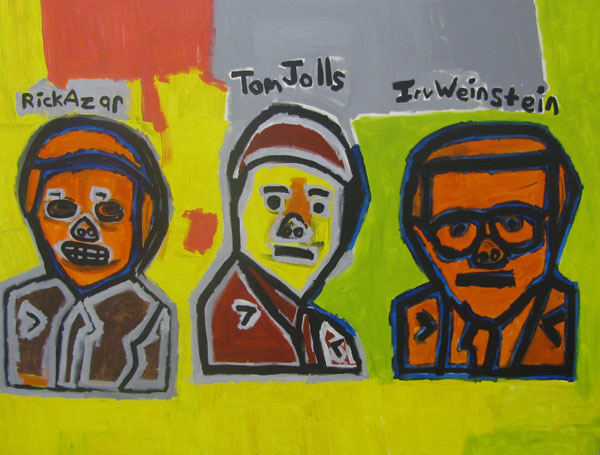
The Buffalo & Erie County Historical Society (BECHS) has announced &#8220Perceiving Buffalo,&#8221 an exhibit of works by artists from Autistic Services, Inc. (ASI). The show opened in BECHS’ second-floor Community Gallery on July 1st and will run through Sunday, August 22, 2010. The exhibit is open to the public, and free with regular museum admission.

In addition, there will be a celebratory reception sponsored by Autistic Services Inc., on Thursday, July 22, from 5 to 8 p.m. at the Historical Society. The reception is free and open to the public.

The exhibit, curated by BECHS Museum Educator Tara Lyons, and facilitated by ASI staff members Veronica Federiconi, Dana Ranke, Todd Lesmeister, and Brian Kavanaugh features work by Aaron B., Dan C., Stacey M. and Neil S., four artists from ASI’s Arts Work Program.

The selected paintings and drawings mesh the works of the artists with BECHS’ mission to tell the stories of people and places in the region. The show highlights the artists’ interests in and creative interpretations of iconic Buffalo landmarks and community figures. Portraits include those of Ani DiFranco, Tim Russert, and one featuring three local newscasters. In addition, there is a series of drawings of Buffalo public school buildings. A short film of artist Neil S. will describe the artists’ creative process and his deep personal connection to the subject matter.

Autistic Services Inc. is a community organization that promotes the awareness of autism and provides treatment, education, and care for individuals with autism spectrum disorders. The Arts Work Program, through which the works in &#8220Perceiving Buffalo&#8221 were created, is part of the ASI’s individual therapy rooted in the creation of visual arts.

The reception will be held in the State Court of the Historical Society, and will feature a performance by No Words Spoken, a group of musicians which also evolved through Autistic Services programming. Wine and cheese will be served, and the public is invited to attend this free evening event.