Whither Wall Street: Architecture of Wall Street Event

Organized by The Skyscraper Museum in partnership with the Museum of American Finance, “Whither Wall Street” will address the changing fortunes of Wall Street –– not the forecast of financial markets, but the architectural assets and liabilities of the physical place. The panel discussion, part of the American Museum of Finance’s 2010 Henry Kaufman Lecture/Symposia Series, will take place Wednesday, October 13, 2010 from 6 to 7:30 PM.

A diverse panel of experts will discuss the recent history and possible futures of one of America’s most famous streets. Key topics include the widespread conversion of office buildings to residential, hotel and retail uses and the new demands on the design of the public realm that need to serve the conflicting needs of both access and security of a post-9/11 world.

Panelists will include:

Carol Willis, Director, The Skyscraper Museum (Introduction and moderator)

Elizabeth H. Berger, President, Downtown Alliance

Rob Rogers, Principal, Rogers Marvel Architects- streetscape designers of Wall Street for the NYC Department of City Planning

Kent Swig, President of Swig Equities, LLC- owner of a portfolio of properties on Wall Street and in the financial district

Alexandros Washburn, Chief Urban Designer, NYC Department of City Planning

The panel discussion will be followed by a question and answer session and reception. Reservations required. Admission is free for students and members of the Museum of American Finance and the Skyscraper Museum, or $15 for non-members. For additional information, contact Lindsay Seeger at 212-908-4110 or [email protected].

Glens Falls Feeder Canal and Towpath Trail Improvements

State and local officials have announced completion of connection improvements to the Glens Falls Feeder Canal and Towpath Trail, and officially opened the improved waterfront.

The &#8220Warren County – Improving Feeder Canal Community Connections Project&#8221 has expanded community connections along the Glens Falls Feeder Canal and the Towpath Trail with $140,585 funded by the New York State Canal Corporation through the Erie Canal Greenway Grant Program.

Warren County partnered with the Canal Corporation, the City of Glens Falls, the Town of Queensbury and the Feeder Canal Alliance, a not-for-profit entity whose mission includes preserving and expanding public use of the Feeder Canal Towpath and associated structures.

Work has been completed in both the Overlook Park in the Town of Queensbury and Haviland Cove in the City of Glens Falls. Site improvements to both parks included resurfacing of the roadways, trailways and parking areas, including Haviland Cove, where school buses park. Electrical services were also installed in both parks, including the pavilion in Haviland Cove. Benches, tables, grills, and a covered pavilion were installed in Overlook Park. Additionally, 3.6 miles of towpath trail was resurfaced by county work forces with stonedust for use as a bike and pedestrian trail.

In addition, the Canal Corporation provided $9,000 to complete signage along the seven-mile Feeder Canal Trail in both Warren and Washington Counties. Weathered signs were refurbished and replaced, and obsolete signs were replaced with new interpretive signs.

The Erie Canal Greenway Grant Program, administered by the Canal Corporation, was created to help spur community revitalization along the 524-mile Canal System. Fifty-four Greenway grants were awarded on a competitive basis to communities and non-profit organizations for capital projects that enhance and promote tourism, recreation, historic interpretation, and community revitalization in 19 counties along the New York State Canal System. All grants require a 50-percent match in local funds or in-kind services.

The New York State Canal System is comprised of four historic waterways, the Erie, the Champlain, the Oswego and the Cayuga-Seneca Canals. Spanning 524 miles across New York State, the waterway links the Hudson River, Lake Champlain, Lake Ontario, the Finger Lakes and the Niagara River with communities rich in history and culture.

The New York State Canal Corporation is a subsidiary of the New York State Thruway Authority. In 1992 State legislation transferred the Canal System from the New York State Department of Transportation to the Thruway Authority. Canal operating and maintenance activities are supported by Thruway toll revenues.

Photo: Glens Falls Feeder Canal Lock 1. Photo Courtesy of Tug44.org.

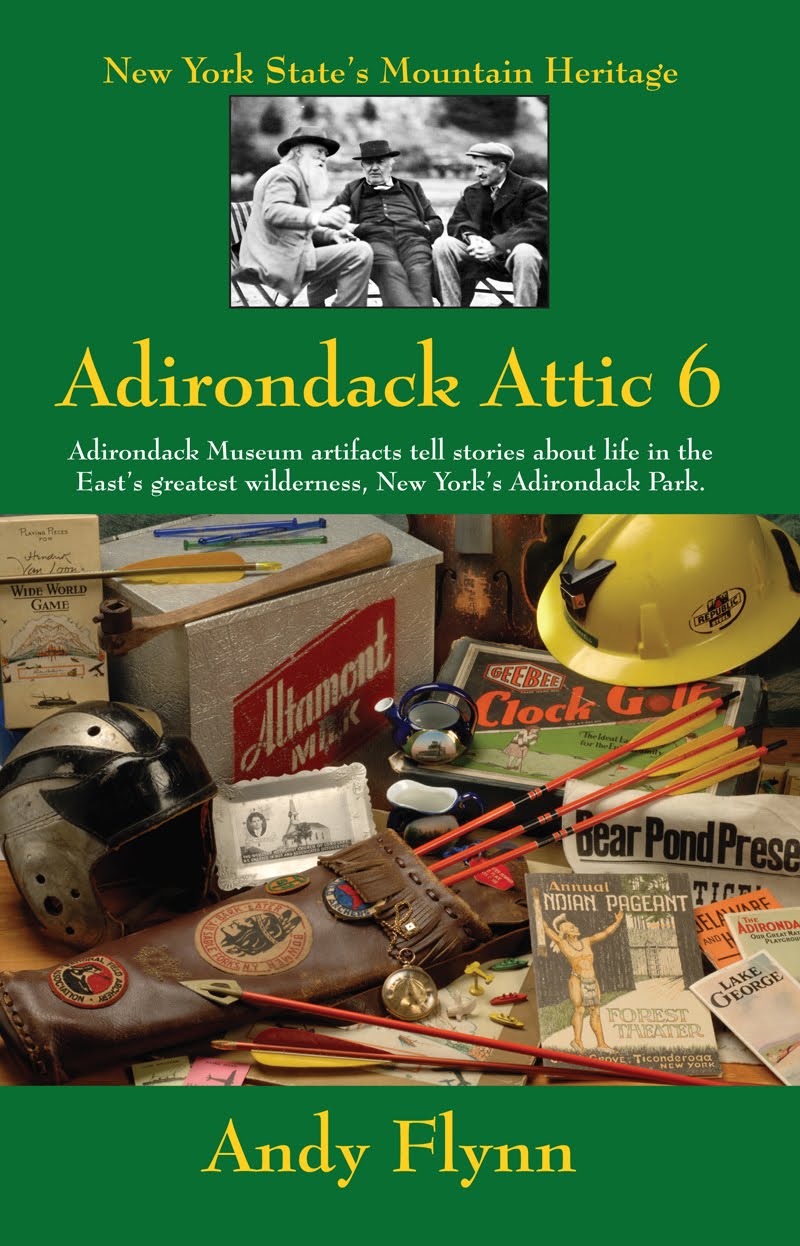
Andy Flynns Sixth Adirondack Attic Book

Hungry Bear Publishing recently released its sixth volume in the “Adirondack Attic” book series, highlighting dozens of artifacts from the Adirondack Museum in Blue Mountain Lake.

Author Andy Flynn, of Saranac Lake, tells 53 more stories about the museum’s collection in New York State’s Mountain Heritage: Adirondack Attic, Volume 6, bringing the story count to more than 300 for the six-volume series that began in 2004. Stories, and artifacts, come from all over the Adirondack region.

“Each story is special unto itself- however, taken as a whole, this series gives us the big picture,” Flynn told the Almanack. “Thanks to these artifacts, we now have a unique perspective on the Adirondack experiment and a better understanding of the 6-million-acre Adirondack Park, its people and communities, and how life has changed here over the past 300 years.”

Stories from Adirondack Attic 6 come from the following communities: Au Sable Forks, Bangor, Blue Mountain Lake, Brantingham Lake, Canton, Chestertown, Cranberry Lake, Dickinson Center, Elizabethtown, Hague, Johnsburg, Lake George, Lake Placid, Long Lake, Loon Lake, Lyon Mountain, Mohawk, Newcomb, North River, Northville, Paul Smiths, Port Henry, Raquette Lake, Saranac Lake, Ticonderoga, Tupper Lake, Warrensburg and Wilmington.

Flynn created the Adirondack Attic History Project to “promote the heritage of the Adirondack Park to residents and visitors through publications and programs.” As the owner/operator of Hungry Bear Publishing, he works with curators at the Adirondack Museum and other historical associations and museums in the region to tell human-interest stories about their artifact collections.

Flynn’s “Adirondack Attic” column ran weekly in several northern New York newspapers from 2003 to 2009. The stories in Adirondack Attic 6 represent the columns from 2008. Each volume includes columns from a specific year- for example, Adirondack Attic 1 featured columns from 2003, the first year of the Adirondack Attic History Project.

In April 2010, North Country Public Radio began running Flynn’s new Adirondack Attic Radio Series, sponsored by the Adirondack Museum and singer/songwriter Dan Berggren. It airs the first Tuesday of the month during the Eight O’Clock Hour with Todd Moe. For each program, Flynn features a different artifact from the collection of a museum in the Adirondack North Country Region. He uses the Adirondack Museum as his “History Headquarters” but also visits other museums to track down the objects people have made, used and left behind.

In 2008, Andy Flynn was awarded a Certificate of Commendation from the Upstate History Alliance for the Adirondack Attic History Project. He has since presented programs on his work with the Adirondack Museum to scholars at the New York State Archives Conference (2008), Association of Public Historians of New York State (2008) and Conference on New York State History (2009).

Flynn also publishes the Meet the Town community guide series with booklets for Saranac Lake, Lake Placid/Wilmington, Canton, Potsdam, Tupper Lake/Long Lake/Newcomb and the Au Sable Valley. From 2001 to 2009, he was employed as the Senior Public Information Specialist at the Adirondack Park Agency Visitor Interpretive Center in Paul Smiths.

Flynn is an award-winning journalist, garnering merits of excellence from the National Newspaper Association, New York Newspaper Publishers Association and the New York Press Association. While the staff writer at the Lake Placid News, he was named the 1996 NYPA Writer of the Year for weekly New York state newspapers with circulations under 10,000. Before joining the VIC staff, he was a writer and editor for the Adirondack Daily Enterprise in Saranac Lake and the Lake Placid News, a correspondent for the Plattsburgh Press-Republican, an announcer for WNBZ 1240-AM in Saranac Lake, and a general assignment news reporter and radio documentary producer for North Country Public Radio in Canton. He is a graduate of the SUNY College at Fredonia (1991) and the Tupper Lake High School (1987).

For more information about the Adirondack Attic book series and radio program, call (518) 891-5559 or visit online at www.hungrybearpublishing.com.

ADIRONDACK ATTIC 6 TABLE OF CONTENTS

1: Delaware & Hudson Railroad guides

2: Camp Santanoni Gate Lodge rendering (Newcomb)

3: Long Lake fire truck

4: Snowbug and Luvbug snow machines

5: Lake Placid bobsledding cassette tape (Saranac Lake, Lake Placid)

6: Mystery of Ironshoes, the bobsled (Lake Placid, Port Henry, Lyon Mountain, Elizabethtown)

7: Nehasane Park wagon (Long Lake)

8: Republic Steel miner’s helmet (Port Henry)

9: J. & J. Rogers Company safe (Au Sable Forks)

10: Paul Smith’s hotel stagecoach photo

11: Willcox & Gibbs sewing machine (Mohawk)

12: Bonnie Belle Farm ensilage cutter (Chestertown)

13: Maple sugaring sledge (Dickinson enter, North River)

14: Acme Leader cooking stove (Warrensburg)

15: Steamer Vermont III menu (Lake Champlain, Lake Placid, Loon Lake)

16: Au Sable Forks archery set

17: Bear Pond Preserve posted sign (Raquette Lake)

18: Fire tower string map (Warrensburg, Lake George)

19: Whiteface Mt. Ski Center brochures

20: Hendrik Van Loon’s Wide World Game

21: “Uncle Mart” Moody pocket watch (Tupper Lake)

22: Civil War memorial poster (Warrensburg)

23: “Assaulted by Mosquitoes” photo

24: Bug dope in the Adirondack woods

25: Sunset Cottage (Forked Lake)

26: Frederic Remington painting (Canton, Cranberry Lake)

27: A Pleasant Day at Lake George painting

28: Picturesque America book

29: Swizzle sticks (Ticonderoga, Port Henry, Hague)

30: E.R. Wallace guidebooks

31: Long Lake church souvenir tray

32: In Nature’s Laboratory book

33: Clock Golf lawn game

34: Altamont Milk Company cooler (Tupper Lake)

35: Blue Mountain House artist’s cottage

36: North River crazy quilt

37: 18th century clay pipe fragment (Blue Mountain Lake)

38: Raquette Lake sectional rowboat

39: Ticonderoga Indian Pageant booklet

40: Lake George souvenir china

41: Sacandaga Park souvenir china (Northville)

42: O.W.D. Corporation 5-cent token (Tupper Lake)

43: 1833 needlepoint sampler (Johnsburg)

44: Warrensburg hearse

45: Lake Placid violin

46: Mystery of the postal hand stamp (Bangor)

47: Dwight P. Church’s aerial camera (Canton)

48: Civilian Conservation Corps ring (Glens Falls/Hudson Falls)

49: Tupper Lake baby shoes

50: 1929 firemen’s convention ribbon (Saranac Lake)

51: Dr. William Seward Webb mailbag

52: Brantingham Lake rustic chair

53: Newcomb Snow Plow

Note: Books noticed on this site have been provided by the publishers.

Richard Dreyfuss to Receive State Archives Award

Richard Dreyfuss, Academy Award-winning actor and passionate advocate for teaching American history in primary and secondary schools, will be given the 2010 Empire State Archives and History Award on Tuesday, September 28, 2010 at 7:30 p.m. in The Egg, Empire State Plaza, downtown Albany. As part of the program, Dreyfuss will be interviewed by noted Lincoln scholar Harold Holzer about his life, work and passion for history. Tickets are $10 and may be obtained from The Egg Box Office at (518) 473-1845 or online at www.theegg.org. The event is sponsored by the New York State Archives Partnership Trust, Greenberg Traurig, the Times Union, the History channel, and the New York State Writers Institute.

Dreyfuss is a leading advocate for the teaching of history in America’s primary and secondary schools. Recently, the Brooklyn-born actor founded a nonprofit organization, The Dreyfuss Initiative, whose mission is to promote Constitutional literacy, historical appreciation and open political dialogue among young people. Regarding the group’s mission, Dreyfuss states, &#8220We are a nation bound by ideas only. We have no common ancestry, no common religion, no common military victory or defeat, no common crime that binds us. If you don’t teach those ideas to every new generation of Americans with wit and rigor, we are not bound.&#8221

A member of the Board of Trustees of the National Constitution Center in Philadelphia, Dreyfuss served as Senior Associate Member of St. Antony’s College, Oxford, where he researched and developed new curricula for teaching the history and practice of democracy in public schools.

Dreyfuss received the Academy Award for Best Actor in Neil Simon’s The Goodbye Girl (1977), the youngest actor to be so honored until 2002. Dreyfuss was nominated a second time for Mr. Holland’s Opus in 1995. The actor’s other noteworthy films include The Apprenticeship of Duddy Kravitz (1974), his first lead role, American Graffiti (1973), Jaws (1975), Down and Out in Beverly Hills (1986), Tin Men (1987), Krippendorf’s Tribe (1998), and Oliver Stone’s W. (2008). Dreyfuss’s remarkable performance in W. as Vice President Dick Cheney earned him a great deal of critical attention and praise. Dreyfuss received a star on the Hollywood Walk of Fame in 1996.

Dreyfuss’s many television credits include four episodes of the Showtime series, Weeds in its 2010 season, two episodes voicing himself in the 2009 season of Family Guy, and the title role in the CBS series, The Education of Max Bickford (2001-2002), about a history professor at a women’s college. The latter role earned him a Screen Actors Guild nomination for Best Actor.

Dreyfuss is also the coauthor of a novel with leading fantasy writer, Harry Turtledove &#8211 The Two Georges (1995), which presents an alternative history of the American Revolution.

In advance of the program, a ticketed reception to honor Dreyfuss will be held at The Egg from 5:30-7:00 p.m. To learn more, contact the Trust at (518) 486-9349, or online at http://www.archives.nysed.gov. Proceeds will benefit the New York State Archives and Archives Partnership Trust.

New Paltz: Nov Events at Historic Huguenot Street

Historic Huguenot Street (HHS), located on the banks of the Wallkill River, is where small group of French-speaking Huguenots settled in 1678. Today, just steps from downtown New Paltz, the site features seven stone houses dating to 1705, a burying ground and a reconstructed 1717 stone church – all in their original village setting. HHS offers six acres of landscaped green space and public programming to the local community and visitors from around the world. For more information about Historic Huguenot Street visit www.huguenotstreet.org or call (845) 255-1660.

Saturday, November 6, 10am to12pm
Behind the Scenes: Coverlets with the Curator

This program is offered in conjunction with the Binary Visions Exhibit at the Samuel Dorsky Museum of Art. Limited to 15, the morning offers an opportunity to see up close the historic coverlets too fragile to exhibit. Cost: $25/$20 for Friends of Huguenot Street

Saturday, November 13, 7 to 9pm
Second Saturdays: The Lenape, Lower New York’s First Inhabitants

In this lively and engaging talk, David M. Oestreicher combines archaeological and historical evidence with decades of firsthand ethnographic and linguistic research among present-day Lenape traditionalists, to arrive at a full picture of the Lenape from prehistory to the present. The presentation includes a slide program featuring native artifacts, maps, illustrations, and photographs, as well as images of contemporary Lenape who are among the last repositories of their culture. This lecture offers a unique opportunity to learn about lower New York’s original inhabitants, the Lenape &#8212- not the romanticized figures of popular mythology or new-age literature, but a living people as they really are. Dr.David M. Oestreicher is recognized as a leading authority on the Lenape (Delaware), our region’s first inhabitants. Cost: $8/$6 for Friends of Huguenot Street

Friday, November 19, 5 to 8 pm
Downtown Unwrapped/ Tree Lighting

What a great way to do your holiday shopping. Downtown New Paltz, including Huguenot Street, will be open late to start the holiday shopping season. Start the evening with the traditional tree lighting ceremony being held on Huguenot Street. Stop in the museum shop, enjoy some homemade hot chocolate and find some unique items in the shop, including holiday decoration and cards.

Saturday, November 20, 4-7 pm
Third Saturday Art Walk: As the Seasons Turn, Holiday Greetings Card

The collections at Historic Huguenot Street include an impressive collection of holiday cards from the late 19th and early to mid 20th centuries. Many are richly detailed. Others contain &#8220holiday&#8221 motifs that are just puzzling in our modern world. This exhibit gives guests rare opportunities to see the celebration of holidays through cards that span several decades.

Friday, November 26, 11am to 3pm
Giving Thanks Day

It’s Friday, the day after Thanksgiving and you’re all cooped up in the house. Don’t go to the mall. Come enjoy a special &#8220Giving Thanks&#8221 day at HHS. Cost: For this day only, tours are just $5 per person or $20 for the whole family.

Saturday, November 27, 11am to 2pm
Photos with Vintage Santa | 11am to 2pm

Come and have your picture taken with our vintage Santa Claus seated next to the period fireplace in the historic Jean Hasbrouck House. These are timeless photographs, of exceptional quality, taken by a professional photographer familiar with the interesting backdrops that our house interiors offer. Every photo will be inserted in a replicated card form the vintage holiday card collection we have here at HHS. For this event we will again partner with Rite Aid, a trusted local business and, at your request, send a .jpg oh your photograph so that they can create your holiday cards with convenience and ease. Imagine, pictures with the most authentic Santa in New Paltz and your holiday cards all wrapped up &#8211 and it isn’t even December yet!! Cost: $15 first photo, $5 for each additional photo

Saturday, November 27, 11am to 2pm
Christmas Quest

Children will search through the grand Deyo House on Huguenot Street looking for Christmas themed clues (vintage cards, stockings, antique cookie cutters&#8230-). Exploring this stately colonial revival will be a delightful challenge as you discover the clues and solve the mystery of the hunt! Holiday treats and warm cider will be provided back at the DuBois Fort Visitor Center upon completion of the hunt. Please note this event is suitable for ages 5 and up. Cost: $7 per child

National Archives Launches Our Archives Wiki

The National Archives has launched its first public wiki called “Our Archives” on Wikispaces located at http://www.ourarchives.wikispaces.net. “Our Archives” provides a collaborative space for members of the public, researchers, and staff to share knowledge about National Archives records, resources and research. The wiki is an opportunity for researchers, historians, archivists, and citizen archivists to work together to create pages on specific records or topics as well as to share information and resources to connect with other researchers.

Users may participate in the wiki in the following ways:

* Create new pages and edit pre-existing pages about historical subjects and records held by the National Archives-

* Expand upon a description in the National Archives online catalog-

* Publish a transcription of a document-

* Add information to build upon other resources-

* Collaborate with other users working on similar subjects or to work together on research projects-

* Join in the discussions for various pages.

Joining the Wiki

Anyone is able to read the pages and join in the discussions. Contributors to the wiki will need a user login and password. To create an account, go to http://www.ourarchives.wikispaces.net and click “Join” in the top left corner, and follow the instructions. New accounts will be approved Monday through Friday between 8:00 am and 5:00 pm.

Questions about the Archives wiki may be sent to Rebecca Warlow at [email protected]

New York Photography by James Maher

I recently learned about a New York City street photographer that’s a big fan of New York history. New York Photography by James Maher focuses on both the architecture and the people on the streets of the city, but Maher also writes historical photo articles on some of the more interesting aspects of the city, such as the construction of the brooklyn bridge, the old Atlantic Avenue Tunnel and the old City Hall subway station.

Photo: Housing for patients, Ellis Island. Courtesy James Maher.

This Weeks Top New York History News

Each Friday morning New York History compiles for our readers the previous week’s top stories about New York’s state and local history. You can find all our weekly news round-ups here.

Subscribe!
More than 400 people get New York History each day via E-Mail, RSS, or Twitter or Facebook updates.

State Board Recommends to State, National Registers

The New York State Board for Historic Preservation recommended that 24 properties be added to the State and National Registers of Historic Places, including the nationally significant Haviland Middle School in Hyde Park and the birthplace of an important American statesman, William H. Seward.

State and National Historic Register listing can assist property owners in revitalizing the structures, making them eligible for various public preservation programs and services, such as matching state grants and state and federal historic rehabilitation tax credits. Listing will oblige state and federal government agencies whose projects would adversely impact the properties to consider other options. Private projects are not subject to state or federal review after a property is listed, and private property owners – or in historic districts, a majority of property owners – must consent for the listing to move forward.

The State and National Registers are the official lists of buildings, structures, districts, landscapes, objects and sites significant in the history, architecture, archeology and culture of New York State and the nation. There are approximately 90,000 historic buildings, structures and sites throughout the state listed on the National Register of Historic Places, individually or as components of historic districts. Property owners, municipalities and organizations from communities throughout the state sponsored the nominations.

Once the recommendations are approved by the state historic preservation officer, the properties are listed on the New York State Register of Historic Places and then nominated to the National Register of Historic Places, where they are reviewed and, once approved, entered on the National Register.

STATE REVIEW BOARD RECOMMENDATIONS

Dutchess County

Franklin Delano Roosevelt High School, Hyde Park. – today the Haviland Middle School, the architecturally and historically significant Colonial Revival-style school shares direct associations with President Franklin Delano Roosevelt, who, along with First Lady Eleanor Roosevelt, dedicated the building at a public ceremony in October 1940, and made several subsequent appearances there.

Erie County

The Calumet, Buffalo – the 1906 commercial building is unique example of the use of glazed architectural terra cotta, decorated with running reeds, their leaves and flowers.

The Zink Block, Buffalo – the 1896 commercial building with Italian Renaissance styling is a particularly rare resource on the once thriving Connecticut Street commercial corridor, which before the mid-century stood as a thriving commercial anchor for the neighborhood.

Kensington Gardens Apartment Complex, Buffalo – the apartment complex built for the influx of workers to the city’s World War II industries reflects designs of the Garden City movement and was one of the earliest projects supported by the Federal Housing Administration.

Nassau County

Glen Cove Post Office, Glen Cove – the distinctive Craftsman/Tudor-style structure was built in 1905 to serve the community’s fast-growing population.

Johns S. Phipps Estate, Old Westbury – the National Register of Historic Places listing from 1976 will be amended to include a large part of the property known as Orchard Hill, which was part of the original estate, and the more information on the significance of the estate’s landscaping and architecture.

Onondaga County

John G. Ayling House, Syracuse – the 1915 Tudor Revival home was designed by noted Syracuse architect Ward Wellington Ward.

Indian Castle Village Site, Manlius and Carley Onondaga Village Site, Pompey – the two sites are significant in the history of the Onondaga Nation and the regional development of the Iroquois Confederation and have yielded significant archaeological insight into domestic life in the seventeenth century.

Orange County

John G. Beakes House, Middletown – built around 1884, the Queen Anne-style home is an architecturally significant example of fashionable middle class housing erected at a time when the city’s West Main Street was being developed as a desirable residential quarter.

Grace Episcopal Church, Middletown – a prominent and recognizable landmark built in 1846 and substantially modified in the late 1860s, Grace Episcopal Church’s soaring spire and highly picturesque masonry work mark it as a significant example of 19th century Gothic Revival-style religious architecture.

Mortimer Mapes House/William H. Seward Birthplace, Florida – the property includes an 1887 Queen Anne-style home built for a prominent local citizen as well as the 1797 home – later converted into a carriage house – where New York Governor, U.S. Senator and U.S. Secretary of State William H. Seward was born.

Queens County

Saint Luke’s Episcopal Church, Forest Hills – the church and parish hall complex built in stages between 1924 and 1950 is an outstanding example of early-20 century Collegiate Gothic architecture.

Richmond County

Louis A. and Laura Stim House/Casa Belvedere, Staten Island – the 1908 Renaissance mansion, a prominent reminder of the 19th and early 20th-century development of Grymes Hill as a fashionable enclave of great estates and overlooking New York Harbor, is one of the few houses of its kind surviving on Staten Island.

Saratoga County

Nathan Garnsey House, Rexford – built in 1791 and remaining in the same family for generations, the home is a virtually untouched gem of Federal architecture owned by one of Clifton Park’s important first families

Jonesville Store, Jonesville – originally built about 1845 or 1850, and expanded in 1900, the Main Street building has been a community gathering spot since throughout its history.

Mohawk Valley Grange Hall, Clifton Park – the 1896 single-story wood frame building used as a gathering place for the agricultural community retains its rural setting, despite the town’s increasing suburbanization.

Abraham Best House, Vischer Ferry – built around 1815, the sophisticated brick federal farmhouse is a rare survivor from the agricultural era of Clifton Park.

Cyrus Rexford House, Rexford – the Stick-style Victorian was built in 1883 by Cyrus Rexford, who owned a canal store in the hamlet named for his father, and served as Clifton Park town supervisor and justice of the peace.

Suffolk County

Winganhauppauge, Islip – the 1941 French Provincial style home was built for Dr. Richard Pasternack, a research scientist whose work allowed Pfizer, his employer, to become the largest producer and distributor of pharmaceuticals in the world in the twentieth century.

The Edwards Homestead, Sayville – believed to be the oldest extant residence in Sayville with a portion dating to 1785, the home is an excellent surviving example of an early Long Island farmstead that began as a smaller New England Colonial but expanded over time by the family of early colonial settlers.

Sullivan County

Greenville Preparative Meeting House/Catskill Meeting House, Grahamsville – built in 1838-39 by Quakers from New England and the Hudson Valley, the simple and symmetrical building remains virtually unchanged since its original construction, lacking central heat, electricity, and indoor plumbing.

Washington County

L.C. Simonds Adirondack Cabin, Clemons – the 1910 cabin built by a Whitehall manufacturer features the hallmarks of the so-called Adirondack style, popularized in the late 19th century, including saddle-no
tched spruce log walls, rustic rough hewn masonry chimney, wraparound porch, and interior rustic detailing.

Westchester County

Hartsdale Railroad Station, Hartsdale – built in 1914 to replace and earlier, smaller wood frame structure, the Tudor Revival-style structure has a pivotal role in the connecting Hartsdale to New York City and attracting homeowners to the community.