This Weeks Top New York History News

Each Friday morning New York History compiles for our readers the previous week’s top stories about New York’s state and local history. You can find all our weekly news round-ups here.

Subscribe! More than 2,800 people get New York History each day via E-mail, RSS, or Twitter or Facebook updates.

New York Heritage Weekend, May 19 and 20th

Organizations throughout the state will celebrate New York history during this year’s New York Heritage Weekend on May 19th & 20th. Now in its 3rd year, the weekend will offer special programs, discounted or free admission to sites and events that celebrate national, state or local heritage.

Guided hikes, local history festivals, historic garden events, open historic houses, and events that explore all kinds of New York culture and history are on tap. Last year Heritage Weekend hosted 166 Heritage Weekend events with 143 federal, state, and private organizations. For a full searchable listing of events, and maps see www.heritageweekend.org .

Not only does this Heritage Weekend celebrate New York’s rich history, but it also boosts local economies. According to recent studies, tourism generates 81 billion dollars and sustains over 670,000 jobs in New York. According to a recent study recent commissioned by the U.S. Cultural & Heritage Tourism Marketing Council and the U.S. Department of Commerce, 78% of US domestic travelers participate in cultural or heritage activities.

“Heritage Weekend opens the door to so many of New York’s great historic and cultural treasures,” said Beth Sciumeca, Executive Director of the Erie Canalway National Heritage Corridor. “Once that door is open, people will find that there is a lifetime of places to experience throughout the state.”

New York Heritage Weekend 2012 is funded in part by The Hudson River Valley National Heritage Area and Erie Canalway National Heritage Corridor and sponsored by I Love NY, National Park Service, New York State Office of Parks, Recreation and Historic Preservation and participating event partners.

This Weeks New York History Web Highlights

Each Friday afternoon New York History compiles for our readers the previous week’s top weblinks about New York’s state and local history. You can find all our weekly round-ups here.

Subscribe! More than 2,800 people get New York History each day via E-Mail, RSS, or Twitter or Facebook updates.

Schoharie Crossing Announces Temporary Exhibits

The Schoharie Crossing Visitor Center is presenting two small temporary exhibits for the 2012 season (May 1- October 31). The exhibits are available for viewing during the regular Visitor Center Hours: Wednesday- Saturday 10AM to 5PM and on Sundays 1PM to 5PM. The Schoharie Crossing Visitor Center is closed on Mondays and Tuesdays and is located at 129 Schoharie Street in Fort Hunter, five miles west of Amsterdam, off Route 5S.

The larger of the two exhibits is entitled “Celebrate 300: Centuries of Fort Hunter History and New Discoveries.” It addresses the 300th anniversary of Fort Hunter and the Queen Anne Chapel, its rich history and recent archaeological discoveries. Fort Hunter, built in 1712, was a British frontier fort- 150 square feet with four corner blockhouses.

Queen Anne’s Chapel served as the center of Christian spiritual life for the settlers of European decent in the area and the surround 600-person Mohawk Village of Tiononderoge.

The other smaller exhibit will show photos of the recent Hurricane Irene flood damage and the recovery effort at Schoharie Crossing State Historic Site.

For more information about Schoharie Crossing State Historic Site, call the Visitor Center at (518) 829-7516. You can also find them on Facebook.  

Photo: Normally high and dry, Putmans Store (and the adjacent Enlarged Erie Lock 28) at Schoharie Crossing State Historic Site filled with water on August 29, 2011. Photo by Howard Ohlhous, Courtesy National Park Service.

Unique Activist New York Exhibit Opens in NYC

&#8220Activist New York,&#8221 the inaugural exhibition in the Museum of the City of New York’s new Puffin Foundation Gallery, will examine the ways in which ordinary New Yorkers have advocated, agitated, and exercised their power to shape the city’s &#8211 and the nation’s &#8211 future. Centuries of activist efforts, representing the full spectrum of political ideologies, will be illuminated through a series of installations featuring 14 New York movements ranging from the mid-17th century to today.

The exhibition will feature historic artifacts and images from the museum’s collection as well as pieces on loan from other collections, along with interactive elements that enable visitors to explore and express their own views. For the first three weeks of the exhibition attendees will have a chance to view the original “Flushing Remonstrance,” the 1657 landmark document protesting restrictions against Quakers in New Amsterdam.

&#8220Activist New York&#8221 begins and ends with questions of religious freedom, from the struggle for religious tolerance in Dutch New Netherland, to today’s debate over a Muslim Cultural Center near Ground Zero. In between, the exhibition examines a wide range of social movements that transformed laws and assumptions regarding race, gender, class, sexuality, economic justice, and other issues.

The Puffin Foundation Gallery is situated in a newly renovated and climate-controlled 2000 square foot south gallery on the Museum’s second floor, and named for the foundation that has supported the gallery with a gift of $3.25 million.

The exhibition unfolds through a series of 14 examples of New York activism:

1. Let Us Stay: The Struggle for Religious Tolerance in Dutch New Netherland, 1650-1664

The exhibition features the Flushing Remonstrance, one of the earliest arguments for religious liberty and tolerance in American history.

2. Beware of Foreign Influence: Nativists and Immigrants, 1830-1860

This section explores efforts to prohibit or limit immigration and contain its impact on 19 th -century New York. Nativists fought to curtail the largely Catholic immigrant community’s access to citizenship, the vote, and public office. The section also illustrates the ways Catholic New Yorkers combated nativism by establishing their own independent institutions to support their community.

3. What Has New York to Do with Slavery? 1827-1865

While New York City was a center of the abolitionist movement, it was also home to many people who sided with the Southern slave owners. This conflict was dramatically revealed in the Draft Riots of July 1863, where the issues of class and race came to a head in a harrowing, violent confrontation. The exhibition chronicles the efforts of both sides of the debate.

4. New York is the Battleground: Woman Suffrage, 1900-1920

In the early 20 th century,New York became the epicenter for organizational activity of the national woman suffrage movement, with suffragists pioneering new methods of behind-the-scenes organizing and media-savvy publicity. The installation also documents the movement against woman suffrage through anti-suffrage images and messages published by aNew York lithograph firm.

5. Houses of Welcome: The Settlement House Movement, 1890-1925

Immigrants in New York at the turn of the 20th century faced overcrowding, illness, and poverty. This section of the exhibition shows how a new type of agent for change—the settlement house worker—combated those conditions by moving into slum neighborhoods to provide instructions in parenting, health, and citizenship.

6. I Am a Working Girl! Upheaval in the Garment Trades, 1909-1915

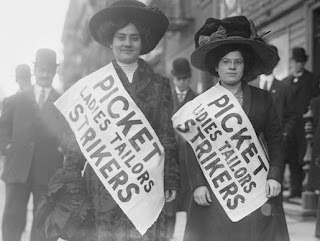
This installation examines the events that led to reform and improvement of deplorable workplace conditions, including the 1909 &#8220Uprising of the 20,000,&#8221 an industry-wide strike by workers affiliated with the fledgling International Ladies’ Garment Workers Union, and the 1911 Triangle Waist factory fire tragedy.

7. Art for the Masses: An Activist Theater, 1930-1945

This movement looks at the politically engaged New Yorktheater groups that used their art to confront Depression-era poverty, labor exploitation, political corruption, racial tension, and the rise of Fascism and Nazism in Europe.

8. We Shall Not Be Moved:New York and Civil Rights, 1945-1964

This installation revealsNew York City’s role in the early Civil Rights struggle of the post-World War II era, from the “Boycott Jim Crow” and anti-lynching movements through the emergence of CORE and SNCC, to the Black Power era of the mid-1960s.

9. What’s Wrong with New York? Conservative Activism, 1962-1973

This segment of the exhibition looks at groups, such as “Parents and Taxpayers,” that were unhappy with a leftward drift in the city and blamed it for an increase in disorder, crime, and the swelling municipal budget. Many joined a new third party, the Conservative Party of New York, formed in 1962.

10. Stop the Wrecking Ball! Preserving Historic New York, 1955-1970

This case study shows how the loss of some of the city’s greatest cultural and architectural landmarks fed the efforts of the early historic preservation movement and eventually led to the creation of New York’s groundbreaking Landmarks Preservation Law.

11. “Gay Is Good”: Civil Rights for Gays and Lesbians, 1969-2012

This installation shows how the Stonewall Riots galvanized the modern gay rights movement in New York and led to the creation of Gay Men’s Health Crisis, ACT UP, and other organizations. The installation brings the story up to date with the successful campaign to secure the legalization of gay marriages in New York State.

12. “Don’t Move, Improve”: Reviving the South Bronx, 1970-2012

The South Bronx became an international icon of urban blight in the 1970s. This section of the exhibition examines grassroots advocacy groups, community organizations, and church congregations that took ownership of the rebuilding of their neighborhoods into livable, affordable communities.

13. Love Your Lane: Bicycle Advocacy, 1965-2011

Amid concerns about ecology, traffic congestion, and pollution, pioneering activists lobbied for changes in the traffic laws. Today, as part of the Bloomberg administration PlaNYC’s effort to build a greener, more sustainable city, bike lanes proliferate, as does agitation against for and against them, as this installation documents.

14. Park 51: 2010-2012

This section provides a detailed exploration of the controversy over the construction of an Islamic cultural center near Ground Zero in Lower Manhattan, which is reminiscent of the long and turbulent saga of activism surrounding issues of religious expression in New York City.

Interactive elements throughout the exhibition provide opportunities to dig more deeply and bring the historic stories up to date. A series of touch screens present a timeline of the history of activism in the city, with more than two hundred examples ranging from slave revolts of the 18th century to the Newsboys’ Strike of 1899 to the woman behind the movement that led to New York’s 1978 “pooper scooper” law. Additional kiosks with touch screens invite visitors to explore the work of contemporary activist groups and send email messages to these groups expressing the visitors’ views on current activism. In addition, members of the general public may submit photographs of contemporary activist in the city to a photo blog housed on the Museum’s website (www.mcny.org) and carried live in the Puffin Foundation Gallery.

&#8220Activist New York&#8221 has been organized by an exhibition team led by Sarah M. Henry, the Museum’s Deputy Director and Chief Curator. Steven H. Jaffe served as guest curator, and Christina Ziegler-McPherson as associate guest curator. The exhibition team was aided by the Puffin Foundation Gallery Advisory Committee, chaired by Peter G. Carroll, Executive Director, Abraham Lincoln Brigade Archives, and comprising scholars and activists Esther Cohen, Joshua Freeman, Victor Navasky, Bruno Quinson, Christopher Rhomberg, Tom Roderick, and Perry, Gladys, and Neal Rosenstein.

Photo: Picketers during a 1910 garment workers strike (Library of Congress)

Last of the Mohicans Outdoor Drama Seeks Volunteers

The non-profit Last of the Mohicans Outdoor Drama is seeking volunteers and interns to assist with a variety of short term and long term assignments for their annual theatrical production in Lake George, NY this summer. This outdoor drama, which recently garnered the “Tourism Excellence for Cultural Heritage” from the NYS Tourism & Vacation Association, brings alive the pages of history through James Fenimore Cooper’s classic novel.

Participants will have a chance to learn more about local history, support a local non-profit organization and assist in bringing the historical dramatic performance to audiences of all ages. This opportunity also provides a learning experience for college students seeking to enter careers in theater, design, fashion design, construction, tourism, public relations and marketing.

Volunteers and college interns are specifically being sought to assist with costume, scenery and set production, delivering of promotional flyers to surrounding businesses, etc., as well as some duties during the actual performance dates which would include ticket booth, ushers  and back stage helpers.

Training and supervision will be provided but experience with live performances is a plus. Any volunteers under the age of 16 must be accompanied by an adult. All volunteers will receive complimentary passes to a performance of the historical outdoor drama and will be recognized for their efforts. Performance
dates for 2012 are July 27 to August 18th, with nightly performances on Tuesday, Wednesday, Friday and Saturday nights. There is one matinee performance on Saturday August 4th. Most volunteer assignments start in early June.

For more information about The Last of the Mohicans Outdoor Drama visit www.LastoftheMohicans.org. This summer’s production has received support in part by the Warren County Tourism Occupancy Tax Fund and with public funds from the New York Council on  the Arts Decentralization Program and administered by the Lower Adirondack Regional Arts Council.

Those interested in applying for volunteer work should email volunteer@LastoftheMohicans.
org or call 518-791-6342 or e-mail Maura Fox at [email protected] by May 15.

Tree Removal Planned for Vanderbilt Mansion NHS

The National Park Service (NPS) will soon begin work to remove hazardous trees along Route 9 at the Vanderbilt Mansion National Historic Site in Hyde Park (Dutchess County).

After a public comment period and agency reviews, the NPS made the decision to remove only trees that have been identified as high or severe risks to public safely. 100 trees will be removed out of the approximately 700 trees in this area. Once tree removal has been completed, 200 white pine trees will be planted in the understory, with the goal of re-establishing a visual barrier between the highway and estate grounds.  

During the project, the park will remain open to the public, but the work area will be closed for safety reasons. Some minor traffic delays may occur on Route 9 when trees leaning over the highway are removed.

Scholarships for Healing Retreats at Historic Adirondack Sites

Creative Healing Connections has several full and partial scholarships available for two upcoming arts and healing retreats for women living with cancer and other chronic illnesses on September 21st to 23rd and September 28th to 30th, 2012 at Great Camp Sagamore National Historic Landmark in the Adirondacks.

Creative Healing Connections also offers scholarships for two arts and reintegration retreats for women veterans. Those retreats are August 6th to 8th and 13th to 15th, 2012. The retreat for female military spouses is sold out this year. Read more

Historic Saranac Lake Offers Lecture Series

Historic Saranac Lake announced a new seminar series, titled &#8220History Matters,&#8221 to be held in May in the John Black Room of the Saranac Laboratory. The three Thursday discussions will focus on various topics of interest in Saranac Lake’s past.

The talks are presented by Historic Saranac Lake in collaboration with Paul Smith’s College. The series begins on May 17, with “The Development of the APA”, a panel discussion with Sandy Hayes and Steve Erman, moderated by Jim Hotaling. On May 24, the topic will be “History of Homesteading in the Adirondacks,” with Brett McLeod of Paul Smith’s College. On May 31, the theme is “Remembering the Olympics,” a panel discussion with Howard Riley, Jack LaDuke and Jim Rogers.


Three Thursday Discussions beginning at 7:00 p.m. in the John Black Room of the Saranac Laboratory, 89 Church Street, Saranac Lake. Entrance is $5 / person, members of Historic Saranac Lake free. Light refreshments will be provided.

40 NYC Historic Sites Vie for $3 Million, Vote Now

Forty historic New York places representing all five boroughs have been named finalists competing for $3 million in grants through Partners in Preservation, a collaboration between American Express and the National Trust for Historic Preservation.

The preservation effort powered by social media will allow the public to vote online through May 21, 2012 for the preservation projects most important to them at www.PartnersinPreservation.com. Participants can vote once a day, every day, for the same site or for different sites. The top four vote-getters, to be announced May 22, are guaranteed to receive grants for their preservation projects. A Partners in Preservation advisory committee of community and preservation leaders, will select sites that will receive the rest of the $3 million in grants.
To encourage voting, a “Preservation Station” vehicle will travel around New York City throughout the voting period, giving New Yorkers the opportunity to get their photos taken against the backdrop of their favorite sites and have those pictures projected onto buildings. To find out where the “Preservation Station” will be, follow @PartnersinPres and @AmericanExpress on Twitter.

The 40 historic places in New York City competing for the $3 million in grants are:

  • Alice Austen House Museum, Staten Island
  • Apollo Theater, Manhattan
  • Astoria Pool, Queens
  • Bartow-Pell Mansion Museum, Bronx
  • Brooklyn Public Library, Central Library, Brooklyn
  • Brown Memorial Baptist Church, Brooklyn
  • Caribbean Cultural Center, Manhattan
  • City Island Nautical Museum, Bronx
  • Cleopatra’s Needle, Manhattan
  • Coney Island B&B Carousell, Brooklyn
  • Congregation Beth Elohim, Brooklyn
  • Duo Multicultural Arts Center, Manhattan
  • Ellis Island Hospital Complex, Manhattan
  • Erasmus Hall Campus, Brooklyn
  • Federal Hall National Memorial, Manhattan
  • Flushing Town Hall, Queens
  • Gateway National Recreation Area, Brooklyn
  • Greenpoint Manufacturing and Design Center, Brooklyn
  • Guggenheim Museum, Manhattan
  • Helen Hayes Theatre, Manhattan
  • Henry Street Settlement, Manhattan
  • High Line, Manhattan
  • Intrepid Sea, Air & Space Museum, Manhattan
  • Japan Society, Inc., Manhattan
  • Jefferson Market Library, Manhattan
  • Louis Armstrong House Museum, Queens
  • Lower East Side Tenement Museum, Manhattan
  • Mind-Builders Creative Arts Center, Bronx
  • Museum of the City of New York, Manhattan
  • New York Botanical Garden, Bronx
  • Our Lady of Mount Carmel Society of Rosebank, Staten Island
  • Queens County Farm Museum, Queens
  • Rocket Thrower, Queens
  • Rossville African Methodist Episcopal Zion Church, Staten Island
  • Smithsonian National Museum of the American Indian, Manhattan
  • St. Mark’s Church in the Bowery, Manhattan
  • Staten Island Museum at Snug Harbor, Staten Island
  • Tug Pegasus & Waterfront Museum Barge, Brooklyn
  • eeksville Heritage Center, Brooklyn
  • Woodlawn Cemetery, Bronx