A Celebration of William and Henry James

The contributions of William and Henry James will be highlighted at a presentation entitled At the Gateway to Modernism: A Celebration of William and Henry James on Wednesday, Nov. 10, from 6 to 8 p.m. at the University at Albany. The event, which is free and open to the public, will take place in the Standish Room of the Science Library on the uptown campus.

Renowned author Henry James and his brother William, a psychology professor and philosopher, had many ties to the Albany area, according to Associate Professor of English Mary Valentis, who organized the event as director of the Center for Humanities, Arts, and TechnoScience (CHATS). &#8220Many of the James family relatives are buried in Albany Rural Cemetery,&#8221 she said. &#8220The father graduated from the Albany Academy, and the grandfather made his fortune in Albany real estate.&#8221 Henry James even opened his story, Portrait of a Lady , in a brownstone on Albany’s State Street.

The significant works and pivotal thought of the two brothers helped shape the 20th Century and more particularly the intellectual, artistic, and philosophical moment now called modernism.
Henry and William James

Author Henry James and his brother William, a psychology professor and philosopher.

The panel of experts celebrating the James family will include:

• Professor Ronald A. Bosco, Distinguished Professor of English and American Literature at UAlbany,

• Professor Linda Simon of Skidmore College, and

• Dean of UAlbany’s College of Arts and Sciences Edelgard Wulfert, professor of psychology.

The celebration will extend to the spring semester, when on March 4, 2011, Henry James on the Stage will be featured at the UAlbany Performing Arts Center. From 3 to 5 p.m. on that day, Dr. Barbara Blatner, Yeshiva University Workshop, will do an adaptation of Henry James’s short stories for poetry and stage. From 7 to 10 p.m. that same evening, there will be a staged reading of Larry Lane’s new play inspired by Henry James’s Aspern Papers. Playwright and director Lane adapted Melville’s Bartleby the Scrivener for stage. After the reading, theater goers will have an opportunity to talk with Lane.

Photo: Author Henry James and his brother William, a psychology professor and philosopher.
Freedoms Treasures Exhibit Headed to Capitol

Governor David A. Paterson has announced that the &#8220Freedom’s Treasures&#8221 exhibit, a rare display of Revolutionary War-era and early nation period historical artifacts, including a handwritten draft of Washington’s Farewell Address, will be open to the public at the State Capitol’s ceremonial Red Room, from 10 AM to 4 PM on November 10-11.

The exhibition, entitled &#8220Freedom’s Treasures,&#8221 features a collection from the New York State Library, Archives and Museum of some of New York’s most important Revolutionary Era artifacts that have rarely been seen by the public. Featured in the exhibition is an original draft of George Washington’s Farewell Address penned in his hand that was sent to Alexander Hamilton for comment and revision on May 15, 1796. The document is part of the George Washington Collection at the New York State Library and was rescued from the fire that ravaged the State Capitol in 1911.

&#8220Freedom’s Treasures&#8221 also will give the public the chance to see a dress sword allegedly given to General Washington by Frederick the Great. The sword was purchased by the State of New York directly from Washington’s family in 1871 and is depicted in the Washington portrait that hangs in the United States House of Representatives. According to Washington family tradition, the sword was given to General Washington
with this verbal message from Frederick (the Great) II, King of Prussia: &#8220From the oldest general of the world to the greatest.&#8221

Among the other artifacts included in this exhibition are a portrait of New York State’s sixth Governor DeWitt Clinton and a writing desk he used. In office during two non-consecutive terms, Clinton was responsible for the building of the Erie Canal. The exhibit also includes the original engrossed copy of the U.S. Constitution sent to
New York State for ratification and the &#8220spy papers&#8221 retrieved from British Major John Andre’s boot that implicated American General Benedict Arnold in the West Point conspiracy.

The full list of exhibited items includes, Washington’s Farewell Address, Bronze bust of George Washington, Leaves from Washington’s copy of &#8220A Representation of the Cloathing of His Majesty’s Household and of all the Forces upon the Establishments
of Great Britain and Ireland&#8221 (the uniform book), Washington’s dress sword, Benedict Arnold / John Andre papers, A print of John Andre crossing the Hudson River (based upon his own drawing of the event), an engrossed copy of the original U.S. Constitution, a DeWitt Clinton portrait, and DeWitt Clinton’s writing desk and chair.

Reservations are required for those interested in visiting the Freedom’s Treasures exhibit on Wednesday, November 10. On Wednesday, those who are registered for the tour should meet at the Plaza Visitor Center, North Concourse, Empire State Plaza, Albany. For those interested in making reservations for Wednesday, November 10, should
visit: http://www.ogs.state.ny.us/.

Reservations are NOT required on Thursday, November 11. Those interested in viewing the exhibit should enter the Capitol directly and follow the signs that will be posted. Visitors can gain access to the Capitol either from State Street or through the Empire Plaza Concourse.

For those who can’t see the items in person, a website has also been established.


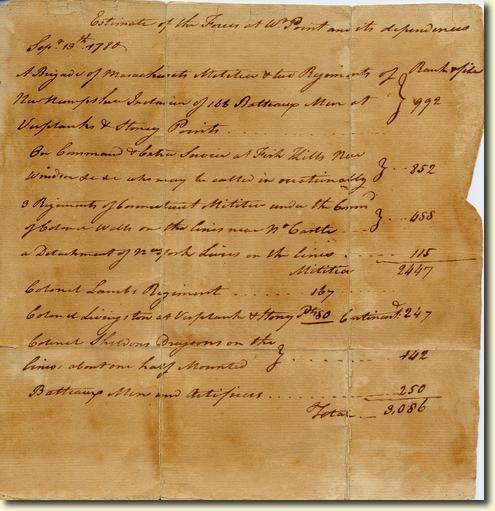
Photo: An estimate of items at West Point one of several documents that were found in Major Andre’s boot when he was captured trying to get to West Point in 1780.

New Guide: Chronicles of Old New York

It’s been said that the history of New York City is written in its streets. A new Museyon Guide, Chronicles of Old New York: Exploring Manhattan’s Landmark Neighborhoods by third generation New Yorker James Roman (who can be found on re-runs of HBO’s Six Feet Under), provides an opportunity to really discover the 400 years of the city’s history. Illuminating those streets through the true stories of the visionaries, risk-takers, dreamers, and schemers who built Manhattan is the strength of this unusual guide.

With eight historical walking tours, illustrated with Chronicles of Old New York is enjoyable for history buffs, city residents, occasional visitors, or tourists. The guide includes detailed maps and full-color photographs, 25 meticulously researched articles on dramatic stories from New York history including episodes from the lives of John Jacob Astor, Cornelius Vanderbilt, Stanford White, Gertrude Whitney, Donald Trump, and more. Sidebars on taverns, townhouses, architecture, and neighborhoods, a detailed timeline of historical events, and walking tours of nine historic New York neighborhoods tat include include detailed maps and subway directions make this guide handy.

Chronicles of Old New York includes nearly 60 historical maps, over 100 photographs and illustrations from the collections of the New York Public Library, the New-York Historic Society, New York University Archive, the Smithsonian Institute Portrait Collection, the Lower East Side Tenement Museum, and the Museum of the City of New York.

Note: Books noticed on this site have been provided by the publishers. Purchases made through this Amazon link help support this site.

Ogdensburgs Lighthouse Point Makes Historic Register

The Fort La Presentation Association’s historic Fort de la Presentation property on Lighthouse Point, already listed on the New York State Register of Historic Places, will soon join the seven Ogdensburg sites recognized by the National Register of Historic Places.

Senator Kirsten Gillibrand’s office has helped move the Fort Association’s application forward, and her office reports the Fort historic site on Lighthouse Point should be on the Federal Register soon.

“Fort de la Presentation, one of the historic jewels in New York State, once played a vital role in the formation of our nation. Once fully restored, the Fort has the potential to attract thousands of tourists, which will help stimulate the region’s economy through new development and job creation,” said Senator Kirsten Gillibrand. “As New York’s first Senator from Upstate in nearly 40 years, I am proud to support the restoration of this beautiful, historic site. Thanks to the work of the Fort La Presentation Association, New Yorkers will soon be able to enjoy this landmark restored to its former glory.”

“The Fort Association is grateful to Senator Gillibrand for her staunch backing of the Fort Project and the assistance of her office to have the Fort’s location listed on the National Register of Historic Places, along with Ogdensburg’s registered heritage sites,” said Barbara O’Keefe, President of the Fort La Presentation Association. “Becoming an acknowledged member of this distinguished group will positively impact our work toward building our Interpretive Center. The recognized historical importance of our property gives us credibility among potential donors as we continue planning to build Fort de la Presentation.”

From the mid-18th century to the early 19th century the fort at the mouth of Oswegatchie River, under French, British and American flags, influenced the development of Ogdensburg and its role in the history of the United States.

“In addition to honoring the City’s place in American, Canadian, and Native histories, placement of these lands on the National Register of Historic Places positions the Fort La Presentation Association to use the site to continue to play an important role contributing to the development of historic tourism and local hospitality businesses, as well as the overall growth of our local economy,” said Ogdensburg City Manager Arthur J. Sciorra.

The Acker and Evans Law Office, New York State Armory, Ogdensburg Armory, Oswegatchie Pumping Station, U.S. Customs House, U.S. Post Office, and Library Park Historic District have met the criteria to be worthy of federal recognition and preservation because of their links to American history.

Until the building of the Interpretive Center and Fort de la Presentation, the interpreted site on Lighthouse Point will attract tourists who would not usually venture this way and indicate to residents the significance of their community’s history.

This Weeks Top New York History News

Each Friday morning New York History compiles for our readers the previous week’s top stories about New York’s state and local history. You can find all our weekly news round-ups here.

Subscribe! More than 550 people get New York History each day via E-Mail, RSS, or Twitter or Facebook updates.

Washington Post Launches Civil War 150 Site

Marking the 150th anniversary of the Civil War, the Washington Post newspaper will provide special ongoing coverage with commentary from experts, sesquicentennial news and an updating event calendar at a new site, Civil War 150.

A sampling of some of the articles and features on the site includes articles like &#8220The Civil War taught us to fight for the right to be wrong&#8221 and &#8220Civil War panelists join ‘A House Divided’: If Lincoln hadn’t won the election, would there have been a war?&#8221 Interactive features include a photo request for reenactors, a photo gallery &#8220Washington, D.C.: 1860 and today&#8220, a quiz entitled &#8220How well do you know Abe?&#8220, and a Civil War events guide.

April 2011 will mark the 150th Anniversary of the firing on Fort Sumter and the start of the American Civil War. While the State of Vermont has laid out preliminary plans for the multi-year observance that include several large statewide events, as well as coordination of community-based activities, New York State has nothing planned and no organization set to undertake commemoration planning.

New York provided 400,000-460,000 men during the war, nearly 21% of all the men in the state and more than half of those under the age of 30. By the time the Civil War ended in 1865, New York had provided the Union Army with 27 regiments of cavalry, 15 regiments of artillery, 8 of engineers, and 248 of infantry.[5] Federal records indicate 4,125 free blacks from New York served in the Union Army, and three full regiments of United States Colored Troops were raised and organized in the Empire State—the 20th, 26th, and 31st USCT.

No actual Civil War battles were fought within the Empire State, although Confederate agents did set several fires in New York City. New York troops were prominent in virtually every major battle in the Eastern Theater, and some in the Western Theater. New Yorker John Schofield rose to command of the Army of the Ohio and won the Battle of Franklin, dealing a serious blow to Confederate hopes in Tennessee.

More than 27,000 New Yorkers fought in the war’s bloodiest battle, the three-day Battle of Gettysburg in July 1863. During the entire war, 834 officers were killed in action, as well as 12,142 enlisted men. Another 7,235 officers and men perished from their wounds, and 27,855 died from disease. Another 5,766 were estimated to have perished while incarcerated in Southern prisoner-of-war camps.

This Weeks New York History Web Highlights

Each Friday afternoon New York History compiles for our readers a collection of the week’s top weblinks about New York’s state and local history. You can find all our weekly round-ups here.

Subscribe! More than 550 people get New York History each day via E-Mail, RSS, or Twitter or Facebook updates.

Admiral Byrd’s City of New York Relics at Auction

The wheel, binnacle (compass) and bell from the ship the City of New York, famously used in Admiral Byrd’s 1929 exploration of Antarctica, and infamously a ship that failed to aid the imperiled Titanic, will be offered for the first time at public auction on November 17th in Dallas, Texas. The items are expected to bring over $10,000.

The history of the City of New York began in 1885, when she was known as the Samson, a 170-foot steam barque, whose first duty was as a sealing ship operating in arctic waters. On the night of April 14, 1912, loaded with 3000 pounds of illegal frozen seal in her hold, Samson was in the waters off Newfoundland and Labrador.

“On the horizon the crew saw signal rockets fired into the night by an unidentified ship,” said auction director Tom Slater. “Fearing a boarding by the Royal Navy, the crew doused the ship’s lights and quickly steamed out of the area. A few days later the captain of Samson heard the news of the sinking of RMS Titanic with the loss of 1517 lives.”

As additional news of the disaster spread, it became clear to the captain and crew of Samson that they did not come to the Titanic’s aid. The captain of SS Californian, another ship in the vicinity which did not respond, was publicly pilloried and became an outcast. Those on the Samson all wisely kept quiet about their unknowing abandonment of Titanic until 1962, the 50th anniversary of the sinking.

The Samson continued to ply the icy waters of the world, well known to the men racing to find glory in the arctic and Antarctic. In 1915 it rescued Sir Ernest Shackleton, who, having been beaten to the South Pole by Robert Falcon Scott and Roald Amundsen, turned his attention to an attempt to cross the Antarctic continent. When his ship, the Endurance, became icebound, it was the Samson that finally got him and his men to safe harbor after more than a year in the icy wilds.

It was actually Amundsen himself that recommended Samson to America’s Admiral Richard Byrd, who was planning an expedition to the Antarctic. Byrd followed his friend’s advice and purchased Samson to be his flagship on the expedition. It was renamed the City of New York, and in 1928 went with Byrd on his first expedition, along with one more ship and three airplanes. From there, City of New York participated in the photographic expeditions and geological surveys and the famous Nov. 28, 1929 flight to the South Pole and back, which captivated the world.

“The flight was successful, if harrowing, and it entered Byrd into the history books,” said Slater. “The expedition returned to North America on June 18, 1930 and was honored with the gold medal of the American Geographical Society.”

Byrd became wildly popular, and interest in his expedition did not diminish. In 1932, City of New York was sailed through the Great Lakes to the site of the Chicago World’s Fair. There, the ship was outfitted with artifacts of the expedition, and served as a floating museum throughout the fair.

In 1944, legendary yachtsman Lou Kennedy, bought City of New York, and converted her into a three-masted schooner. During the refitting, Kennedy discovered the ship’s wheel, binnacle (compass), and bell were all original equipment on Samson, and that Byrd had the bell and wheel engraved with the ship’s new name, City of New York when he retrofitted it in 1927. Kennedy replaced them and kept the originals, along with an intricately knotted ceremonial bell-pull used to ring President Franklin D. Roosevelt aboard when he visited the Chicago World’s Fair in 1933. The old ship burned and sank in 1953, ending a long career where she played a role in some of the twentieth century’s greatest sea tragedies and triumphs.

Heritage Auctions, headed by Steve Ivy, Jim Halperin and Greg Rohan, is the world’s third largest auction house, with annual sales more than $600 million, and 500,000+ registered online bidder members. For more information about Heritage Auctions, and to join and gain access to a complete record of prices realized, along with full-color, enlargeable photos of each lot, visit HA.com.

NY Military Museum Director to Speak

Michael Aikey, Director of the New York State Military Museum, and a founding member of the Capital District Civil War Round Table, will give a talk on November 13th at the Schenectady County Historical Society. His topic is the collections of the New York State Military Museum housed in the historic Saratoga Armory building. The museum preserves the military history of New York State, and the history of New York State’s National Guard. Aikey’s talk will be a special introduction to the museum located in Saratoga Springs.

The museum was started in New York State in 1863, during the Civil War, and moved to several locations before finding a permanent home, in 2001, in the Saratoga Armory at 61 Lake Avenue, Saratoga Springs, New York. The museum houses over 10,000 artifacts from the Revolutionary War period to the present, including historic weapons, artillery pieces, uniforms, flags and artwork. The museum has a gallery, a library, a gift shop and offices for the Veteran Research Center, an oral history program. Aikey’s talk will be of particular interest to anyone interested in the military history of New York State, and the place in history of New York State veterans, including the history of the New York Army National Guard.

Michael Aikey has been working for the New York State Division of Military and Naval Affairs (DMNA) since 1996 serving as the Director of the New York State Military History Task Force, Librarian/Archivist, and Deputy Director, before moving to the directorship of the New York State Military Museum/Research Center in 2002. He is a graduate of the State University of New York at Albany’s School of Information Science and Policy, with experience working in both public and academic libraries before going to DMNA.

Mr. Aikey was a founding member of the Capital District Civil War Round Table, has published articles on military history, guest curated several museum exhibits and worked as an NEA grant consultant. He lectures on New York State military history and the Civil War. Currently he serves on the Capital District Library Council’sboard of directors. His spare time is frequently involved in historical research, and tinkering with classic British cars.

This program is free and open to the public. There will be refreshments at 1:30 pm on Saturday prior to the talk at 2:00 pm. The Schenectady County Historical Society is located at 32 Washington Avenue, Schenectady, NY 12305. The building is wheel chair accessible with off-street parking. For more information contact Katherine Chansky at (518) 374-0263 or email [email protected]. Find directions to SCHS at www.schist.org.