Local Foods Writer at the Adirondack Museum

If you love to cook and support regional agriculture, join a discussion about cooking with local ingredients in the Adirondack region.

On Monday, August 23, 2010 food writer Annette Nielsen will offer a program entitled &#8220North Country Foodways in the 21st Century&#8221 at the Adirondack Museum, Blue Mountain Lake, New York.

The final offering of the season in the museum’s Monday Evening Lecture series, the presentation will be held in the Auditorium at 7:30 p.m. There is no charge for museum members. Admission is $5.00 for non-members.

Annette Nielsen is the editor of Northern Comfort, Recipes from Adirondack Life &#8211 the fall and winter edition, as well as the newly released Northern Bounty: Spring & Summer Recipes from Adirondack Life.

Drawing on recipes from both cookbooks, Nielsen will identify ways to obtain ingredients throughout the entire year, whether sourcing from forest, orchard, or farm.

Nielsen, a food writer, has contributed articles and columns on regional farms, food and folkways to a variety of publications and has conducted farm-to-table tours and cooking classes at the Battenkill Kitchen, in Washington County, N.Y. for youth and adults.

She worked earlier in her career with Glorious Food, a catering concern in New York, and taught principles of healthful eating and cooking to teens and parents in underserved areas of Washington, DC with Share Our Strength’s Chef Outreach Program.

Photo: Annette Nielsen, photo by Elias Garfinkel.

You Are Needed at Headquarters at New Windsor Cantonment

&#8220You Are Needed at Headquarters” a special presentation on the important role of the Continental Army military headquarters in Newburgh and New Windsor, will be held at the New Windsor Cantonment on September 25, 2010. The event includes special tours of the Edmonston House, headquarters for Major General Arthur St. Clair, Knox’s Headquarters State Historic Site and Washington’s Headquarters State Historic Site.

Once the British captured New York City, in 1776, the natural defenses of the Hudson Highlands sheltered the Continental Army for the remainder of the war, except for a few weeks, in the fall of 1777. Many of the homes in the valley were used as military headquarters. Typically, the soldiers stayed in tents during mild weather and constructed log huts for the winter. The highest ranking officers vied with each other to stay in the most comfortable houses available. In the sparsely populated Highlands, there were few places large enough to accommodate the generals and their retinue, without being a major burden on the property owner, who often continued living in the house. Learn about the role of these headquarters and the interaction between the army and their often reluctant hosts.

The formal presentation, at the New Windsor Cantonment, from 1:00 to 2:00 PM, will give visitors the background of the American military presence, in the Hudson Valley, during the Revolutionary War. General George Washington made his headquarters at the home of the widow Hasbrouck, south of Newburgh. The modest fieldstone home was used for 16 months, the longest occupation of any headquarters by Washington. Constructed in 1754, the elegant John Ellison house was the military headquarters for Quartermaster General Nathanael Greene and artillery commander General Henry Knox, in 1779. Knox returned in 1780-81 and over the summer of 1782. Appointed commander of the army at New Windsor, in October 1782, General Horatio Gates, victor of the Battle of Saratoga, resided there from November 1782-April 1783. First billeted at the Edmonston House, Gates complained directly to Washington that “your Excellency’s dog kennel at Mount Vernon, is as good a Quarter as that I am now in.” If the Edmonston House was any where near as bad as Gates intimated, it was fortunate that the New Hampshire, New Jersey, New York and Maryland Detachment commander, at the New Windsor Cantonment, General Arthur St. Clair, the next occupant, spent much of the winter of 1782-83 home on furlough.

From 2:00 to 5:00 PM, visitors are invited to visit Washington’s Headquarters State Historic Site on Liberty Street, in Newburgh, New York, Knox’s Headquarters, at the intersection of Route 94 and Forge Hill Road, in Vails Gate and Edmonston House, located on Route 94, west of the Vails Gate intersection with Routes 32 and 300. There is a small fee to tour Washington’s Headquarters and the Edmonston House. For more information please call New Windsor Cantonment at (845) 561-1765 ext. 22. New Windsor Cantonment is co-located with the National Purple Heart Hall of Honor on Route 300 (374 Temple Hill Road) in the Town of New Windsor, four miles east of Stewart Airport. It is three miles from the intersection of I-87 and I-84 in Newburgh, New York.

Cazenovia Colleges Lecture Series

The seventh season of Cazenovia College’s Faculty Library Lecture Series: &#8220Great Minds / Great Ideas,&#8221 at Cazenovia Public Library and the Manlius Library, continues beginning Tuesday, Sept. 21, 2010. The series, sponsored by Doris Eversfield Webster, Cazenovia College Class of 1946, features noted faculty members from Cazenovia College discussing the lives and work of important thinkers who opened doors of opportunity for the human spirit. Ample time for questions and conversation follows each lecture. Complete information may be found at www.cazenovia.edu/greatminds.

Sept. 21, 2010, at The Manlius Library, 1 Arkie Albanese Avenue, Manlius, N.Y. &#8220Real Horse Power!&#8221 presented by Karin Bump, professor of equine studies. This presentation will encompass a journey through time to provide an understanding of &#8216-horse power’ from past to present, and celebrate the remarkable power of the horse to capture the hearts and minds of young and old alike.

Sept. 21, 2010, at Cazenovia Public Library, 100 Albany Street, Cazenovia, N.Y. &#8220What a Great Idea! The Inventive Minds behind Some of Our Favorite Toys,&#8221 presented by Scott Jensen, assistant professor of visual communications. The creators of many familiar toys all started with a great idea&#8230- but didn’t always know what to do with it. Discover the fascinating stories of these and some other familiar playthings in this fun, playful lecture.

Oct. 19, 2010, at The Manlius Library, 1 Arkie Albanese Avenue, Manlius, N.Y. &#8220What a Great Idea! The Inventive Minds behind Some of Our Favorite Toys,&#8221 presented by Scott Jensen, assistant professor of visual communications. The creators of many familiar toys all started with a great idea&#8230- but didn’t always know what to do with it. Discover the fascinating stories of these and some other familiar playthings in this fun, playful lecture.

Oct. 19, 2010, at Cazenovia Public Library, 100 Albany Street, Cazenovia, N.Y. &#8220Numbers: How They Amaze Us,&#8221 presented by John Livermore, assistant professor of mathematics. Number theory is the branch of mathematics that deals with the study of the properties of the natural numbers. Livermore will discuss our base 10 number system, some basic number theory proofs and how the results of these proofs are applied on the Internet to amaze us.

For more information about the lectures, contact: Cazenovia Public Library at 315-655-9322, or visit www.midyork.org/cazenovia – or The Manlius Library, at 315-682-6400, or visit www.manliuslib.org

Mountain Men Return to the Adirondack Museum

The grounds of the Adirondack Museum at Blue Mountain Lake, New York will become a lively 19th century tent city with an encampment of American Mountain Men interpreting the fur trade and a variety of survival skills this weekend, August 20 and 21, 2010.

The group will interpret the lives and times of traditional mountain men with colorful demonstrations and displays of shooting, tomahawk and knife throwing, furs, fire starting and cooking, clothing of both eastern and western mountain styles, period firearms, and more. This year’s encampment may include blacksmithing as well as a beaver skinning and fleshing demonstration.

All of the American Mountain Men activities and demonstrations are included in the price of regular Adirondack Museum admission. There is no charge for museum members. The museum is open daily from 10:00 a.m. until 5:00 p.m.

Participants in the museum encampment are from the Brothers of the New York, Vermont, New Hampshire, and Massachusetts segment of the national American Mountain Men organization. Participation in the encampment is by invitation only.

Mountain men are powerful symbols of America’s wild frontier. Legends about the mountain man continue to fascinate because many of the tales are true: the life of the mountain man was rough, and despite an amazing ability to survive in the wilderness, it brought him face to face with death on a regular basis.

The American Mountain Men group was founded in 1968. The association researches and studies the history, traditions, tools, and mode of living of the trappers, explorers, and traders known as the mountain men. Members continuously work for mastery of the primitive skills of both the original mountain men and Native Americans. The group prides itself on the accuracy and authenticity of its interpretation and shares the knowledge they have gained with all who are interested.

Women and Divorce: 19th Century Outrage-21st Century Strategies

The Buffalo & Erie County Historical Society, in collaboration with co-sponsors Adrienne Rothstein Grace, Certified Financial Planner, and the Western New York Women’s Bar Association, will present &#8220Women and Divorce: 19th Century Outrage/21st Century Strategies,&#8221 an evening of speakers on the topic of the changing rights and history of women and divorce in New York State on Thursday, August 26, at 7 p.m.
at the Buffalo & Erie County Historical Society, 25 Nottingham Court (at Elmwood Ave.).

Keynote speaker Dr. Ilyon Woo is the author of The Great Divorce: A Nineteenth-Century Mother’s Extraordinary Fight against Her Husband, the Shakers, and Her Times (Atlantic Monthly Press). The book tells the story of Eunice Hawley Chapman, whose husband left her, taking their children, and joined the Shakers, a reclusive religious sect. At the time, a married woman in her circumstances had few rights and no legal identity. Chapman sought unprecedented intervention, and fought hard for the return of her children, rallying even the State legislature. Dr. Woo will speak on the topics addressed in her book. She will also sign copies of the book, which is available in the Museum’s gift shop

Attorney Carol A. Condon will address present-day New York State divorce law. New York is the last state in America to consider putting no-fault divorce laws on its books. Condon is a member of the Family Law Committee of the Bar Association of Erie County, and of the New York State Bar Association. She is a frequent speaker and author on topics related to divorce and family law. Condon is the past president of the Western New York Chapter of the Women’s Bar Association of the State of New York.

Co-sponsor Adrienne Rothstein Grace, Certified Financial Planner and Certified Divorce Financial Analyst, will present information specifically on the topic of divorce financial planning. Rothstein Grace has a widely varied background in financial services. She is currently with Mass Mutual/The Buffalo Agency. In concert with attorneys and mediators, Rothstein Grace helps clients in divorce gain clear ideas of their financial position, outline different settlement scenarios, and forecast long term effects.

The event is $7.00- Free to Historical Society and Western New York Women’s Bar Association members. For more information log on to www.buffalohistory.org, e-mail [email protected], or call 873-9644 x319.

VT: British Raid on Addison County to be Recreated

Addison County was “A nest of the greatest rebels in that part of the country,” when British forces led by Major Christopher Carleton invaded the area, determined to eliminate any possible supplies for rebel troops. Carleton’s 21 day expedition of 350 soldiers and 100 Indians, supported by naval vessels on the lake, proudly tallied up their success: crops destroyed, livestock slaughtered, barns and homesteads burned – nearly 100 structures and enough supplies to feed 12,000 men for four months.

On August 21 and 22, Lake Champlain Maritime Museum’s “Rabble in Arms” weekend offers an insider’s look at the experiences of British and Rebel combatants, and an average frontier family, during these volatile years of the American Revolution. With the defeat of General Burgoyne at Saratoga in 1777, the British feared a possible American counter-offensive from the Champlain Valley into Canada, and the following year Major Christopher Carleton, nephew of Canada’s Governor -General Sir Guy Carleton, led the invasion known as “Carleton’s Raids,” targeting homesteads in Addison County Vermont.

To recreate these dramatic events, some of the re-enactors take British roles, and even LCMM’s venerable gunboat Philadelphia II will be transformed into the captured American gunboat Jersey, carrying British troops. On Saturday, the British troops will make landfall and establish a foothold at the museum’s North Harbor, defended by local militia. A “homestead” will be raided and put to the torch on Saturday afternoon. On Sunday, the public can meet the re-enactors of both camps, before a final skirmish with the departing British troops.

A further perspective on the Revolutionary War in the Champlain Valley is provided on Saturday at 1:00 p.m., when historians Paul Huey and Tom Barker, in Braunschweig Jaeger uniform, present the viewpoint of the Hessian troops in a special presentation “German Maps and Myths about the War for Independence.” Copies of their forthcoming book on the subject can be pre-ordered from the museum store.

Food service for the event is available on-site, or receive a 20% discount the Red Mill Restaurant with your museum admission. Lake Champlain Maritime Museum, at 4472 Basin Harbor Road, is open daily from 10 am – 5 pm. For more information see www.lcmm.org or call 802 475-2022.

Lecture on the Battles at Plattsburgh

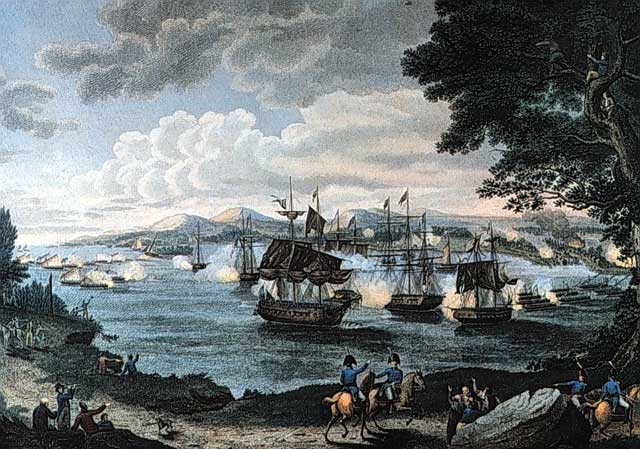
The Wilmington Historical Society invites you to their program with historian and author Keith Herkalo “September 11th, 1814: The Battles at Plattsburgh” to be held on Friday, August 20th at 7 pm at the Wilmington Community Center on Springfield Road in Wilmington, Essex County, NY.

Would the United States exist if our naval and land Battles at Plattsburgh on September 11, 1814 had been lost? For the United States, the War of 1812 is often referred to as “the second war for independence”. We have learned of the battles at Baltimore, Washington and Sacketts Harbor, but what about the Battles at Plattsburgh?


Keith Herkalo, using personal journals, military journals, contemporary newspaper accounts, and other original source documents, examines the evidence that leads to the conclusion that the Battles at Plattsburgh on land and on Lake Champlain, were actually the key battles of the War of 1812. He claims that were it not for the exemplary talents and skills of two young military officers, Commodore Thomas McDonough and General Alexander Macomb, a small force of regular army and navy personnel and New York Militia, a few thousand Vermont Militia, a handful of Native Americans and Veteran Exempts (those too old for military service), and a group of boys from a local school, the United States, as we know it today, would not exist.

Plattsburgh City Clerk and a charter member of the Battle of Plattsburgh Association, Keith Herkalo believes that the Battles at Plattsburgh and the individuals who fought in the War of 1812 in the Champlain Valley and surrounding area deserve national recognition. Karen Peters, President of the Wilmington Historical Society, notes that many area residents of that time period participated in the land battle, including Major Reuben Sanford of Wilmington who commanded a regiment of detached militia. Stephen Partridge, also of Jay and Wilmington was one of the first to be killed in action in a skirmish at Culver Hill on September 6, 1814, a few days prior to the main battle.

Having grown up in both Philadelphia and Plattsburgh, and spending more than a decade in military service, Keith Herkalo returned to Plattsburgh developing a keen interest in Plattsburgh’s history with a particular attention to Plattsburgh’s involvement in the War of 1812. He is a builder and member of the boat crew of the award-winning bateau “Rooster” (the 37-foot replica of an 1812 era work boat). As an 1812-era re-enactor and an amateur historian he is the research catalyst behind the archaeological re-discovery and preservation of the 1812 Camp Site known as “Pike’s Cantonment” and the Crab Island Graves location. He is the editor of The Journalof H.K. Averill. Sr.: An Account of the Battle of Plattsburgh and Early North Country Community, and author of September 11th, 1814: the Battles at Plattsburgh which documents Plattsburgh’s importance in the War of 1812.

The “September 11th, 1814: The Battles at Plattsburgh” program on August 20th is free and open to the public. Refreshments will be served. For further information, contact Karen Peters at (518) 524-1023 or Merri Peck at (518) 946-7627.

Illustration: Naval battle on Lake Champlain. Engraving in 1816 by B. Tanner.

Glimmerglass Opera to Perform at Adk Museum

On August 17, 2010 Adirondack Museum visitors can enjoy early nineteenth century American music as the Glimmerglass Opera Company’s Young American Artist program performs &#8220They Heard American Singing,&#8221 an evening of music by Aaron Copland and Charles Ives, as well as songs that influenced both of these original composers.

The program will include tunes that made up the fabric of American life at the turn of the twentieth century: hymns, folk tunes, opera, and a liberal sprinkling of ragtime.

The gates will open at 5:30 p.m. for guests who wish to bring their own picnic. The performance itself will begin at 7:00 p.m. The cost of the concert only is $25. Tickets for the concert will be available at the door. Limited seating will be available. Guests are asked to bring lawn chairs or a blanket.

Proceeds from the performance will support exhibits and programs at the Adirondack Museum.

Glimmerglass is an internationally renowned opera festival that offers four productions each summer season in the Alice Busch Opera Theater on the shores of Otsego Lake in Cooperstown, New York.

The Young American Artists Program was established at Glimmerglass Opera in 1988 to promote an artistically challenging environment for young American performers. The program provides training and performance experience for talented singers at the beginning of their professional careers.