New Book On The Woolworth Building

The New York Times is reporting on a new book by Gail Fenske, a professor of architecture at Roger Williams University: The Skyscraper and the City: The Woolworth Building and the Making of Modern New York.

On the evening of April 24, 1913, President Woodrow Wilson pressed a tiny button inside the White House, lighting up the Woolworth Building in Manhattan. It was “the tallest structure in the world, with the one exception of the Eiffel Tower in Paris,” The New York Times reported, and it was a marvel of architecture and engineering.

Of course, the Woolworth Building has been surpassed in height — by the Chrysler Building in 1930 and by the Empire State Building in 1931 — and it has at times seemed to recede into the fabric of Lower Manhattan. The building’s owners at one point considered converting the building into luxury apartments, but now the structure is being refurbished as top-end offices.

The book places the Woolworth Building in the context of its time and place: the booming commercial culture of early 20th century New York- the often unsettling experience of modernization- advances in technology and communications- and a new phenomenon of “urban spectatorship” that made skyscrapers sources of public wonder and admiration.

Many innovations set the Woolworth Building apart. It contained a shopping arcade, health club, barber shop, restaurant, social club and even an observatory. Its use of technology — including an innovative water supply system, a electrical generating plan, high-speed electric elevators providing both local and express service and what Professor Fenske calls “the first prominent use of architectural floodlighting in the world” — also set it apart. So did the construction process, run by the builder Louis Horowitz of the Thompson-Starrett Company, who managed to avoid labor conflict, rationalize the building process and set a record for speed — paving the way for the famously rapid completion of the Empire State Building nearly 20 years later.

The building has survived the Woolworth Corporation itself. The company announced in 1997 that it would close its remaining discount stores. The company was renamed the Venator Group, began focusing on athletic wear, and since 2001 has done business under the Foot Locker name. Although there are no longer Woolworth’s stores in the United States, the Woolworths Group, a former subsidiary of the American company, continues to operate hundreds of retail stores in Britain.

FDR Library literally falling apart

From the New York Times, via the History News Network:

The Franklin D. Roosevelt Presidential Library and Museum at Hyde Park, N.Y., the nation’s first presidential library, is literally falling apart. The roof leaks, the basement floods, asbestos is flaking from old steam pipes, an ancient electrical system could send the whole place up in smoke. This sorry situation is an insult to the person the library and museum honor: the founder of the New Deal, the greatest investment in our nation’s modern development&#8230-.

While the library sits high above the river, its basement lies below the water table. Sump pumps installed in 1939 are supposed to keep it dry, but don’t. Storms have caused flooding in the basement where collections are stored and in restrooms and public areas. What’s worse, storm and sewer drainage run together, which means they mingle if there’s a backup in the basement.

The electrical system, which was also installed in 1939, has outlived the suppliers of replacement parts. Archivists turn the lights on and off using the original circuit breakers. And with the electrical vault in the flood-prone basement, the library’s director, Cynthia Koch, fears that a short in the system could set the place on fire and destroy the entire collection.

Fort Ticonderoga Facing Financial Ruin

Fort Ticonderoga President Peter S. Paine Jr. has suggested in a memo forwarded to the Plattsburgh Press Republican that the historic site (a veteran of the French and Indian and American Revolutionary wars as well as the War of 1812) has seven options to avoid permanent closure, none of them good.

Paine wrote in the memo that &#8220the fort is running through its available endowment funds to pay the Mars Education Center bills, and, in the absence of a major infusion of funds, the fort will be essentially broke by the end of 2008.&#8221


His options include applying for new short-term loans (perhaps from the Essex County Industrial Development Agency), banking on a new capital campaign to raise $3 million to $5 million (Paine had said the Fort needed 2.5 million), asking the state for a bailout or to take over ownership of the fort, selling some of the fort’s property or collections (it holds paintings worth millions, including Thomas Cole’s 1831 &#8220Ruins of Fort Ticonderoga,&#8221 but its ownership is in dispute) or closing for an indefinite period until the finances are sorted out.

Paine’s proposals come after a year of chaos at the fort began when Deborah Mars, a Ticonderoga native married to the billionaire co-owner of the Mars candy company Forrest Mars Jr., bailed on their long-time support for the fort just before completion of the new $23 million Deborah Clarke Mars Education Center. The Mars paid for nearly all of the new building’s construction but left before it was finished leaving Fort Ti about a million dollars in debt. When the building bearing their name opened this month, they didn’t show. Mr. Mars said disagreements with fort’s Executive Director Nicholas Westbrook were the reason why. Paine replaced Deborah Mars as the fort’s president.

A newly released study of Revolution War and War of 1812 sites by the National Park Service [pdf] points to the problem of private ownership of some America’s most important heritage sites:

Nonprofit organizations dedicated to preserving, maintaining, and interpreting their historic properties own all or portions of 100 Principal Sites [identified by the report]. Ownership of four Principal Sites is unknown currently. Private owners still control most of the Principal Sites, especially the battlefields and associated properties made up of large land areas. Privately owned sites or portions of sites are without any known form of enforceable legal protection. Many private owners maintain and care for their historic properties, but without legally mandated protection, the properties could be damaged or destroyed at any time.

Fort Ticonderoga had already been identified in the report as a Priority I (&#8220these sites need immediate preservation or may be lost by 2017&#8243-) facing a &#8220medium&#8221 level of threat. The threat is real for the already economically depressed Adirondack region of New York State, and the locals are restless.

A Short History of Fort Carillon / Fort Ticonderoga

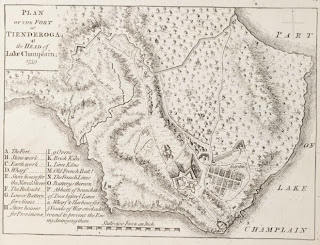
The fort located at the north-south choke-point between Lake George and Lake Champlain was ordered built by French Governor-General Vaudreuil (the French Governor of Canada) as the southernmost fort of the French Empire in the New World as a bulwark in anticipation of attacks on Fort St. Frederic and the French settlements at today’s Crown Point, New York (currently being excavated) and Chimney Point, Vermont. Named Fort Carillon, it was built by soldiers and settlers in 1755-56. The following year French General Montcalm used Carillon as a base to attack British Fort William Henry at the southern end of Lake George. In 1758, British General Abercromby led an overwhelming British and Colonial Army in a attack on the fort that ended disastrously. American colonial forces under Benedict Arnold and Ethan Allen took the poorly manned fort in the opening engagements of the American Revolution without a fight in 1775. It was retaken by Gentleman Johnny Burgoyne in 1777. Native Americans from the Algonquin, French Mohawk, Huron, and Nippissings are among those associated with the history of the fort.

It is considered one of America’s oldest heritage tourism sites with tourists arriving in numbers in the 1830s (by way of comparison, the Hasbrouck House, George Washington’s headquarters at Newburgh, NY, became the first historic house museum in the United States in 1850). In 1783, George Washington visited the Fort with New York’s Governor Clinton. Following the Revolution New York State granted the Fort and its surrounding grounds to Columbia and Union Colleges. In 1791 future presidents Thomas Jefferson and James Madison both visited the fort.

William Ferris Pell purchased 546 acres containing the ruined fort in 1820, but it wasn’t opened to the public until 1908. The non-profit Fort Ticonderoga Association took control in the 1930s and members of the Pell family formally loaned many of the paintings and artifacts to the fort in the 1940s. Mount Independence, the high ground on the Vermont side of Lake Champlain where many colonial troops were encamped during occupation of the fort is under the care of the Vermont Division for Historic Preservation. The ruins at nearby Crown Point are a New York State Historic Site.

This post also appeared at Adirondack Almanack, the premiere blog of the culture, politics, history, and environment of the Adirondacks.

Historic Central Park Concert Numbers Questioned

The historical memory of recent Central Park concerts has been called into question in a recent New York Times article. Apparently the great concerts of central park weren’t so great after all, at least in terms of attendence numbers.

Here is an official history of attendance at great public gatherings in Central Park: James Taylor played in Central Park’s Sheep Meadow in the summer of 1979, and officials announced that 250,000 people came. A year later, Elton John performed on the Great Lawn, and the authorities said he drew 300,000 people. Then Simon and Garfunkel performed in September 1981, and city officials and organizers reported that 400,000 people had packed into the park. Ten years later, it was announced that Paul Simon drew 600,000. The biggest concert of all, it seems, was by Garth Brooks, on Aug. 7, 1997, at the North Meadow, with a reported attendance of 750,000 people.

This month’s Bon Jovi concert was actually counted and seems to have put serious doubt in these numbers.

Bon Jovi played on the Great Lawn, and the city’s official head count came to 48,538 people — a number tallied by parks workers with clickers at the entryways to the lawn. This total includes only the people admitted to the 13-acre oval that makes up the Great Lawn, and not any of those gathered in the walkways and swaths of ground to the east and west of the lawn.

Still, the Bon Jovi crowd was a fraction of the colossal throngs that are part of the city’s collective mythic memory. If fewer than 50,000 people were able to fill the oval, how could a half million more people get anywhere near the Paul Simon concert held in the same space?

Apparently, they didn’t. Former city parks administrator Doug Blonsky explained the previous numbers like this: “You would get in a room with the producer, with a police official, and a person from parks, and someone would say, ‘What does it look like to you?’ The producer would say, ‘I need it to be higher than the last one.’ That’s the kind of science that went into it.”

The record corrected?

Womens Rights History Trail Bill In Congress

The Hudson Valley Press Online is reporting that a bill is making it’s way through Congress to establish an Women’s Rights History Trail linking New York State sites, expand the National Register of Historic Places’ online database, and &#8220Require the Department of Interior to establish a partnership-based network to offer financial and technical assistance for the development of educational programs focused on national women’s rights history.&#8221

New York Senator Hillary Clinton will testify at a hearing in on July 30, 2008 in support of the National Women’s Rights History Project Act (S.1816), now before the Senate Subcommittee on National Parks.

The full story is here.

1800s Natural History Survey of New York Online

The mid-1800s Natural History Survey of New York has been posted online at the New York State Library here. According to a recent note from the Library’s staff:

The Natural History Survey of New York, undertaken in the mid-1800s, covered zoology, flora, mineralogy, geology, agriculture and paleontology. The NYS Library has digitized the first three components of the survey so far. The &#8220Zoology of New York&#8221, or the &#8220New York Fauna,&#8221 is a five-volume set published from 1842-1844. This pioneering study by James E. De Kay addressed both recent and fossil mammals, birds, reptiles, amphibians, fish, mollusks and crustaceans. The hand-colored plates in part 1 (Mammalia), part 2 (Birds) and part 5 (Mollusca and Crustacea) can be found at the end of those volumes. &#8220A Flora of the State of New-York,&#8221 a two-volume set by John Torrey, was published in 1843- at the time, it was the largest single work of its kind published. The hand-colored plates are listed after each volume. &#8220Mineralogy of New-York&#8221 by Lewis C. Beck was published in 1842 and provided detailed descriptions of minerals found in the state, with information on their uses in the arts and agriculture.

Here is a description of the Northern District from the Survey’s preface (note the presence of wolverines [photo above] &#8211 alternate spellings are in the original):

The Northern District comprises, as its name imports, the northern portion of the State, which forms an irregular truncated triangle, bounded on its western side by Lake Ontario and the River St. Lawrence, on its eastern side by Lake Champlain and Lake George, and lying north of the Mohawk valley. This district, in its southern and southeastern portions, rises into numerous conical peaks and short ranges, attaining in some places an elevation of more than five thousand feet. Towards Lakes Champlain and George, these subside suddenly to the level of those sheets of water. To the north and northwest, this descends by a gradual and almost imperceptible slope towards the River St. Lawrence. This slope is watered by the Oswegatchie, the Moose and Black rivers, the Raquet [sic] and Grass and St. Regis rivers, all arising from numerous lakes embosomed in the mountainous regions of its southern parts. Lake Champlain, a part of its eastern boundary, extends north and south one hundred and forty miles, is twelve miles wide in its broadest part, and discharges its water through the Sorel river into the St. Lawrence. Into the southern part of this lake is also poured the waters of Lake George or Horicon, thirty-seven miles long, and varying from one to seven miles in breadth. The cluster of mountains in its southeastern portions may be considered as an offset from the great Appalachian system, which, descending through the States of Maine, New-Hampshire and Vermont, passes southwesterly between the Western and Hudson river districts, and is continued under the name of the Allegany range of mountains. In this region too we find the Sacondaga, Cedar, Jessup, and other tributaries of the Hudson, within a short distance of those which pour into the St. Lawrence. This mountainous region comprises the counties of Essex, Hamilton, Herkimer and Warren, and the southern part of the counties of Clinton, Franklin and St. Lawrence, and has been estimated to contain an area of about six thousand square miles. Its zoological character is strongly impressed by the features just alluded to. The chief growth of trees in this district are the Spruce, Pine, Larch, Balsam, Fir and Cedar. We find in this district many of the fur-bearing animals, such as the Sable, the Fisher, and the Beaver. Here too roam the Moose, the Wolverine, and others now only found in high northern latitudes. It also forms the southern limits of the migration of many arctic birds- and we accordingly meet here with the Canada Jay and Spruce Grouse, the Swan, the Raven and the Arctic Woodpecker.

Treasure Trove of Vinyl Heads to Syracuse

The New York Times is reporting that some quarter-of-a-million 78 records (one of the worlds largest collections of 78s) from the New York City vintage gramophone record shop Records Revisited will be headed to Syracuse University’s Belfer Audio Laboratory and Archive:

Records Revisited was packed floor-to-ceiling with discs of a vintage and variety that drew a steady stream of record buffs to 34 West 33rd Street. The shop, more like an archive than a store, held approximately 60 tons of swing, big band jazz and other styles on vinyl, forming one of the largest collections of 78s in the world.

The shop has been closed since Mr. Savada’s death in February. Last Thursday, his son, Elias Savada, was poring over a cardboard box, one of 1,300 being filled with records and put on waiting trucks. The collection will be sent to Syracuse University’s Belfer Audio Laboratory and Archive, which will now have the second-largest collection of 78s in the United States, after the Library of Congress, university officials said&#8230-

The Syracuse University archivists couldn’t be more pleased with the obscure records arriving in numbered boxes. Not only is there a huge swing collection, but also recordings of country, blues, gospel, polka, folk and Broadway tunes. Suzanne Thorin, the university’s dean of libraries, said the truckloads of Mr. Savada’s records — at least, the tiny percentage sampled so far — has revealed fascinating auditory treasures, including Carl Sandburg reading his own poetry while accompanying himself on the guitar, and Hazel Scott, the pianist and singer. There are also many rare recordings preserved only on V-Disc records produced for American military personnel overseas in the 1940s.

New York Genealogical and Biographical Society Gives Up Collection

Now that the news has trickled down that the New York Genealogical and Biographical Society, popularly known as the &#8220G & B,&#8221 has given its enormous genealogical collection (75,000 volumes, 30,000 manuscripts and 22,000 reels of microfilm) to the New York Public Library &#8211 I thought we’d take a look at the fall out.

First a recap of the news from the New York Times:

Faced with a dwindling endowment, the members-only G & B, as it is known, sold its four-story building on East 58th Street in Midtown Manhattan last year for $24 million. It bought an office condominium in Midtown where it will now focus on grant-giving, tours, lectures and other means of encouraging genealogical research. One of the first grants was about $1 million to the library for a four-person staff to process and catalog the G & B collection within two years.

The heaviest criticism comes from members themselves. Dick Hillenbrand of the Upstate New York Genealogy Blog has been following the struggle inside the G & B for over a year. Members posting to the blog decried last year what they called a plan to &#8220disenfranchise all members of the NYG&BS and absolutely and forever empower a board of 15 to unilaterally make decisions about the NYG&B’s assets and future.&#8221 They were apparently right about that.

Hillibrand’s latest post laid out some of the opposition positions:

Looks like the present total membership of the G&B of 15 members, made an unrecoverable decision. If you are a former member and donated your time, money, effort, books and manuscripts to the G&B because you thought that they would be there forever, guess what? When you voted your rights away and became former members it was all over.

The statements that we were told about moving the society to new quarters to be able to keep the collection available to all former members, well would you consider those as untruths? . You will never be able to roam through the open stacks of your old friends. At the NYPL you must fill out a call slip of the book you want and wait for a runner to bring it to you. You will never again have the pleasure of finding the rarity treasure sitting on the shelf right near the item you were interested in.

The official blog of Genealogy Bank, took no position, but had this context to add:

The NYPL’s genealogy collection &#8211 more formally called: The Irma and Paul Milstein Division of United States History, Local History and Genealogy has long been known for its strong collection of research materials gathered for over a century &#8211 from the founding of the NYPL in 1848.

When I first began using the NYPL in the 1960s it was administered by Gerald D. McDonald who served from 1945-1969 and then by Gunther Pohl (1969-1985) and John Miller (1985-1987). The Division is currently under the capable leadership of Ruth Carr long serving Chief of that Division.

Randy Seaver, blogging at Genea-Musings said: &#8220I welcome this move since it brings records out of the &#8216-members only’ repository into a public repository. Of course, I wasn’t an NYG&BS member and I don’t have an emotional attachment to NYG&BS or NYPL.&#8221 He also called on the NYPL to:

1 &#8211 Put the NYG&BS catalog on their web site &#8211 either as part of the current NYPL catalog or as a separate catalog until the NYG&BS material can be integrated into the NYPL catalog. That way, researchers in the genealogy world can identify records of interest to be searched.

2 &#8211 Digitize as many unique records as possible and make them publicly available on a web site, subject to copyright restrictions.

3 &#8211 As NYPL catalogs and/or digitizes the NYG&BS collection, index the names in the manuscript and/or estate papers collections? The records that nobody knows what’s in them. If they can’t or won’t do that, would they please request volunteers to do it with them or for them?

Schelly Talalay Dardashti at Tracing the Tribe: The Jewish Genealogy Blog condensed the NY Times historical context:

G&B was founded in 1869 and moved into the recently sold building in 1929. Early members were interested in 17th-18th century Dutch and English roots. Holdings include censuses, deeds, baptisms, births, deaths and wills. However, after WWII, the group had almost disappeared with members conflicted about its direction, despite the increasing popularity of genealogy following the major impact of &#8220Roots,&#8221 Ellis Island’s restoration and database, and commercial websites devoted to family history.

Here is the press release from the NYPL.

New York Council for the Humanities Grants

FYI, comes a release from the New York Council for the Humanities noting that updated Major and Mini Grant Application Instructions and Forms are now available online at www.nyhumanities.org/grants.

New York Council for the Humanities Grants support public programs presented by not-for-profit organizations across New York State that bring humanities scholars and scholarship to a general public audience.

Please note, that as of July, full resumes and letters of commitment are no longer accepted with your grant application. Instead, all grant applications must include one paragraph bios for all scholars and key project personnel, and the original scholar confirmation letters need to be kept on file by the Project Director.

The next Major Grant application deadline, for up to $20,000, is September 15, 2008 and Mini Grants, for up to $2,500, continue to be accepted on an ongoing basis throughout the year. To learn more about both of our grants programs, review eligibility, and see past awarded grants please visit nyhumanities.org/grants. For other inquiries, Council program officers are available for consultation via email or by phone at 212.233.1131.

Underground Railroad Site Travel Grants to AASLH

If you represent an underground railroad related site or organization, the New York State Underground Railroad Heritage Trail is offering Travel Grants to support attendance at this year’s AASLH Annual Meeting in Rochester.

The Underground Railroad Heritage Trail Travel Grants will provide museum staff members and volunteers, from URHT sites, the opportunity to expand their horizons by participating in the American Association of State and Local History Annual Meeting.

Organizations may apply for travel grants of up to $350. This travel grant can be used towards conference registration fees, travel expenses and accommodation fees associated with attendance at the 2008 AASLH Annual Meeting. For further information on the AASLH Annual Meeting visit: www.aaslh.org/anmeeting.htm

Applications for URHT Travel grants to attend the AASLH Annual Meeting must be postmarked by August 3, 2008. Applicants will be notified within 30 days of receipt. To apply, contact Catherine Gilbert directorATupstatehistoryDOTorg at the Upstate History Alliance for an application form.

According to New York State’s Underground Heritage Trail website:

New York State was at the forefront of the Underground Railroad movement. It was a major destination for freedom-seekers for four main reasons:

Destination & Gateway
New York was a gateway to liberation for freedom-seekers (often referred to as escaped slaves). Its prime location, with access to Canada and major water routes, made it the destination of choice for many Africans fleeing slavery along the eastern seaboard.

Safe Haven
Freedom-seekers knew they would be protected in New York’s many black communities as well as Quaker and other progressive white and mixed race communities. A large and vocal free black population was present after the manumission (freeing) of slaves in New York State in 1827.

Powerful Anti-Slavery Movement
Anti-slavery organizations were abundant in New York State &#8211 more than any other state. The reform politics and the progressive nature of the state gave rise to many active anti-slavery organizations.

Strong Underground Railroad Leaders
Many nationally-known and locally influential black and white abolitionists chose to make their homes in New York. Among them were: Harriet Tubman, Frederick Douglass, Gerrit Smith, Henry Ward Beecher, Sojourner Truth and John Brown.