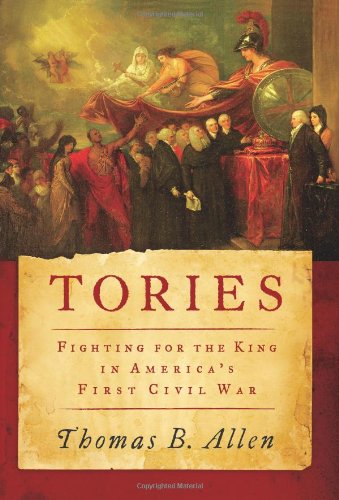
Tories: American Revolution and Civil War

In 1777, as General John Burgoyne’s army marched south, having taken Fort Ticonderoga, a temporary loyalist enclave was created in Rutland County, Vermont. While many rebel Americans fled before the British Army, a few stayed on. In Rutland Nathan Tuttle, a rebel known locally for hating and taunting loyalists, was one of them.

Tuttle’s decision to stay behind was not a very good one at a time and place when the American Revolution was a full-scale Civil War. As Burgoyne’s army passed through Rutland, Tuttle disappeared. Ten years later it was revealed by a local Tory that Tuttle had been bayoneted, his body weighted with stones and thrown into a creek. Nathan Tuttle was an American, and so were his murderers, likely men associated with the notorious Loyalist and close confidant of John Burgoyne, Philip Skene of Whitehall.

Under the grand story of the fight for American independence are finer threads, stories of people who are often assigned a mere footnote in the Revolutionary narrative. Offering a fresh look at the lives of those who sided with Britain during the American Revolution, TORIES: Fighting for the King in America’s First Civil War, by Thomas Allen, weaves a provocative and unsettling picture of a bloody and savage civil war that divided America and sent more than 80,000 Tory Americans — Loyalists, as they called themselves — fleeing to Canada, the United Kingdom and other parts of the world.

For Loyalists, America was home- yet, when they sought to preserve allegiance to the Crown and protect their homes from the rebels, many Loyalists found themselves in a civil war raging in the midst of a Revolution. Hatred between Tories and Patriots divided families, friends, and communities. This war was vicious and personal, forcing many Loyalists to flee America. Those who chose to stay quickly realized that if they had any chance of survival, the British had to win.

Incorporating firsthand documents from archives in the United Kingdom and Canada, TORIES gives voice to little heard and Americans. TORIES also explores little known facts about Loyalists, such as: New York City and Philadelphia were Tory strongholds throughout the Revolution- at times, Georgia and the Carolinas had more trained and armed Tories than British Redcoats- Lord Dunmore, a Virginia royal governor, offered freedom to any slave that joined the British fight, creating thousands of black Loyalists- Scottish Highlanders, though onetime foes of the British, fought for the Crown in exchange for land grants- and William Franklin, son of Benjamin Franklin, led a brutal Tory guerrilla force that terrorized New Jersey.

While historical accounts portray the Revolution as a conflict between the Patriots and the British, there is another narrative: the bloody fighting between Americans, a civil war whose savagery shocked even battle-hardened Redcoats and Hessians. From mudslinging and rhetorical sparring to water-boarding, house-burning, and lynching, here is the rarely chronicled war-within-the-war that adds a new dimension to the history of the American Revolution. TORIES introduces readers to the forgotten Americans who chose the British side—and paid dearly for their choice.

THOMAS B. ALLEN is the author of numerous history books, including George Washington, Spymaster and Remember Valley Forge. A contributor to Smithsonian Magazine, National Geographic, Military History Quarterly, Military History Magazine, Naval History, Naval Institute Proceedings, and other publications, he lives in Bethesda Maryland with his wife, artist Scottie Allen.

Note: Books noticed on this site have been provided by the publishers. Purchases made through this Amazon link help support this site.

Ferdinand Pecora’s Investigation of the Great Crash

In the aftermath of the financial crisis of 2008, the image of Wall Street’s most influential powerbrokers being called before Congress to give an accounting of their actions will not soon be forgotten. One name was repeatedly invoked during this time, a reminder of when the government first had to step in to protect the American people from Wall Street’s excessive greed: Ferdinand Pecora.

In the winter of 1933, Ferdinand Pecora took the reins of the bumbling Senate investigation of the 1929 crash. He was an unlikely hero: Sicilian-born, stout, with little experience in the Wall Street realm, he nevertheless created the sensational headlines needed to galvanize public opinion for reform. The hearings, under his leadership, spurred Congress to take unprecedented steps to rein in the free-wheeling banking industry, and led directly to the New Deal’s landmark economic reforms.

Now, Michael Perino’s The Hellhound Of Wall Street: How Ferdinand Pecora’s Investigation of the Great Crash Forever Changed American Finance, tells the story of Pecora’s pursuit of the “banksters” of Wall Street. The story a resonates so powerfully even today that Nancy Pelosi, Frank Rich, and Ron Chernow, among others, have publically referred to his legacy.

The Pecora commission brought an end to Washington’s traditionally hands-off approach to the stock market and led directly to the creation of the SEC and other landmark financial reforms that still govern our markets today.

In Hellhound Of Wall Street, Congressional hearings become high-stakes courtroom drama, with an inspiring tale of an unlikely hero’s triumph over powerful interests. Michael Perino provides a minute-by-minute account of the ten dramatic days when Pecora turned the hearings around, cross-examining the officers of National City Bank (today’s Citigroup), particularly its chairman, Charles Mitchell, one of the best known bankers of his day.

Mitchell strode into the hearing room in obvious disdain for the proceedings, but he left utterly disgraced. Pecora’s rigorous questioning revealed that City Bank was guilty of shocking financial abuses, from selling worthless bonds to manipulating its stock price. Most offensive of all, and all too familiar sounding today, was the excessive compensation and bonuses awarded to its executives for peddling shoddy securities to the American public.

A gripping courtroom drama with remarkable contemporary relevance, Hellhound Of Wall Street brings to life a crucial turning point in American financial history and reminds us again of the delicate and crucial relationship between Wall Street and government.

Michael Perino is the Dean George W. Matheson Professor of Law at St. John’s University School of Law. A former Wall Street litigator, Perino has authored numerous articles on securities regulation, securities fraud, and class action litigation. He has testified in both the United States Senate and the House of Representatives and is frequently quoted in the media on securities and corporate matters. He has appeared on NPR’s “All Things Considered”, “Morning Edition”, and “Marketplace”, and on “Bill Moyers’ Journal” on PBS, and on CNBC.

Note: Books noticed on this site have been provided by the publishers. Purchases made through this Amazon link help support this site.

Syracuses Clark Music Company, Melville Clark

In Pulling Strings: The Legacy of Melville A. Clark, musician Linda Pembroke Kaiser explores the extraordinary career of Melville A. Clark (1883–1953), a musician, inventor, entrepreneur, community leader, and collector whose colorful story is largely unknown. The story is told by Kaiser, a musician who performs on the harp, piano, and guitar. She has published articles in the International Folk Harp Journal and has published and recorded an album of harp music, Lullabies for Earth Children.

Beginning with an account of Clark’s musical family, Kaiser chronicles the founding in 1859 of the Clark Music Company, of which Melville Clark became president in 1919. Originally just a tinkers shed, the business ultimately moved into a six-story building in the center of Syracuse. The Clark Music Company celebrates its 150th anniversary in 2010. Clark also combined his talents as a gifted musician and astute entrepreneur to start the first Syracuse Symphony Orchestra.

Kaiser recounts the development of the Clark Irish Harp, the first portable harp manufactured in the United States, that could easily play accidentals. There were other Clark inventions, such as the first nylon strings for instruments. In addition, Clark designed balloons that the British used in 1918 to drop more than 1,250,000 pamphlets over Germany.

Clark’s story unfolds in detail: a musical encounter with President Wilson, entertaining President F. D. Roosevelt, a visit to Buckingham Palace to present Princess Elizabeth with a music box, and the journey of a Clark Irish harp to Antarctica with Admiral Byrd.

Pulling Strings uncovers the life of a musical genius and also sheds light on a forgotten chapter in Syracuse history.

Note: Books noticed on this site have been provided by the publishers. Purchases made through this Amazon link help support this site.

A Progressive History of Union Square, NYC

Even in the supersized world of New York City, Union Square stands out for its astonishing legacy. Yet most of that rich history was lost in the square’s descent from a city showplace to an area approached only at personal peril.

Union Square’s 300-year story is finally told by author/photographer James Isaiah Gabbe in The Universe of Union Square, a coffee-table book and companion DVD (Visions & Voices) that marks the first time the history of the square has been captured from a progressive cultural perspective.

The book relates the people, places and events that shaped so much of America’s progressive tradition while the DVD brings the chronicle up to the moment through 60 lively interviews with city officials, business owners, artists, activists, clergy and others whose lives are intertwined with this remarkable place. More information about the book and a full list of interviewees can be found online.

Gabbe, a former journalist and historian is a longtime resident of Union Square and was for many years the president of the Union Square Partnership &#8211 the nation’s first business improvement district.

As president of the Union Square Partnership Gabbe thought he knew the area’s history well enough to create a nicely illustrated brochure, but wherever he turned, Gabbe heard stories that led him through a warren of intrigue and Dickensian characters.

Three years, hundreds of interviews and site visits later, The Universe of Union Square spans 265 pages of fascinating vignettes and nearly 1000 archival images and contemporary photographs. Visions & Voices, the companion DVD, brings the chronicle up to the moment through 60 lively conversations with city officials, community activists, business leaders, academics, clergy, artists and others whose lives are intertwined with this remarkable place.

Gabbe’s exploration extends to an eight-block radius beyond the confines of the park, touching nine adjacent neighborhoods that together form Union Square’s “Universe.”

“Who knew that such a small area of land would become a cauldron in which an unprecedented diversity of people would shape America’s restless, progressive soul,” Gabbe said. “By turns violent and peaceful, with triumph and dismay, Union Square was witness and party to the growth of a nation.”

The Universe of Union Square explores the area’s people, architecture, institutions and happenings through eight thematic chapters – highlights include:

* Peter Stuyvesant’s Harvest: From the Lenape Nation and European Walloons to “blue bloods” and immigrants, a look at the area’s changing populations, including the criminal fringe, from prosperity through hard times between World War I and the 1980s. Includes notable architectural landmarks, the Greenmarket and acts of violence.

* Democracy’s Stage: The “universe’s” history – and legacy – as New York’s center of free public expression. From Civil War protests and Lincoln proclaiming “right makes might” to serving as headquarters for the nascent labor movement and political activists of all persuasions – through to providing the world a haven to mourn and heal after 9/11.

* Creative Cauldron: Celebrating the impresarios, actors, writers, artists and musicians who have made their mark here. Covers the area’s role as the original “heart” of Broadway and the Yiddish theater- the earliest center for American opera- the birthplace of American vaudeville and the modern nightclub- and home to many famed arts clubs and enterprises that founded the film industry.

* Inventive Ventures: This is where gutsy entrepreneurs built the peerless Ladies’ Mile, a collection of urban shopping emporiums that set the stage for modern department stores but have never been equaled. And where scores of other fascinating enterprises were fostered, including world-famous Strand Book Store, Blatt Billiards and the landmarked Bowlmor bowling alley.

* Fibers of the Future: Past and present, individuals and organizations exemplifying compassionate and visionary citizenship, from the selflessness of baker Charles Fleischmann, who fed anyone willing to wait in line for bread, to Tammany Hall, which began as a noble civic and political service to immigrants but ended in infamy. This was also home to Peter Cooper, Helen Keller, Teddy and Eleanor Roosevelt, Ida Tarbell, Margaret Sanger and Bill Wilson – all of whom changed society in momentous ways.

The Universe of Union Square also covers the area’s 60 institutions from preschools to universities, libraries to museums – many like NYU, New School, Cooper Union, Stuyvesant and Washington Irving High Schools – created to serve the working class, immigrants and women, who had no access to education. And Gabbe recounts tales of Emma Goldman, Andy Warhol and the Mad Bomber among scores of other famous and infamous characters as it documents the area’s modern resurrection from decades of urban decay.

Note: Books noticed on this site have been provided by the publishers. Purchases made through this Amazon link help support this site.

Buffalos Central Park: Photography, Architecture

Proud Buffalonians and Erie County local history and architecture buffs will find a new book, Central Park, Buffalo, New York: A Neighborhood of History and Tradition, a unique glimpse at one of the first planned neighborhoods in Western New York.

The 214-page, full color, photo-based thoroughly documented coffee-table book takes readers on a tour of the Central Park’s graceful homes, historic churches and tree-lined streets. The book is available at the Buffalo & Erie County Historical Society’s Museum Shop. The price is $39.95, and all proceeds go directly to the Museum.

Central Park was planned and developed by Lewis J. Bennett, a successful entrepreneur who moved to Buffalo from the Hudson Valley. Bennett planned and named the streets, as well as many other amenities which enticed people to build homes in Central Park. As the book reveals the neighborhood’s history and streets, the reader is introduced to past residents, including business pioneers Bob Rich, John J. Boland, Adam E. Cornelius and Edward Barcolo- literary critic Leslie Fiedler- painter Robert Blair, and his brother, Charles Blair, a dashing war hero and aviator who married Hollywood legend Maureen O’Hara.

The book project was originally inspired by Rev. Samuel McCune, an amateur historian, who looked out of his Morris Avenue home and wondered who the street was named after. Rev. McCune embarked on several years of research, compiling information and historic pictures which are used in the volume.

It features photography by the late Dr. Peter Hare and other local photographers. James R. Arnone, a local attorney, wrote the text and took many of the photographs as well. The book also features recollections by the late Bob Venneman (1912-1998) of his experience living his entire life in Central Park, and especially during the relative early days of its development.

Note: Books noticed on this site have been provided by the publishers. Purchases made through this Amazon link help support this site.

This Weeks Top New York History News

Each Friday morning New York History compiles for our readers the previous week’s top stories about New York’s state and local history. You can find all our weekly news round-ups here.

Subscribe! More than 550 people get New York History each day via E-Mail, RSS, or Twitter or Facebook updates.

Winter Welcome Week at Washingtons HQ

Washington’s Headquarters State Historic Site will offer a special focus on what was happening the final winter of the American Revolution. The Hasbrouck House, will be decorated with holiday ornaments. Outside in the park enlisted men will be near their campfire so visitors can learn what soldiers lives were like.

The program starts Monday, December 27th and continues until Thursday, December 30th. Tours begin at 10:00 AM and run throughout the day until 3:00 PM. Admission is $4.00 for adults, $3.00 for seniors and students and children 12 and under are free. Call 845-562-1195 for further details or directions.

Washington’s Headquarters State Historic Site is a registered national historic landmark. It is located at the corner of Liberty and Washington Streets within the city of Newburgh’s East End Historic District.

Washington’s Headquarters is part of the Palisades Interstate Park Commission, which administers 28 parks, parkways, and historic sites for the Office of Parks, Recreation and Historic Preservation in New York as well as the Palisades Interstate Park and parkway in New Jersey. For more information about New York State parks and historic sites, please visit www.nysparks.com and for more information about the Palisades Interstate Park parks and historic sites, please visit www.palisadesparksconservancy.org

This Weeks New York History Web Highlights

Each Friday afternoon New York History compiles for our readers a collection of the week’s top weblinks about New York’s state and local history. You can find all our weekly round-ups here.

Subscribe!
More than 550 people get New York History each day via E-Mail, RSS, or Twitter or Facebook updates.

On The New York State Museums Sunday Hours

Beginning January 1, 2011 the New York State Museum will have new hours of operation, including being closed on Sundays. The Museum will be open Monday &#8211 Saturday 9:30am &#8211 5:00pm.

During the one weekend in February when the museum hosts NY in Bloom and the Annual Gem and Mineral Show. That weekend the Museum is open on Sunday. It’s also the only weekend when Admission is charged, as a fundraiser for the Museum’s after school program.

New York in Bloom &#8211 20th Anniversary
Friday, February 25 -Sunday, February 27 ? 9:30 a.m.-5 p.m.
1st Floor Exhibition Halls ? Adults ? Children ? Admission Fee:
Friday-$5/Adult- Saturday and Sunday-$6/Adult. Children age 12 and under FREE

Experience the sights and scents of the approaching spring during this 20th annual fund-raising weekend benefiting Museum Club and Discovery Squad, the Museum’s award-winning after-school programs for children and teens. Free parking available next to the Museum on Saturday and Sunday. $6 entrance fee to the Museum on Saturday and Sunday includes admission to the 18th Annual James Campbell Memorial Gem, Mineral, and Fossil Show and Sale on the 4th Floor. For information, call 518-474-5877.

18th Annual James Campbell Memorial Gem, Mineral, and Fossil Show and Sale
Saturday, February 26 and Sunday, February 27 ? 10 a.m.-5 p.m. 4th Floor ? Adults ? Children ? Admission Fee: $6/Adult- Children age 12 and under FREE

Vendors from throughout the Northeast display and sell gems, jewelry, minerals, lapidary equipment, fossils, and much more. Meanwhile on the 1st Floor, staff members conduct guided tours of the mineral and fossil exhibitions and are on hand to identify visitors’ own minerals and fossils. Call 518-474-5877 for information about times and locations. $6 entrance fee to the Museum on Saturday and Sunday includes admission to all New York in Bloom activities on the 1st Floor. For information, call 518-474-5877.

Brooklyn Museum January Public Programs

During January the Brooklyn Museum will present a variety of public programs for adults, including a new series of programs that will take place every Thursday at 7 p.m. (during the Museum’s new extended hours), a performance by the Brooklyn Philharmonic, a panel discussion about the sexual exploitation of women farmworkers in America, and a screening of the independent film Good Fortune.

As a component of this series, the Museum is partnering with the Nuyorican Poets Cafe and PBS’s award-winning independent film showcase POV. The Nuyorican Poets Cafe will present poetry and performance every third Thursday of the month and POV will present Brooklyn-related films every fourth Thursday.

PERFORMING ARTS & FILM

Music Off The Walls: The Brooklyn Philharmonic
Sunday, January 23, 2 p.m.
In a program entitled &#8220Falling Apart and Coming Together,&#8221 members of the Philharmonic present the world premiere of a work by composer Corey Dargel inspired by the exhibition Body Parts: Ancient Egyptian Fragments and Amulets. A related gallery talk precedes the program at 1 p.m. Tickets are $15- $10 for members, students, and seniors. To purchase tickets, visit www.brooklynphilharmonic.org or call (718) 488-5913.

TALKS & TOURS

Lecture: Farmworkers in America
Saturday, January 22, 2 p.m.
Monica Ramirez, Senior Staff Attorney and Project Director of Esperanza, the Immigrant Women’s Legal Initiative of the Southern Poverty Law Center, discusses the state of American farmworkers, with an in-depth look at the economic and sexual exploitation suffered by farmworker women.

NEW THURSDAY EVENING PROGRAMS

January 6
&#8220You Must See This&#8221 Tour:
Norman Rockwell’s artistic process.

January 13
Conversation
Noted cultural thinkers and media theorists Douglas Rushkoff, author of Program or Be Programmed- and Steven Berlin Johnson, author of Where Good Ideas Come From, discuss technical innovation. A book signing follows.

Visitor’s Choice Tour
Visitors choose the objects they want to see.

January 20
Nuyorican Poets Cafe
First installment in the Museum’s partnership with acclaimed forum for innovative poetry features poetry and performances by muMs and Aurora, Carlos Andres Gomez, and others.

Hidden Secrets of the Brooklyn Museum Collection
&#8220Inside the Museum’s Mummies: The CT Scanning Project,&#8221 with curator Edward Bleiberg.

Erotic Art Tour
&#8220Erotic Art through the Ages&#8221

January 27
POV Independent Film
Good Fortune (Landon Van Soest and Jeremy Levine, 2010, 90 min.). Provocative exploration of how massive international efforts to alleviate poverty in Africa may be undermining the communities they aim to benefit. The event is a collaboration with the award-wining documentary series POV. (www.pbs.org/pov).

CLASSES & WORKSHOPS

Creative Art Making: Collage with Maura Madden
Saturday, January 15, 2 p.m.
Maura Madden, author of Crafternoon: A Guide to Getting Artsy and Crafty with Your Friends All Year Long, leads a workshop in how to make creative collage pieces inspired by Norman Rockwell. There is a $15 materials fee, and registration is required. Register at www.museumtix.com or at the Museum’s Visitor Center. A limited number of free tickets are reserved for Museum members on a first-come, first-served basis. Members should call (718) 501-6326 for tickets.

Photo: Carlos Andres Gomez. Photo courtesy Nuyorican Poets Cafe