
Month: March 2012
This Weeks New York History Web Highlights
- Ephemeral NY: Ghostly Outlines of NYC Buildings
- Eastman House: Hine Retrospective Celebrates Collection
- Brooklyn Historical: Remembering Elsie Richardson
- American Conservative: German Sabotage and World War I
- Berfrois: TR’s Diligence and NYC Drinkers
- Chronicle: Aging Professors Create Faculty Bottleneck
- 1919 Film: ‘-Treasures of the Far Fur Country’
- New-York Historical Society: Behind-The-Scenes Writing Contest
Each Friday afternoon New York History compiles for our readers the previous week’s top weblinks about New York’s state and local history. You can find all our weekly round-ups here.
Subscribe! More than 2,600 people get New York History each day via E-Mail, RSS, or Twitter or Facebook updates.
Peter Feinman: Recent NY History Collaborations
 Good things are happening in the world of New York history. Maybe not as many as we would like, but at least some signs of change are in the air. In this post, I would like to mention three events at the state, regional, and local level all in the Capital District that represent positive actions on the New York history front. Read more
SPLIA to Present 2012 Preservation Awards
 As an advocate, the Society for the Preservation of Long Island Antiquities (SPLIA) works to promote the appreciation and protection of regional cultural heritage. To encourage standards of excellence and raise public awareness, their 2012 Preservation Awards recognize individuals, organizations and projects that demonstrate extraordinary achievement in the field of historic preservation on Long Island.
This year’s honorees include Robert A. M. Stern Architects, Seatuck Environmental Association, the Town of Southampton, and the Aquinas Honor Society of the Immaculate Conception School.
The 2012 SPLIA Preservation Awards will be held on Sunday, April 22, 2012 at 3:00 pm at SPLIA Headquarters (161 Main Street, Cold Spring Harbor, NY 11724). The event is free, but registration is required by calling SPLIA at 631-692-4664, Monday – Friday.
Albany’s Unique Architecture: H.H. Richardson
 Any visitor to Albany has to consider the unique architecture styles that define the city. New York History had the recent opportunity to talk with Andrew Alberti, the program manager for Lakes to Locks Passage, about Albany’s architecture. Alberti studied the history of Albany’s architecture when he was a Masters student at the University at Albany’s public history program. Read more
Amtrak and Fort Ticonderoga Partner in 2012
 For the first time, Fort Ticonderoga and America’s National Railroad Passenger Corporation (Amtrak) have partnered to connect people traveling between New York City and Montreal to one of the nation’s oldest and most significant historic sites, Fort Ticonderoga. Amtrak will offer one free companion rail fare with the purchase of one regular adult rail fare, on the state-supported Adirondack line to and from Fort Ticonderoga, New York, beginning April 1, 2012 through October 31, 2012.
“The partnership with Amtrak will enable Fort Ticonderoga to reach a broader destination market from New York City to Montreal,” according to Beth Hill, Fort Ticonderoga Executive Director. “Fort Ticonderoga is very fortunate to have an Amtrak stop on our property. Our epic story combined with the Fort’s immersive programs and beautiful landscape makes Fort Ticonderoga an exciting destination experience.”
Customers simply need to purchase tickets a minimum of 3 days in advance and enter discount code V430. The Northbound Adirondack operates daily between New York City and Montreal, departing New York Penn Station at 8:15 am arriving in Ticonderoga at 1:17 pm. The Southbound Adirondack departs Montreal at 9:30 am, arriving in Ticonderoga at 2:33 pm.
Fort Ticonderoga opens for the 103rd season on Friday, May 18 and will offer new programs, events, exhibits, gardens and a six-acre corn maze designed in the shape of the Fort. Fort Ticonderoga is open daily from May 18 through October 18, 2012 from 9:30 am until 5 pm.
Historians Should Promote Preservation
 In recent articles several authors have pointed out the multifaceted world that is New York history. Museums, historical societies, historical agencies on all levels and the local government historians all play a role in our efforts to ensure the continued importance of this state’s history and heritage. Is this the right approach or should there be a more top down method to our madness? Whatever your answer is to that question, the same divergent pattern is found in historic preservation in the Empire State. Read more
Civil War Lectures Set for Schoharie Crossing
 Schoharie Crossing State Historic site’s Enders House (adjacent to the Visitor Center at 129 Schoharie Street, Fort Hunter, NY, five miles west of Amsterdam, off Route 5S) will host a series of lectures on the Civil War, Wednesdays in April, 7:00 pm.
On April 4, the lecture series will begin with Montgomery County Historian Kelly Farquar, who will discuss “The Abolitionist Movement in Montgomery County,” a topic of her latest publication.
The series continues on April 11 with Bob Arnold, an instructor at the College of St. Rose whose talk is entitled “New York State and the Civil War.” Arnold is also the former Albany County Historian. On April 25 the lecture series concludes with Matt Zembo’s talk on “Civil War Weapons and Strategy.” Zembo is an instructor at Hudson Valley Community College and is a military reenactor.
The fees for these lectures are $3.00 adults, $2.00 seniors and $1.00 for children under 16. Please contact Tricia Shaw at [email protected] or 518-829-7516 for more information.
Photo: Schoharie Aqueduct, showing the canalway (Courtesy Wikipedia).
Lawrence Gooley: The Spanish Swindle Revisited
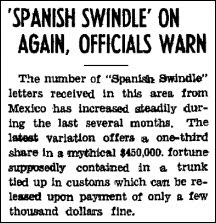 Many of us have received e-mail scams from fake sources (bogus relatives, supposed political prisoners) promising great financial reward if we agree to help them recover a secreted fortune. I’ve received them from Ghana and Germany, and even one from the country of West Africa. Never heard of it? I can assure you it’s real—in 2008, world traveler Paris Hilton said “I love Africa in general. South Africa and West Africa, they are both great countries.”
The senders of these messages range from detained relatives and imprisoned citizens to dethroned kings, urgently seeking help. Most people think it’s “an Internet thing,” but the only thing new about it is the manner of delivery.
That particular scam has been around for more than a century. Known as the Spanish Swindle, it is believed to have originated in Spain’s infamous prisons during the late-nineteenth century. Inmates with far too much time on their hands took advantage of a corrupt system, developing many criminal strategies and exercising them to great effect.
The original Spanish Swindle hasn’t changed much, except that it was often a two-step process. The first was to hook the sucker with a plea for empathy and the promise of great wealth. When a nibble was received, the ante was raised with an urgent plea to help rescue the prisoner’s poor, innocent daughter from the clutches of some tyrant or lecher.
Just as is done with e-mail today, hundreds (and sometimes thousands) of such messages were sent at the same time by mail. In the Adirondacks, a few hotel owners were among those who received the letters, their addresses having been obtained from newspaper advertisements. The plea was appropriately modified— in the hopes of gaining sympathy, the sender claimed to have once been a hotel owner himself.
None of those in the Adirondacks who received the message were fooled by the scam attempt, but elsewhere, pharmacists, doctors, and others were victimized, much to their embarrassment. The Spanish Swindle became so successful that, in 1912, the US Official Postal Guide began including a complete description of the process in order to alert employees.
That’s not to say North Country folks are immune to trickery. All types of swindles have been attempted in the region, many of them successfully. A number of scams from long ago focused on obtaining a person’s signature. A sort of caveat emptor (let the buyer beware) then took over: if your name was on a document, you were bound by its clauses. Even if a signature was obtained fraudulently, victims often paid to avoid court time and public embarrassment.
In 1888, teams of encyclopedia salesmen made the rounds in Franklin County, targeting schoolteachers. The first salesman gave his best pitch for a great new line of books, innocently asking the teacher to sign his log book to record the visit. A few days later, a second man delivered a full set of books, demanding payment from the surprised teacher, whose signed order was offered as proof of sale. (Sleight of hand and “bait and switch” were routine components of scams. Papers were subtly arranged to obtain signatures on documents hidden beneath.)
Sleight of hand was sometimes replaced by the latest technology. In 1889, swindlers focused on the devoutly religious, of which the North Country had many. An attractive female pleaded for donations of ten cents to aid overseas missionary work. Donors, asked to sign a sheet, were all too happy to have their names displayed on the list of generous givers.
But vanity came with a price. Beneath the sheet was “an ingenious copying paper which transcribed the name onto a promissory note.” In those days, a promissory note was as good as a check or a banknote. The notes were quickly cashed and the scammers moved on.
Photo: 1951 North Country headline noting the return of the Spanish Swindle.
Lawrence Gooley has authored ten books and dozens of articles on the North Country’s past. He and his partner, Jill McKee, founded Bloated Toe Enterprises in 2004. Expanding their services in 2008, they have produced 19 titles to date, and are now offering web design. For information on book publishing, visit Bloated Toe Publishing.
Rockland Lake Park Complex Master Plan Underway
 The Office of Parks, Recreation and Historic Preservation (OPRHP) Palisades Region and the Palisades Interstate Park Commission (PIPC) will hold a public information meeting regarding the preparation of a Draft Master Plan and Draft Environmental Impact Statement (DEIS) for Rockland Lake, Hook Mountain, Nyack Beach, and Haverstraw Beach State Parks (together, the Rockland Lake Park Complex) on the west bank of the Hudson River in Rockland County, New York.
OPRHP and PIPC encourage the public to participate in the planning efforts for the park complex and welcome all comments and suggestions. Developed and opened to the public in the early 1960s, the parks are part of the Palisades Interstate Park system.
The public meeting will be held at Rockland Lake State Park Championship Golf Course Clubhouse on Tuesday, March 27, 2012 at 7:00 PM. Park staff will make a brief presentation about the master planning process and the park after which the meeting will be open to receive public comments.
All persons interested in the Rockland Lake Park Complex are urged to attend- those who cannot may view the Public Information Meeting Packet on the OPRHP website.
Written comments and suggestions may be submitted by April 27, 2012 to:
Mark Hohengasser
Park Planner
Agency Building 1, 17th Floor
Empire State Plaza
Albany, NY 12238
[email protected]
Upon inclement weather conditions, please visit the OPRHP website for a meeting cancellation notice and updated information.
For additional information and directions to the meeting, contact the park office at 845-268-3020.